
The city that fits on your coffee table
I leaned over my desk in the headset and there it was — a city the size of a dinner plate, roads spidering outward from a single interchange, and my hands were the only tool I needed to make it grow. Cities: VR isn’t a port of Cities: Skylines. Fast Travel Games built a separate, native VR game from the ground up, and the whole thing sits on a tabletop in front of you like an expensive diorama you’re allowed to wreck.
That framing matters more than it sounds. This is a god-game in the literal sense: you’re above the world, not inside it. You paint roads, drag zones, drop fire stations, and watch traffic jam up because you forgot the single-lane bridge. The depth is real — this is the Skylines simulation with its budgets, services, and death-spiral economics — but the camera stays pinned to the table. You lean in, zoom out, rotate the map, you never walk the streets. For a city builder, that works, and it’s also why this is one of the most comfortable things you can put a headset on: no artificial locomotion, no smooth-turn vection, just you and a map.
Drawing roads with your hands
The first ten minutes are pure dopamine. You point a controller and draw a road with a swipe, hold a button and drag a residential zone, and the city hums to life under your fingertips. There’s a real satisfaction in grabbing the edge of the map and spinning it to find the dead-end street choking your industrial district. This is the part the flat version never gave you — your hands are the mouse, and zoning a block feels like you’re actually laying it out, not clicking a palette.
But the friction shows up fast, and almost all of it lives in the interface. The menus are panels floating around the table, and reaching the right one mid-build breaks your flow. Selecting, confirming, and cycling tool options means a lot of small controller gestures that should be one tap and instead become three. UploadVR’s launch review nailed the balance: the systems are authentic Skylines, but the presentation and UI hold the experience back. I’d put it blunter — the simulation wants to be deep, and the interface keeps tugging you back to the surface before you get lost in it.
What Cities: VR actually gets right
Strip away the menu grumbling and the bones are strong. This is a real economy simulator, not a skin. You manage districts, balance tax rates, route services, respond to traffic, and watch a budget curve that punishes bad planning the same way the PC game does. Disasters are here too — and dropping a meteor on a district you spent twenty minutes perfecting is its own specific joy. Fast Travel Games didn’t dumb the simulation down to a toy; they shrank the stage it plays on and rebuilt the controls around it.
Comfort is a non-issue by design. You’re seated, the world is fixed to a table, and the only movement is your head leaning over the map. I’ve spent long sessions in here without the slightest hint of vection — this is about as safe as VR gets, the genre equivalent of a puzzle game. If you hand this to a VR-skeptic friend who gets queasy in twitchy games, this is one of the few titles I’d trust not to cost you a couch.
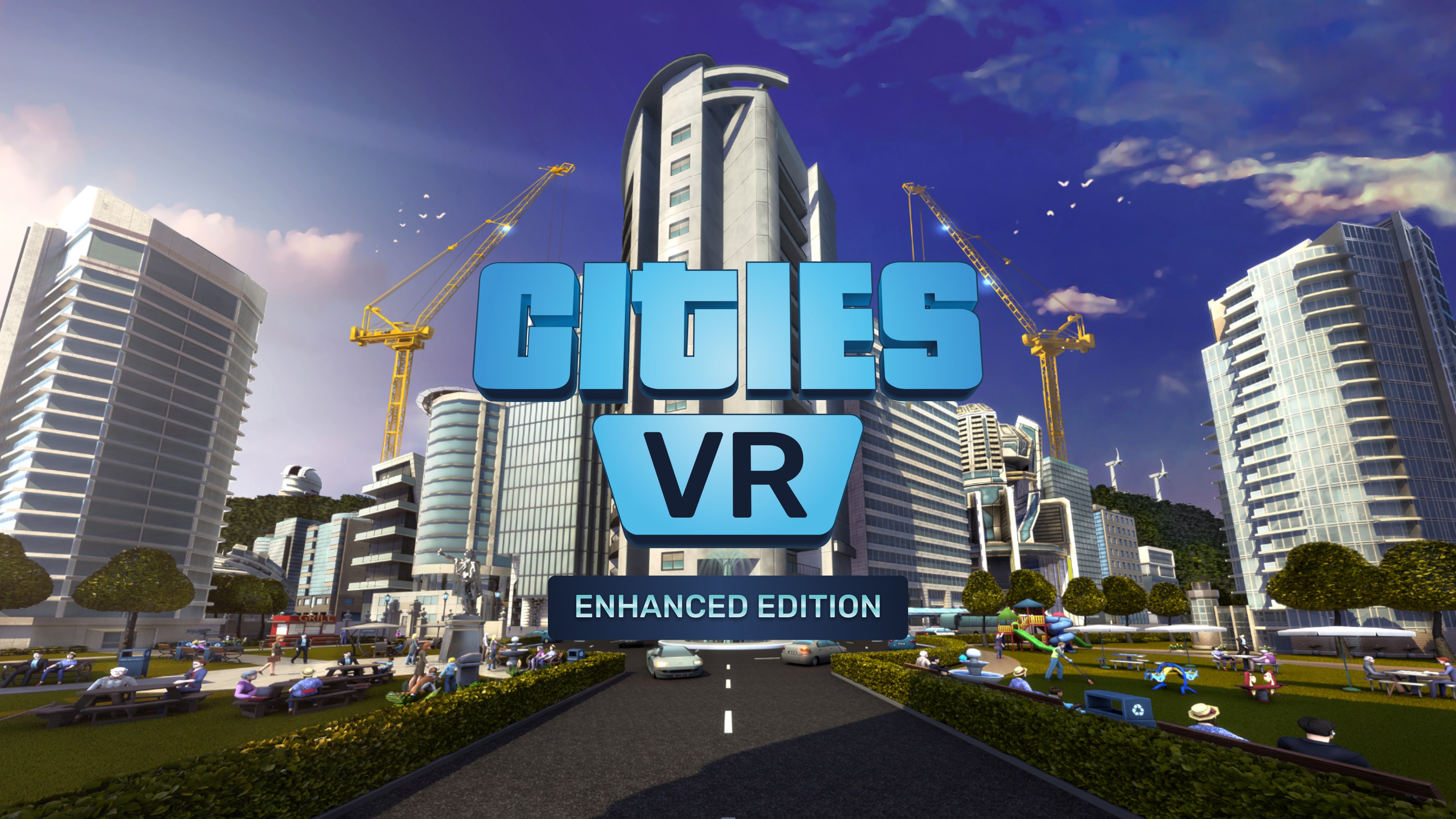
The PSVR2 version, the Enhanced Edition, is the one I’d point most players to if they have the hardware. It landed in the PSVR2 launch window with sharper visuals and, more importantly, larger buildable cities — the flat game’s whole appeal is watching a town graduate into a metropolis, and the original Quest build’s size ceiling is the single biggest leash on the experience. Sense controller haptics add a small but real texture when you’re placing and confirming. The Quest 2 original is the lighter, more portable way to play, and it runs on Quest 3 through backward compatibility, but the Quest city-size limit is the same on Quest 2 and Quest 3.
Where it falls apart
Two things drag this down from “I’d tell everyone to buy it” to “I’d tell the right person to buy it.”
First, the city-size and map limits. Skylines is a game about scale — about the moment your grid clicks and the population explodes. Cities: VR caps how far that goes, and once you hit the wall you feel it. You’re not building a sprawling metropolis; you’re building a very good mid-size town. For some players that’s enough. For anyone who fell in love with the flat game’s endless horizon, it’s a ceiling you bump your head on constantly.
Second, the simplified visuals and the UI friction I mentioned earlier. The look is functional, not pretty — you’re not here for postcard screenshots. And the menu system never stops being a small tax on every action. Neither is fatal, but together they keep the experience from ever feeling effortless. You’re always a little aware that you’re fighting the tool, not just the city.
Cities: VR vs. Little Cities
If you’ve shopped for a Quest city builder, you already know the other name: Little Cities. The community has spent years framing these two as a binary choice, and the split is clean. Little Cities is the cozy, minimalist, pick-up-for-ten-minutes version — small grids, soft colors, gentle goals. Cities: VR is the serious one. If your instinct is “I want to zone industrial away from residential and watch the traffic model react,” this is your game and Little Cities will feel like a coloring book. If your instinct is “I want something calm to poke at on the bus,” the reverse is true.
The serious city builder, and who it’s for
Cities: VR is the real Skylines simulation rebuilt for your hands, and that’s a genuine thing no other VR title delivers. The UI fights you, the cities hit a size ceiling that the flat game never would, and the visuals are workmanlike. But the loop — plan, build, watch it breathe, fix what breaks — is intact and it’s tactile in a way the mouse-and-keyboard version never was. That earns it a recommendation with caveats, not a shrug.
This is for the player who actually wants to zone and manage. If you’ve ever lost a weekend to a traffic death spiral on PC, the tabletop version will feel like home with your hands finally on the wheel. If you wanted cozy and calm, Little Cities is waiting. But if you want the serious city builder in VR, this is the one that earns the name — just know the map ends sooner than you’ll want it to.