
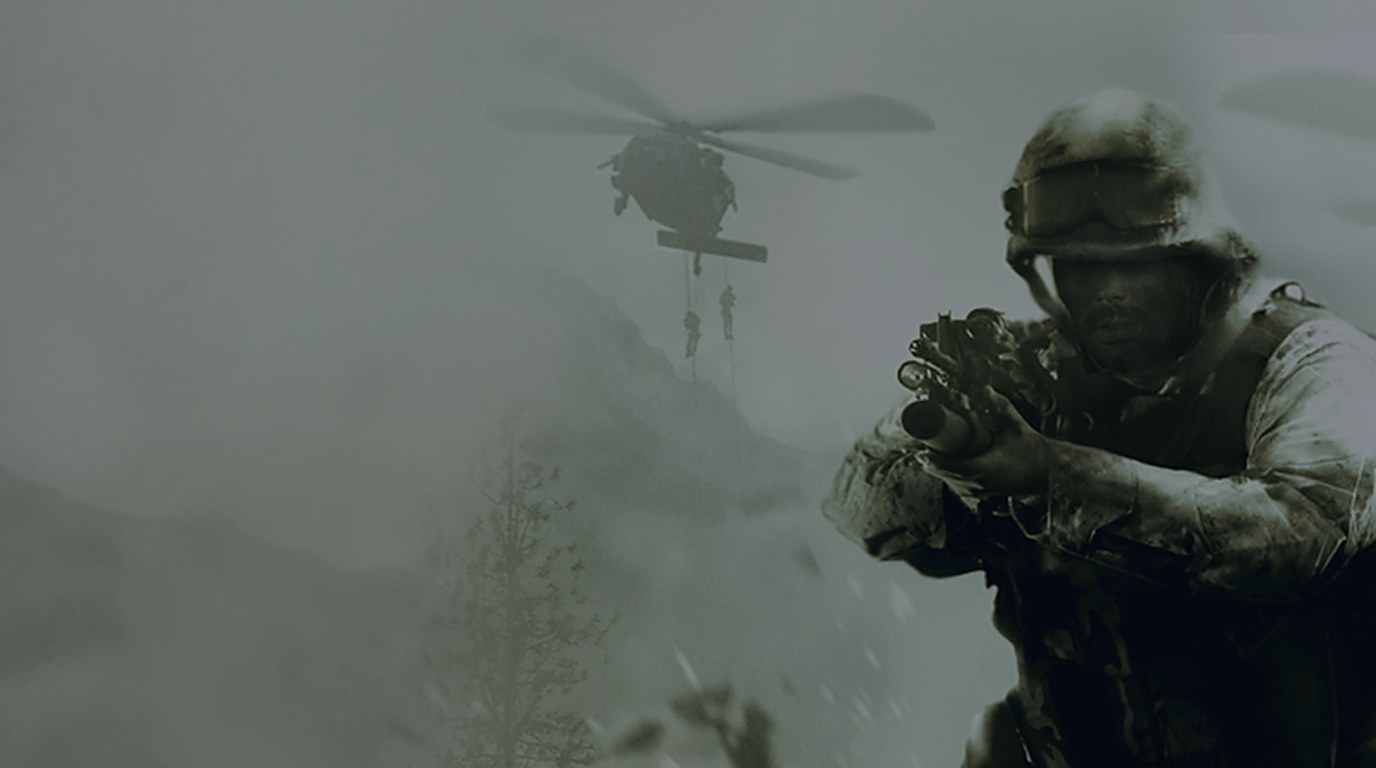
There’s a sequence in “All Ghillied Up” where you go prone in waist-high grass and watch a convoy crawl past, your spotter whispering which targets actually matter. On a monitor it’s a great scripted moment. In the headset, with a rifle you’re actually holding and a scope you raise to your eye, it stops being a cutscene-with-guns and becomes a held breath. That is the entire pitch for playing Call of Duty 4: Modern Warfare in VR, and the community mod that makes it possible mostly delivers on it.
What KisakCOD VR actually is
Call of Duty 4 never got an official VR mode. What exists instead is KisakCOD VR, a free, open-source OpenXR conversion of the original 2007 Windows release. It adds stereoscopic rendering, 6DoF head tracking, and motion-controller weapon handling to the single-player campaign. You supply a legitimately installed copy of the 2007 game; the mod supplies the VR. It is in active public beta, which matters for how you should set your expectations.
The mod covers the campaign and only the campaign. There is no multiplayer here. If your attachment to Call of Duty 4 is the sniper lobbies, the killstreaks, or the maps, none of that is present. A legacy vorpX profile can inject stereoscopic 3D and head tracking into the flat game, but it is a thin fallback: no motion controls, no hand presence, no room-scale weapon handling. It is not a peer of this mod.
The rifle in your hands
The mod hands you the campaign with motion controllers mapped to your rifle. Aiming uses calibrated relative steering, so shouldering the weapon and lining up a shot feels like shouldering a weapon. Snap-turn is available, but this is a smooth-locomotion military shooter, so plan accordingly. The HUD is placed in VR space and can be scaled to fit wide or canted fields of view, which is the kind of detail that tells you someone actually wore a headset while building this.
The real standout is the physical scope. Raise it to your eye and the world narrows the way it should. On the overwatch missions this changes everything: you are no longer moving a reticle, you are steadying a long gun and choosing when to exhale. The Javelin and controller refinements added in the September beta keep that loop tightening — weapons feel more consistent, and the anti-tank sequence now behaves like a thing you are operating rather than a flat interface mapped onto your hands.
Manual grenades arrived earlier in the beta cycle, and they matter more than a feature list suggests. Pulling a grenade, arming it, and throwing it with your own motion is the difference between pressing a key and actually participating in a firefight. The night-vision visor gesture does the same trick: flip your hand to bring the green wash down, and a toggle becomes a physical action.
A 2007 game is not going to tax a modern GPU even rendered twice for stereo. It runs efficiently — mid-range hardware is plenty. The catch is not horsepower, it is polish. This is beta software with known open issues and per-headset quirks. OpenVR hand paths and SteamVR compatibility have improved across recent releases, Pimax support has been explicitly addressed, and the HUD and menu placement have been pulled closer to comfortable VR distances. But “works on more headsets now” is not the same as “works on every headset.” The beta label still means something.
Where the campaign lands
The campaign is the draw, and it holds up as a thing to inhabit. Call of Duty 4’s single-player is a string of famous set-pieces — the ship-board breach, the nuclear aftermath, the sniper overwatch — and VR does not just resize them, it changes who you are in them. You are not watching Price clear a room, you are the person with the rifle. The physical scope on the overwatch sections alone justifies the mod for anyone who remembers why those levels worked.
Motion-controlled aiming is the difference between a tech demo and a shooter. When you are working a corner with both hands on the stock and the scope, the gun stops being a reticle and becomes a tool you are manipulating. That is the presence dividend, and for a game this tightly designed, it lands hard.
Where the beta shows through
It is a beta, and it reads like one. Expect bugs, expect a config tool you will actually need to open, expect the odd texture or interaction that does not survive the translation into VR. The author is iterating fast — that is a point in its favor — but “fast iteration” and “finished” are not the same status. The version number will keep moving.
The structural limit is single-player only. The mod covers the campaign and stops. If your CoD4 attachment is multiplayer, this is not a return to the lobbies. You also have to own the original 2007 Windows release. The mod carries no game data; you bring the disc or the Steam install. That is standard for this kind of conversion, but it is a hard gate: no copy, no VR.
What it asks of you
If you loved this campaign and have ever wondered what it felt like to actually be in it, this is the version that answers that. Bring patience for beta rough edges, a willingness to open a config tool, and your own copy of the game, and the trade is worth it. It is best suited to players who want a legendary single-player shooter with real motion-controlled gunplay and do not mind helping a mod find its feet.
Call of Duty 4: Modern Warfare was never supposed to be a VR game, and the community mod that fixes that is still finding its feet. But the feet are under a legendary campaign, and the motion-controlled shooting is real, not faked. Bugs and the single-player-only scope aside, this is the way to stand inside one of the best shooters ever made.