
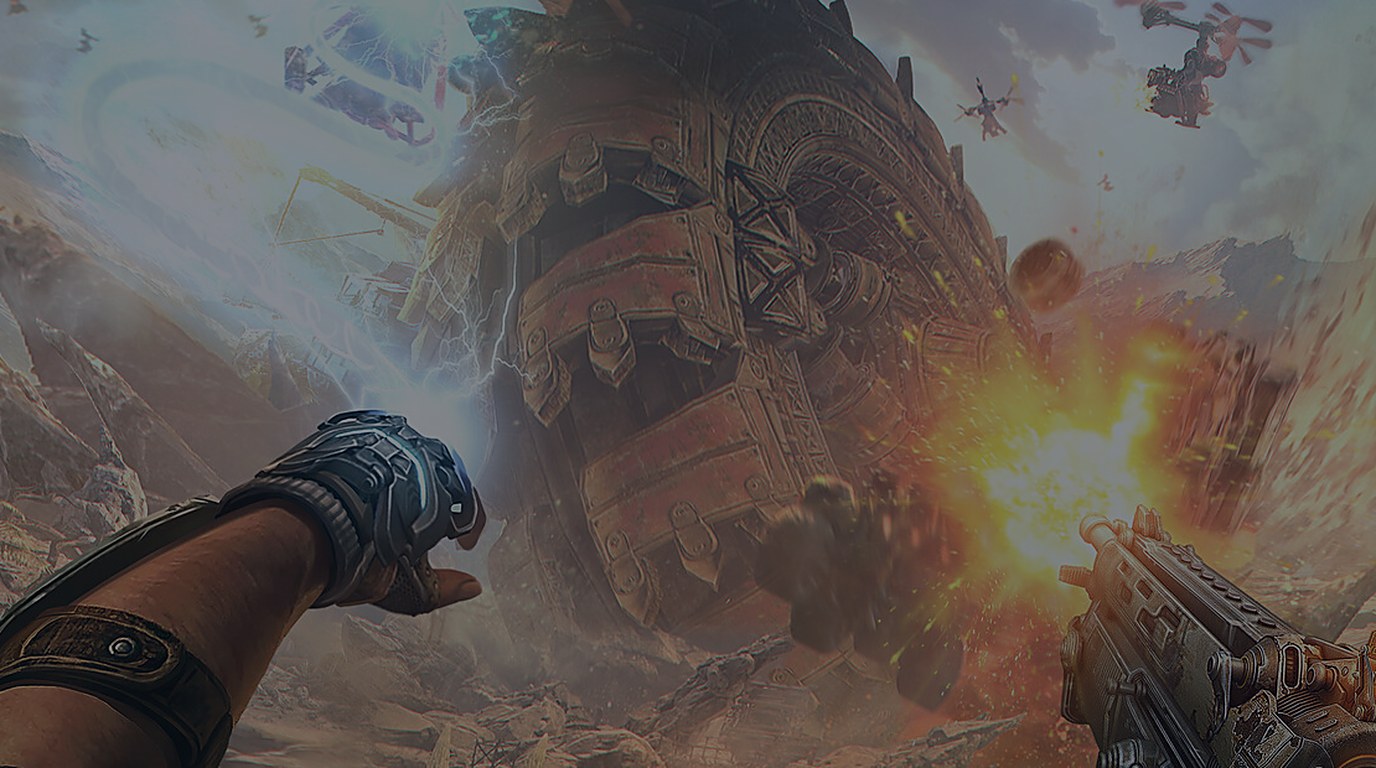
I spent a weekend with the Energy Leash wrapped around my wrist. Pulling a mutant halfway across the arena, watching him ragdoll toward my boot, then kicking him into a spinning ceiling fan is the single most Bulletstorm moment ever put in a headset. The leash was always the soul of this game. In VR, flicking your controller and yanking a guy into point-blank range finally feels like you did it, not like a button press queued an animation.
That one mechanic is the entire reason this port exists. Everything else is a 2011 arcade shooter learning to live in a headset — and it’s a rougher education than the premise deserves.
What you’re actually buying
Bulletstorm VR is a full native rebuild, not a mod and not an injection trick. Incuvo — the Polish studio behind the Green Hell VR and Blair Witch VR ports — rebuilt People Can Fly’s 2011 shooter from the ground up for motion controllers, and People Can Fly themselves published it. You buy it on your headset’s store and play. Quest, PSVR2, PCVR over Steam, and PICO all got the same native build. There is no framework ceiling to worry about and no community mod scene to chase, because the official port occupies the entire space.
Setup is nothing. Install, put the headset on, go. Comfort options and the usual VR locomotion settings are present, and the game runs on a mid-range PC without drama.
How the carnage actually plays
The core loop is unchanged, and that’s the point. Bulletstorm was never about tactical shooting. It’s about Skillshots — killing enemies in stupid, specific, inventive ways to bank points — and the flat game’s reputation was built on that imagination. In VR the loop gets a physical layer the original never had. You don’t select a weapon from a wheel; you hold two of them. Dual-wielding is the headline feature here, and it’s not a gimmick you try once and forget. Carrying a shotgun in one hand and the rifle in the other, then suddenly yanking a thug into your left-hand blast, is the kind of improvised violence the game was always reaching for.
The kick and slide melee round it out. You’re not standing still popping heads — you’re closing distance, booting a guy off a ledge, leashing the next one back for the kill. When it clicks, Bulletstorm VR is louder, dumber, and more physical than almost anything else on the platform, and the Skillshot scoring rewards you for exactly the chaos your own hands are causing. Lining up a ridiculous kill and watching the points roll in feels authored by you, not by a combo tree.
On PSVR2 and PCVR the thing looks like what it is: a polished-last-gen shooter rendered in stereo. The PCVR build in particular keeps higher-res models and textures that make the world read clearly even when the action gets frantic.
Where it stumbles
The cracks are the same ones every flat-to-VR conversion of a 2011 game shows. The shooting itself is looser than you want. The weapons feel less precise than the flat original’s tight arcade feedback — and when a game is built entirely around rewarding creative kills, a gun that doesn’t quite do what you aimed for undercuts the whole point. You can still line up a great Skillshot, but you’ll also whiff throws you were sure were perfect, and the scoring system doesn’t care whether the miss was the game’s fault or yours.
On standalone Quest the visuals take the expected hit. It’s a portable headset running a 2011 shooter, so the texture and geometry budget drops to keep the framerate honest — and Bulletstorm’s whole identity is spectacle. Some of that spectacle survives (the kills are still ridiculous), but the world feels thinner than it does tethered to a PC or on PSVR2. If you only own a Quest, you’re getting the same concept with less shine.
The launch itself was rough. The port shipped with real problems on PC and PSVR2 that patches have since smoothed out — the worst of the instability is gone, and the experience is meaningfully better than day-one coverage suggested. Anyone buying now is getting a firmer build than the people who reviewed it at release. But the memory of that launch hangs over the game’s reputation, and the patched version is still a 2011 arcade shooter under the hood, not a modern VR showcase.
And let’s be blunt about what Bulletstorm has never been: a deep game. The campaign is linear, front-loaded with cutscenes, and light on reasons to care about the story or the world. There’s no sprawling sandbox to inhabit, no role-playing weight, no reason to wander. You move from set piece to set piece kicking, leashing, and shooting things until it’s over. That’s fine — the game knows exactly what it is — but it means the VR headset is selling you kinetic fun, not a world worth living in.
The parts that earned their keep
After launch, Incuvo added Horde Mode — three arenas with leaderboards — and a chunk of playable Trishka Novak content with dual-wielding Energy Blades and a couple of new levels. Neither is a reason to buy on its own, but both show the studio understood the toy they were handed. Horde Mode is where the dual-wielding and leash really breathe, because there’s no scripted beat to wait for — just waves, your hands, and a score that climbs the stupider you get. If you bounce off the campaign’s structure, the arena mode is the better argument for why this thing works in VR.
The motion controls are the real win and the reason to bother. A native port that kept the flat game’s gamepad aiming would have been a forgettable checkbox. Instead the leash, the kick, the slide, and the two-gun arsenal are all in your hands, and that physicality is what separates this from ‘a shooter on a floating screen.’ It’s not flawless, but it is genuinely rebuilt for the headset rather than bolted onto it.
Who should put it on
If you want a precision shooter or a game that respects your time with a deep world, this isn’t it — go play something built for 2024. But if you’ve got a Saturday and a craving for unapologetic, creative violence, Bulletstorm VR delivers a kind of playground mayhem that almost nothing else on the platform attempts. Buy it on PSVR2 or PCVR for the fuller picture, know the Quest build trades shine for portability, and don’t expect the gunplay to feel as tight as the flat original. The Skillshot loop in your own hands is the closest the series has ever come to its own pitch — and for a game that’s always been about style over substance, that’s the only verdict that matters.