
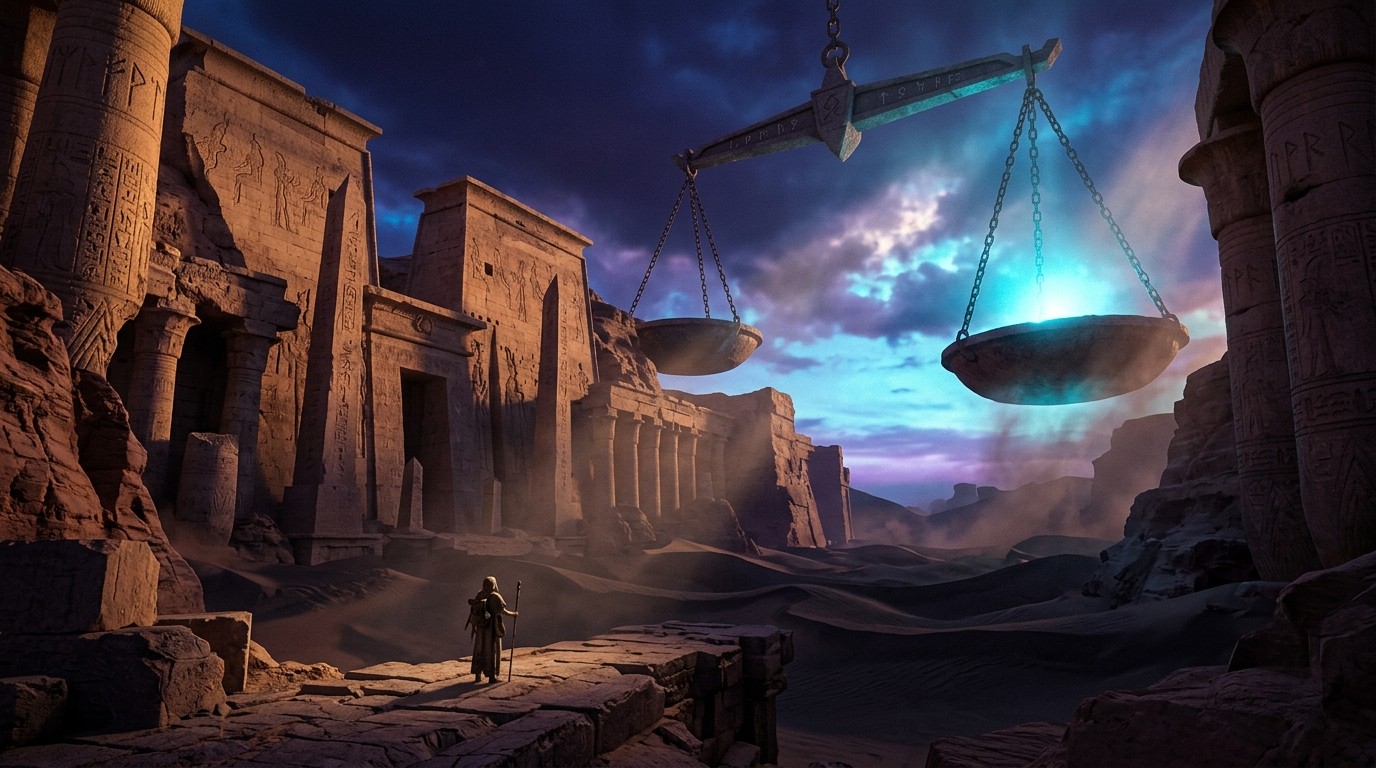
The first time Asgard’s Wrath 2 lifts you out of your mortal body and floats you up into the sky to rebalance a giant set of scales, you understand where the budget went. This isn’t a tech demo strapped to a headset. It’s a 60-hour action RPG that lives entirely on a standalone Quest — no PC, no cable, no “wait while it compiles shaders.” You buy it on the store, you install it, and you’re standing in the sand.
That’s the whole story, and it’s worth saying plainly: Asgard’s Wrath 2 has exactly one way to play it in VR, and that’s the official Quest version. There’s no PC build, no flat version to mod, no emulator option, no injection driver that can touch it. It was built from the ground up for Meta’s standalone hardware, and the only real question is whether you own a Quest. If you do, the way in is a single purchase. If you don’t, there isn’t a way in.
How it plays is the part that earns the hype. Combat is first-person and physical — you swing a sword, you raise a shield to block, and you parry at the right moment to crack an enemy’s guard before the real damage lands. Throwing a weapon and watching it arc into a crowd never stops feeling like you actually did something. Between fights, the game drops you into “god-scale” puzzles: your view pulls up and out, top-down, and you manipulate the environment — slide stones, hook pulleys, guide your mortal self across a gap. It’s a perspective trick that shouldn’t work as well as it does, and it’s the single most distinctive thing the game does with the medium.
Underneath that, it’s an RPG of real girth. You play a Norse god possessing four different mortal heroes across Egyptian, Greek, and Norse realms, each with their own story and skill tree, and you convert animals into follower companions who fight beside you. When the campaign winds down, there’s Uncharted Rifts — a roguelike mode with procedurally generated dungeons and leaderboards, plus rotating Cosmic Events that layer modifiers on top. Meta’s “60-hour campaign, 130-hour completionist” claim isn’t crazy.
The one thing that will stop you
Here’s the wall, and it’s a real one: there is no teleport. Movement is smooth locomotion only. The game opens with a comfort choice — visceral, comfortable, or default — and you get a vignette, adjustable snap turning, and toggles for camera shake and head-based steering. The vignette is weird: instead of dimming at the edges whenever you move, it kicks in based on how close your gaze is to a wall or object, so you can coax it on by tipping your head toward the floor. It helps. But if free movement in VR makes you queasy, this is a wall, not a speed bump, and no amount of snap-turning dresses it up as a teleport game. I’d rather they’d shipped teleport as an option; the spectacle is big enough that a lot of people who’d love it will bounce off the locomotion alone.
On the hardware, it’s a study in what a standalone chip can do. On current-gen Quest silicon it runs at a dynamic 72–90Hz with an optional enhanced-rendering toggle that bumps resolution and draw distance; on previous-gen hardware it holds 72Hz with foveated rendering in the heavy areas. Performance is solid but not invisible — there’s pop-in across the world (objects shimmer into existence a few meters out), and the occasional hitch on the bigger set pieces. It was clearly built first for the older headset, and the textures show it up close. Step back, and the art direction and scale carry it.
That scale is the real strength. The production values — motion-captured performances, a genuine voice cast, vistas that demand your attention — are the reason IGN called it a new gold standard for VR and why it sits at an 87 on Metacritic. When it commits to a god-scale boss or a cutscene that moves forward instead of cutting between flat-style camera angles, it’s doing something you can’t get on a television. And because it’s a complete, offline single-player game, it keeps working regardless of what happens to the people who made it.
Which brings up the awkward part. Sanzaru Games, the studio behind both Asgard’s Wrath titles, no longer exists — Meta closed it. For a live-service game that’s a death sentence; for this one it’s a footnote. The game is finished, still sold, and runs without a server. You’re not buying something with an expiration date. What you are buying is a game whose open world is thinner than the marketing implies. The map is big and often beautiful, but it reads as set dressing between missions rather than a place that’s alive, and the story leans hard on dense mythological lore that bogs down more than it pulls you forward. UploadVR’s dissent — that it’s “godly scale, but at what cost,” a traditional RPG that doesn’t meaningfully transform just because it’s in VR — lands harder the longer you play.
So: is it worth the headset time? If you own a Quest and you can handle smooth locomotion, this is the RPG to own on the platform, full stop. Get it on sale — it’s been as low as the high thirties, and it launched bundled free with new Quest headsets. The combat is physical, the scale is real, and the hundred-odd hours of content are content. If you need teleport to play comfortably, or you’re holding out for a PC version that will never come, this one stays on the shelf. It’s a flagship that justifies the hardware without quite justifying the word “essential” — the world is big, but it’s not one I’d inhabit forever.