
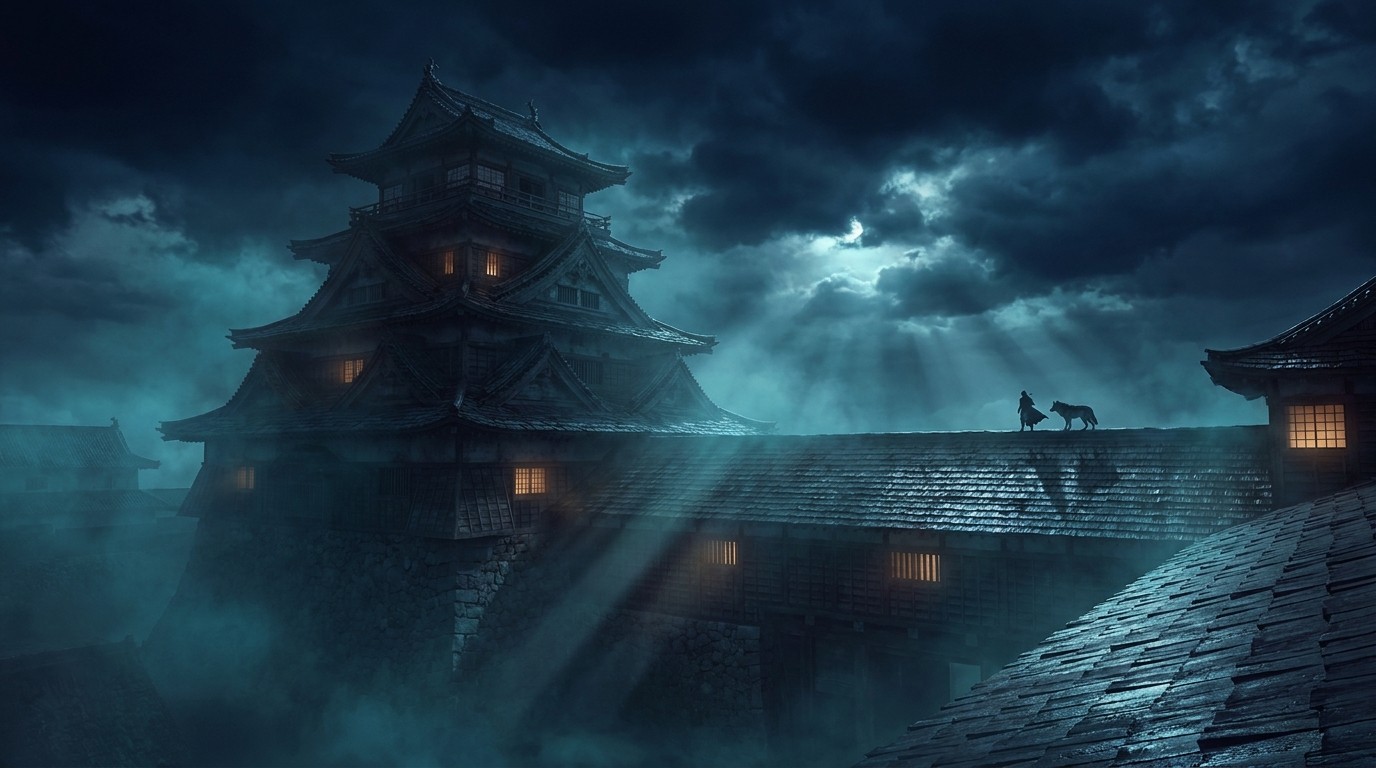
I spent twenty minutes creeping along a castle rooftop, katana sheathed, waiting for a guard to turn his back. When he did, I dropped, grabbed him from behind, and my wolf Haru pinned his legs while I went to work. For that stretch, Arashi: Castles of Sin is the VR ninja game I’d been waiting years for. Then I needed Haru to search a corner, and I had to physically swing my head like a laser pointer to aim a dot locked to the center of my view at the ground. The spell cracks — not shatters, but cracks.
What Arashi actually is
Arashi is native VR, full stop. No flat version, no community mod, no injection driver doing stereoscopic tricks. Endeavor One built it for the headset from the start, first on PSVR in August 2021, then two years later Skydance Interactive co-developed and published a definitive Final Cut that landed on PSVR2, Quest, and PCVR (SteamVR) on December 5, 2023, with ForwardXP handling the port. You buy it on your platform and you’re in. No dependencies, no config files, no ritual — just a VR game you install and play.
You’re Kenshiro, last surviving son of House Arashi, moving through feudal Japan to assassinate the Six Oni of Iga, a bandit crew wrecking the countryside. First-person stealth-action with real motion-controlled blades: katana, tanto, and a loadout that runs wider than you’d expect — grenades, mines, blowguns, bows, even a pistol. Before each mission you kit out from a chest of tools, and the game lets you lean silent or loud. That loadout screen is the first sign this isn’t a corridor stalker — it’s a sandbox where you decide how a castle falls.
The sneak is real
The levels are the win. These are open-ended sandboxes, not hallways — multiple ways into a keep, guards you can avoid or butcher, rooftops to grapple between, shadows to melt into. The feudal Japan presentation sells it: mist over the walls, lantern light on timber, a score that knows when to get out of the way. When I’m crouched in a doorway watching a patrol path, deciding whether to poison him or drop on his head, that’s a VR Tenchu moment the medium has been short on.
Haru is the soul of the thing. She’s an AI wolf who restrains enemies mid-fight, digs up loot you’d otherwise miss, and plays fetch in the quiet bits between castles. She’s a companion the game actually earns — not a HUD marker, a partner you watch work. I petted her between missions more than I’ll admit, and the missions play better for it: point her at a guarded courtyard and she’ll clear a path you’d have to sneak twice.
The swordplay is motion-captured and physical. Parries, counters, stealth kills from above — when it lines up, it lines up, and the weight of the blade reads through the controller. The Final Cut tightened this considerably: boss fights now run multiple phases with shadow-clone decoys that actually test your reading of the room, a real leap from the original’s sluggish, single-pattern encounters. Each of the Six Oni has a distinct style and personality, and those fights are where Arashi remembers it’s supposed to be a game, not a diorama.
The reticle that won’t quit
Here’s the flaw I can’t stop naming, because it touches everything you do. Menus, wolf commands, object interaction — all aimed by a dot fixed to the dead center of your view. To point at anything, you move your whole head. On PSVR2, a headset with eye tracking built for exactly this problem, the feature goes unused. You aim with your neck. It’s a habit carried over from the 2021 PSVR build instead of fixed, and it yanks you out of the fantasy every time you need Haru to do something or you’re digging through a menu mid-mission. A simple motion-controlled pointer would have solved it on every platform. Skydance confirmed the controls are identical across Quest, PSVR2, and PCVR — so the quirk travels with the game, not just the original hardware.
The AI outside the bosses is thin. Guards, archers, samurai — same models, same behaviors from the first castle to the last. They don’t adapt, don’t flank, don’t surprise. The castle layouts share the same bones; by the back half they blur together, and the stealth that felt clever in hour one starts to feel like the same puzzle with the furniture moved. And the story, such as it is, faceplants at the finish — the final boss is the weakest of the six, the last level the shortest, and it stumbles to credits like it ran out of budget mid-swing.
It’s a standing game, too: smooth locomotion, no teleport, and sitting makes grabbing gear off your hips and back a real chore, so you’re meant to be upright, and the head-locked aiming asks you to crane around more than a standing-sneak fantasy should. Fine for this audience, but know what you’re strapping on for.
Who should put the headset on
If you’ve wanted a VR stealth game — a Tenchu, a real shinobi fantasy — Arashi is one of the only ones built for the headset, and the good parts are genuinely good. Get the Final Cut on whatever you own; PSVR2 and PCVR look the best, Quest runs it but rougher around the edges. Skip it if you need your VR clean and polished — the reticle and the repetition will wear on you by hour four. For the right player, though, creeping a castle with a wolf at your side is worth the cracks.