
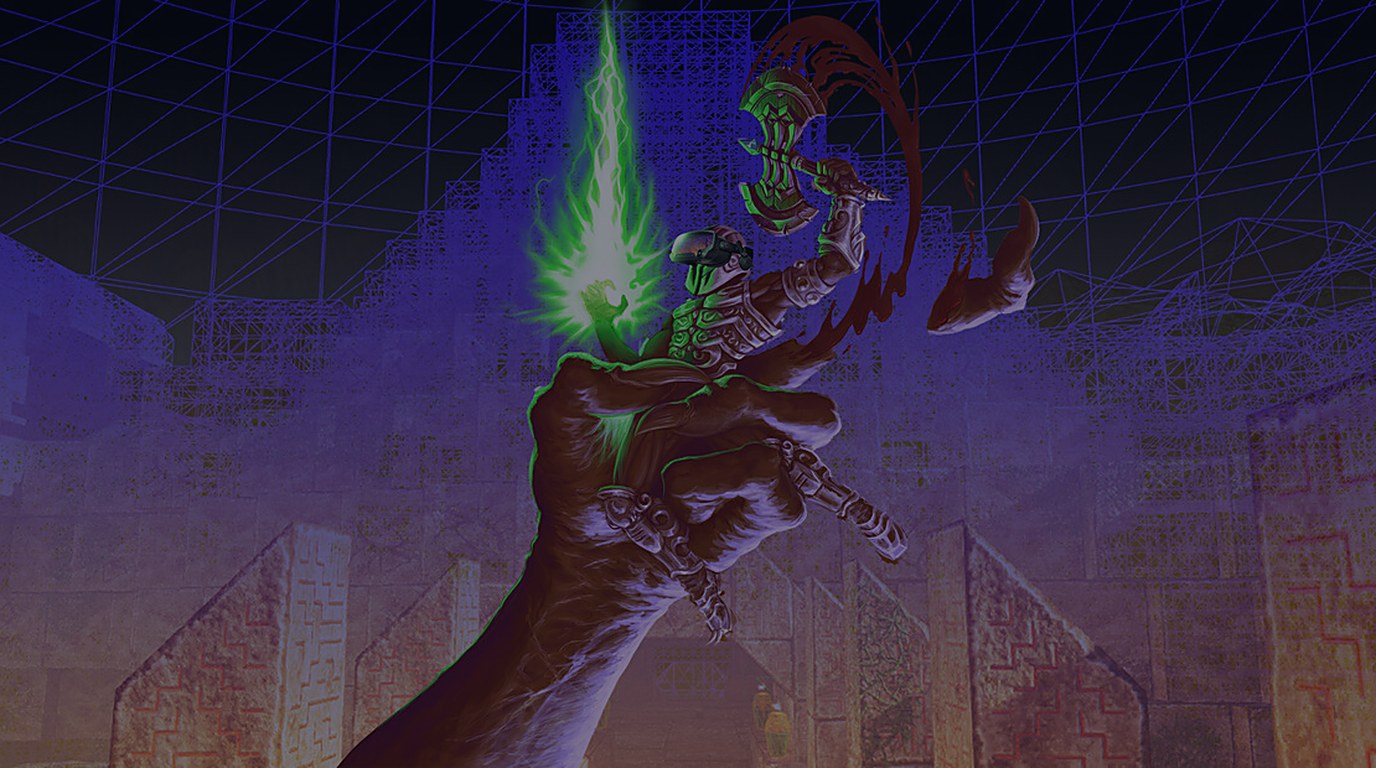
I strapped on the headset expecting a flat game with a VR skin stretched over it. Instead, the first thing I did in AMID EVIL VR was grab a spinning planet out of my own hand and hurl it at a demon. That’s not a flat-game feature with head tracking bolted on — that’s a game that was rebuilt around the fact that you have two hands and a head that moves.
It’s a separate, purpose-built VR product from Indefatigable and Andre Elijah Immersive, published by New Blood, and it launched day-and-date on PCVR and Quest. If you already own the 2019 flat game, that doesn’t get you in — it’s a separate purchase, not a free update. That stings a little, but once you’re in the headset, the reasoning is obvious: almost nothing from the original’s code path survived the trip to VR.
A Rebuild, Not a Patch
The flat AMID EVIL is a loving tribute to Heretic and Hexen — seven themed episodes, soul-charged magical weapons, an Andrew Hulshult soundtrack that sounds like a cathedral caught fire. The VR version keeps all of that and throws out the parts that don’t work when your body is the controller. The weapon wheel, for example, no longer freezes time while you pick — it slows it down Superhot-style, so you’re still dodging projectiles with one hand while you swap spells with the other. That one change tells you everything about the design philosophy: this was built for VR, not ported to it.
Setup is the least interesting part of the story, which is exactly how it should be. Buy it on Steam for PCVR or on the Quest Store for standalone, install, play. No BepInEx, no UEVR injection, no config edits. On PCVR you need a VR-ready GPU (a GTX 1070 is the floor) and SteamVR, but there’s no dependency chain to untangle. The game ships with a pile of comfort options, so you can tune snap turning, vignette, and the rest to taste without hunting through a wiki.
The Weapons Are the Game
AMID EVIL VR separates itself from every boomer shooter that just mapped “look” to the headset. The weapons in the flat game were 3D models turned into retro sprites. In VR they’re back to full 3D, and you hold them. You can physically swing the sword and mace to cleave enemies. You can throw the axe like a tomahawk and it comes back to your hand — and it reflects enemy fire on the way out, which turns a basic attack into a defensive play. The Celestial Claw lets you pull a planet out of the sky, hold it up, look at it, and use it as a wrecking ball.
That last one sounds like a gimmick until you’re actually doing it. There’s a specific kind of VR joy that only comes from grabbing something the size of a small moon and deciding, with your own arm, where it goes. The game gives you two independent hands, so you can hold a weapon in each and use them differently — overcharge one with stolen souls, keep the other as a melee tool. The 2025 Next Gen Update leaned further into this, reworking the axe throw to feel deliberately overpowered and tightening planet throwing so it stops feeling like a party trick and starts feeling like a real option.
Eight Hours of Cathedral-on-Fire Energy
The campaign is no afterthought. Seven episodes, twenty-one levels, seven boss fights, and a pile of non-linear, secret-stuffed arenas that reward exploration the way the old games did. This is a real eight-hour single-player campaign, not a tech demo with a shooting gallery bolted on. The Endless Mode update added Hordes of Evil — a horde survival mode across three levels with an optional Slow-Mo Soul Mode — which gives the game a reason to live past the credits if you want to chase high scores.
What keeps it from feeling like a chore is the pacing. Boomer shooters live on the rhythm of “find the choke point, get swarmed, blow everything back.” In VR that rhythm becomes physical: you’re actually stepping sideways to dodge a projectile, actually raising a shield, actually throwing the one weapon that counters the enemy in front of you. The soundtrack does a lot of heavy lifting here — Hulshult’s score is loud, liturgical, and relentless in the best way, and hearing it wrapped around your head in 3D changes how the arenas feel.
Where the Port Shows Its Seams
I’m not going to pretend it’s flawless. The flat game’s visuals took a hit in the jump to VR, and that’s most visible on Quest — the standalone build runs a noticeably softer, simpler version of the PCVR graphics. On a SteamVR headset like the Index or Vive you’re much closer to the original’s look. The 2025 Next Gen Update explicitly addressed this with improved visual fidelity and lighting, so the gap is smaller than it was at launch, but if you play the Quest version first and then see the PCVR version, you’ll notice. That’s a platform reality of standalone VR, not a betrayal.
The other honest caveat is that this is a fast, continuous-motion arena shooter. Comfort options exist, but the game wants you moving — dodging, strafing, throwing — and the intensity sits at a level that demands decent VR legs. If you can handle a fast shooter, this is fine; if smooth locomotion in a projectile-dense arena makes you queasy, this one will test you.
The Boomer Shooter VR Forgot It Needed
Most retro FPS ports to VR treat the headset like a windshield — you look through it, but you’re not really in it. AMID EVIL VR is the opposite. Someone looked at a game built around swinging enchanted weapons and throwing planets and asked, “how do we make the player’s hands do that?” — then rebuilt the whole thing to answer. That’s why it lands where it does. The visual downgrade on Quest is real, the motion is intense by design, and paying full price again after owning the flat game is a fair gripe. None of that changes the core fact: this is a complete, eight-hour campaign rebuilt around motion controls that genuinely transform how the combat feels.
If you cut your teeth on Heretic, Hexen, or DOOM and you’ve got a VR headset collecting dust between the big releases, this is the game that justifies picking it back up. It’s for players who want to physically fight their way through a retro shooter, not just watch one — and it’s one of the cleaner native rebuilds you can point a boomer-shooter fan toward without a disclaimer the length of a setup guide.