
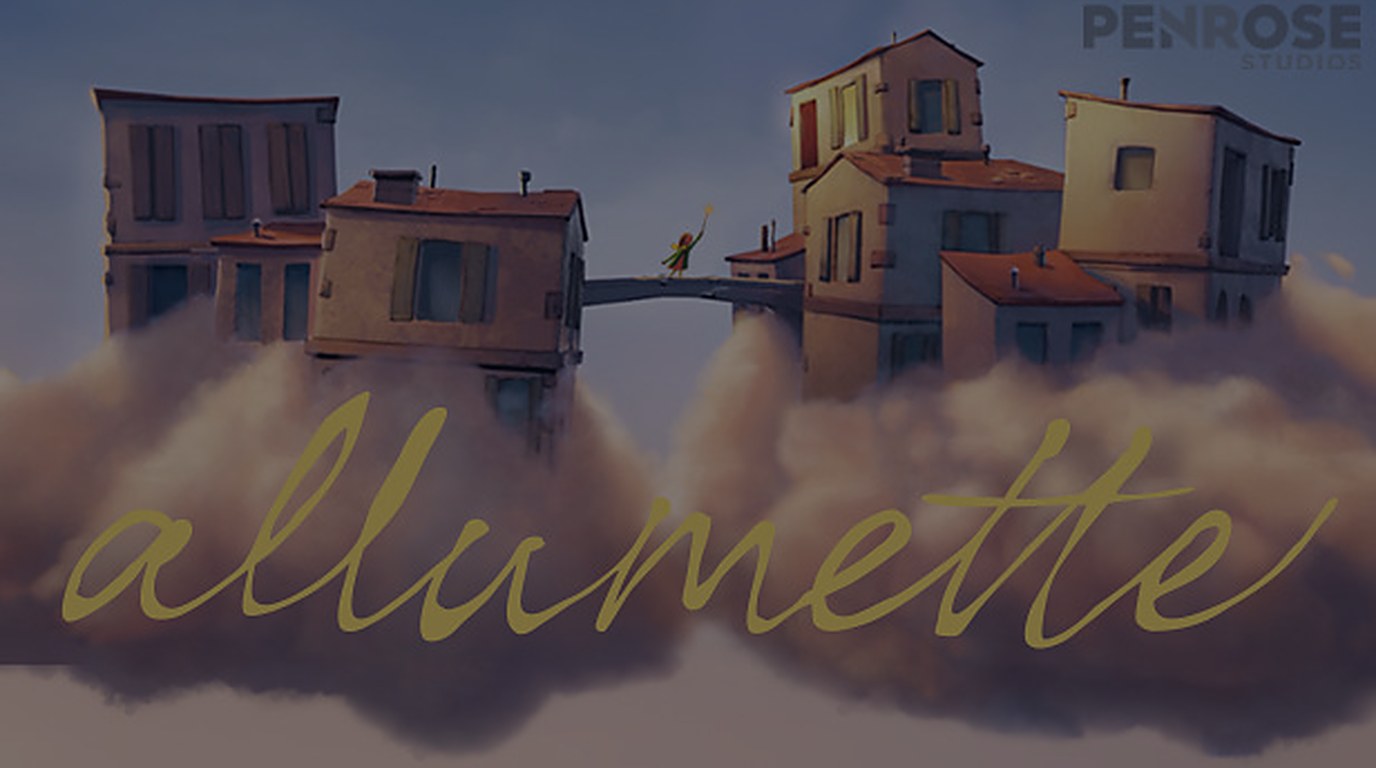
I leaned in until my face was a few inches from a tiny woman no taller than my thumb, and watched her light a match. The flame caught, the cloud-city around me warmed from dusk-blue to amber, and for a beat I forgot the headset was on my face at all. That’s the whole trick of Allumette, and it’s a better trick than most VR games manage with a hundred systems and a hundred hours of content.
Allumette is a VR-native animated short from Penrose Studios — Eugene Chung’s outfit, the same people who’d go on to make Arden’s Wake. It landed in October 2016 as a launch title for PlayStation VR and, the same week, on Oculus Rift and HTC Vive through Steam. There’s no flat version. This was built for the headset from the first frame, which means you’re not watching a movie with VR bolted on — you’re standing inside a diorama.
And it really is a diorama. The story is Hans Christian Andersen’s “The Little Match Girl” loosely retold: an orphan child in a fantastical city in the clouds, and the love between her and her mother. Penrose stages it like a puppet theater floating in space. You’re positioned as a spectator, usually seated or standing in one spot, and the world plays out in front of and around you at roughly model-train scale. Lean in and a detail sharpens. Look up and the city keeps going. The camera (your head) is the only real control, and that’s the point — this is a film you inhabit rather than a game you operate.
Getting into it is about as close to zero-friction as VR gets. It’s free, it’s on the store, you download it and put the headset on. No mods, no profiles, no runtime gymnastics, no Discord confirmation. On PC you need SteamVR or the Oculus PC runtime and a headset; on console you need a PS4 and a PSVR. It’s a stationary, lean-and-look experience — about as comfortable as VR gets, with no locomotion to fight and nothing demanding you move.
Don’t come in expecting a gamepad campaign. There’s no gameplay loop, no objectives, no fail state. The “input” is your attention. You watch, you look around, you occasionally lean toward a character to catch a gesture. If you’re the kind of VR owner who only straps in for something to do, this won’t scratch that itch — and I’m not going to pretend it will. It’s a short film. The honesty matters: Allumette is a story you receive, not a world you act in.
What it does deliver is presence, and presence is the one thing flat screens can’t fake. The miniature city has weight and depth — gondolas drift between cloud-platforms, the lighting reacts to the matches the girl strikes, and the scale play (you as a giant peering into a dollhouse world) is genuinely affecting in a way 2D animation never lands. Penrose understood early that VR’s gift isn’t eye-candy, it’s being there, and they built the entire piece around proximity: the closer you lean, the more intimate the moment becomes. The mother-daughter thread lands harder because you’re hovering inches from their faces when it pays off.
It’s also a landmark, and that’s worth something on its own. Allumette premiered at Tribeca earlier in 2016 and shipped as a PSVR launch title, sitting alongside Oculus Story Studio’s early work as proof that VR could be a storytelling medium and not just a shooter showcase. The critical reception at launch was warm and a little reverent — reviewers treated it as a sign of where the medium might go, not just a free trinket. As a launch-title piece it still makes its case cleanly: a tight, intentional, beautiful 20 minutes that respects your time.
The caveats are real but narrow. Twenty minutes is the whole thing — you’ll blink and it’s over, and there’s no replay hook beyond rewatching the craft. The narrative is slight and unapologetically sentimental; if you’re allergic to Andersen’s weepier instincts, the ending will either get you or annoy you, and which one depends entirely on your tolerance for a sad little orphan story. And again: it’s passive. No interaction, no agency, no “VR game” systems to dig into. For the right mood it’s perfect; for a Saturday of active play it’s the wrong call.
Performance is a non-issue. This is a stylized animated short, not a render farm, and it runs comfortably on a modest PCVR rig of the era without reprojection drama. On PSVR it’s a clean, stable experience befitting a launch title. You’re not tuning settings here — you’re pressing play.
Here’s my honest take: if you own a headset and you haven’t seen Allumette, you should. It’s free, it’s twenty minutes, and it’s one of the cleaner arguments for why this medium exists at all. I’d hand it to a curious friend the way I’d hand them a short story — not because it’s the biggest thing in VR, but because it’s a small thing done with real care, and it shows you what presence feels like before the guns and the loot boxes show up. It’s a film, not a game, and it never pretends otherwise. That’s exactly the kind of experience worth keeping on your drive for a rainy afternoon.