
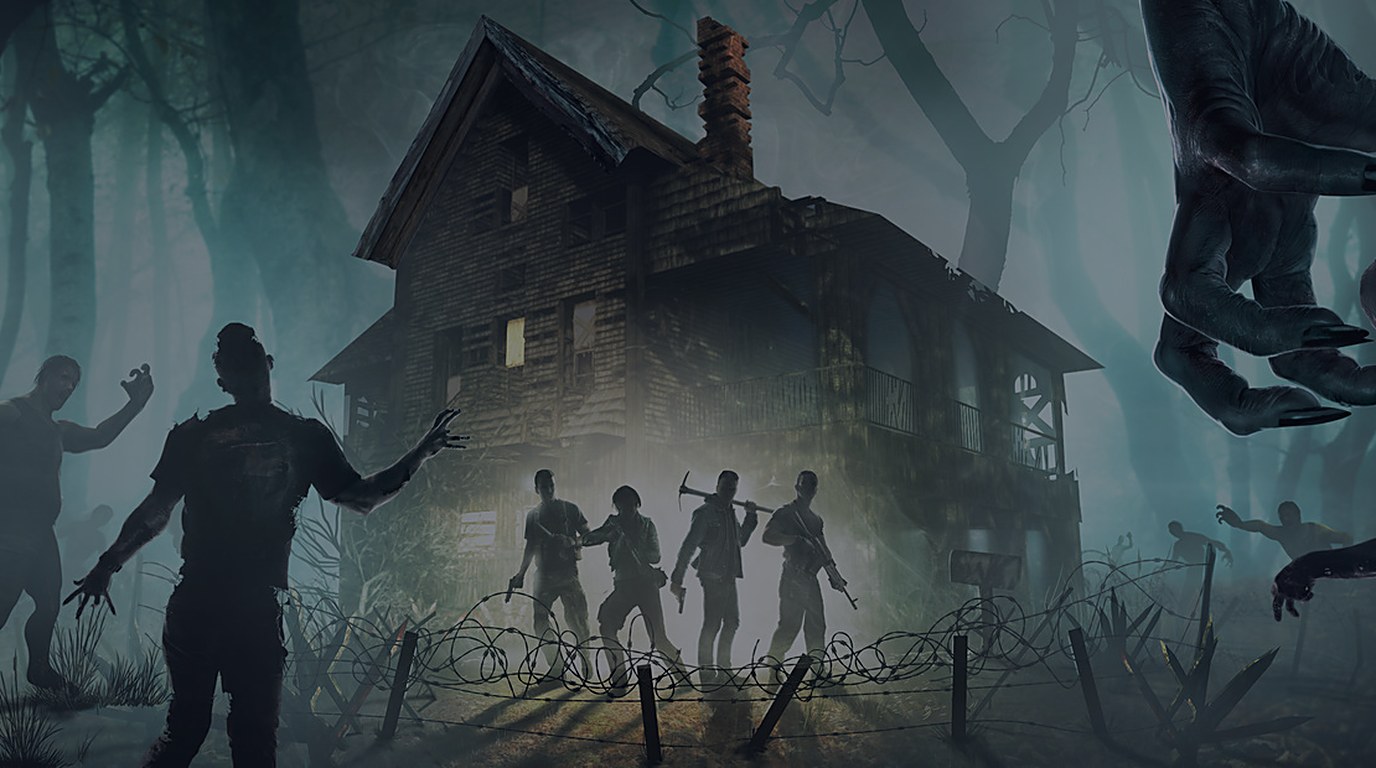
I spent a horde night in 7 Days to Die with a plank in my hand and a wall I’d nailed together myself at my back. When the first zombie hit the fence I’d built by reaching out and snapping each support into place, it didn’t feel like a survival game loading an encounter — it felt like something was trying to get into my house.
There is no official VR version of 7 Days to Die. The Fun Pimps never built one. What exists is the 7DVR mod, on Nexus Mods and a dedicated GitHub org. It’s a full VR overhaul: 6 degrees of freedom, motion controls, the whole vanilla game standing up in your living room. This is a Unity title, so the generic injector route that rescues a lot of Unreal games doesn’t apply here — the 7DVR mod is the whole show, and it’s maintained by a team that’s shipped across multiple game versions.
Getting in requires matching the 7DVR build to your game build. The team ships separate release lines pinned to specific game builds — Alpha 21, 1.0, 1.2, 2.x, 3.x — and a base-game update can leave the mod a step behind until the next 7DVR drop lands. There’s an install tutorial with tens of thousands of views and a wiki that walks the version matching, so it isn’t a dark art, but it is a tax you pay up front and again every time the game moves. The newest game build, 3.3.0, has temporarily outrun the mod, so version-matching may mean holding your install on an earlier build until a new 7DVR line catches up.
Once you’re in, the thing that hits you is scale. 7 Days to Die is a voxel world — every block is a thing you can walk up to, touch, and pull apart. On a monitor that’s a map you read from above; in VR it’s a horizon you stand under. I’d be scavenging a town and look up at a water tower I could feel was tall enough to matter, then realize the goddamn horizon went on further than my peripheral vision could hold.
Building is where VR stops being a novelty and starts being better. In flat 7DTD you place blocks with a cursor. In the mod you reach out, aim your hand, and slap a support into the wall. I built a ramp to a rooftop nest by physically leaning to check the angle before I committed — something I’d never bother doing on a screen. The feedback of connecting a block where I wanted it was in my hand, and the spatial sense of “this ledge is defendable” came from my body, not a minimap.
Combat feels different for the same reason. Swinging a melee weapon is a real arc — you put your shoulder into a club strike and the zombie in front of you reacts to where the hit actually lands, not where a reticle sat. Shooting works through the same motion-control aiming: you lean the right amount, draw down on a feral wight shambling out of the treeline, and the round goes where your hands pointed. It’s not a perfect physics sandbox — enemies still eat hits that look like they should connect and shrug off swings that looked clean — but the loop of “I threw a punch in real space and something died” is the part flat 7DTD can’t give you.
Performance is the honest catch, and it’s a heavy one. A voxel world that rebuilds draw distance around you every frame is not cheap to feed at 90Hz, and the mod’s own “Dynamic Object Quality” system exists because the team had to trade view distance against framerate to keep it liveable. On a mid-range PC you’ll be turning down object quality and accepting a shorter draw distance to hold framerate through a busy horde. On a high-end rig it opens up. This is a Heavy Demand title — budget and older machines will reproject their way through it, and that’s a worse experience in a game where spatial awareness is the whole point.
Horde night is the reason anyone puts up with the rest of it. Every seventh day the game throws a siege at your base, and in VR it becomes a siege you’re standing inside. I was standing in the kill corridor with them, boarded up behind the wall I’d built, hearing the scrape of something climbing the outside. When a breach opened and a pack came through the gap, the panic was physical: I was rearranging my own barricade with my hands while zombies poured in. That’s the single best moment the mod delivers, and it’s the best argument for this mod over playing flat. No amount of screen reading gives you the bodily “they’re in the house” spike.
The mod scene is why this matters beyond a vanilla playthrough. You can run the same deep, community-built sandboxes flat players do, with the same motion controls. The team has built compatibility for the big overhaul mods — Darkness Falls and Afterlife. A VR mod that breaks on those is a toy. The fact that you can drop into a years-long overhaul save and build it by hand is what separates 7DVR from a tech demo.
What doesn’t translate is the UI. 7 Days to Die’s interface is a flat-screen menu — inventory grids, crafting trees, the map — and the mod floats that panel in front of you rather than rebuilding it for VR. You’ll be reading a floating 2D panel at arm’s length to manage your loot and blueprints, which is fine for a quick check and annoying when you’re deep in a crafting chain. It never gets in the way of the core loop of build, fight, survive, but don’t expect a VR-native menu. Memorize your crafting paths before you put the headset on and the friction mostly disappears.
The setup tax never fully goes away. This is a mod that tracks a live, still-updating game, so every major base-game version is a moment where you check whether 7DVR has caught up. That’s the real cost of admission: not a one-time install, but a relationship with a project that moves when the game moves. Read the version notes before you update your game, and you’ll avoid the night where your mod stops launching after a surprise patch.
Here’s the thing: 7 Days to Die was never about a story. It’s a sandbox with teeth, a world to fortify and a clock that wants you dead every seventh day. The 7DVR mod is the difference between reading about that world and standing in it with a plank in your hand. If you’ve got a PCVR rig, the patience to match a version, and you want a survival sandbox deep enough to actually live in for a hundred hours, this is an easy yes. The flat version is a great game. The VR version is a great game you survive instead of watch.