
Famous Game Trailers You Can Actually Play in VR (2026)
Twenty-five of the most famous game trailers ever cut, ranked by how much of the promise survives once you are standing inside the game in VR — native ports, injection mods, and one emulator miracle.
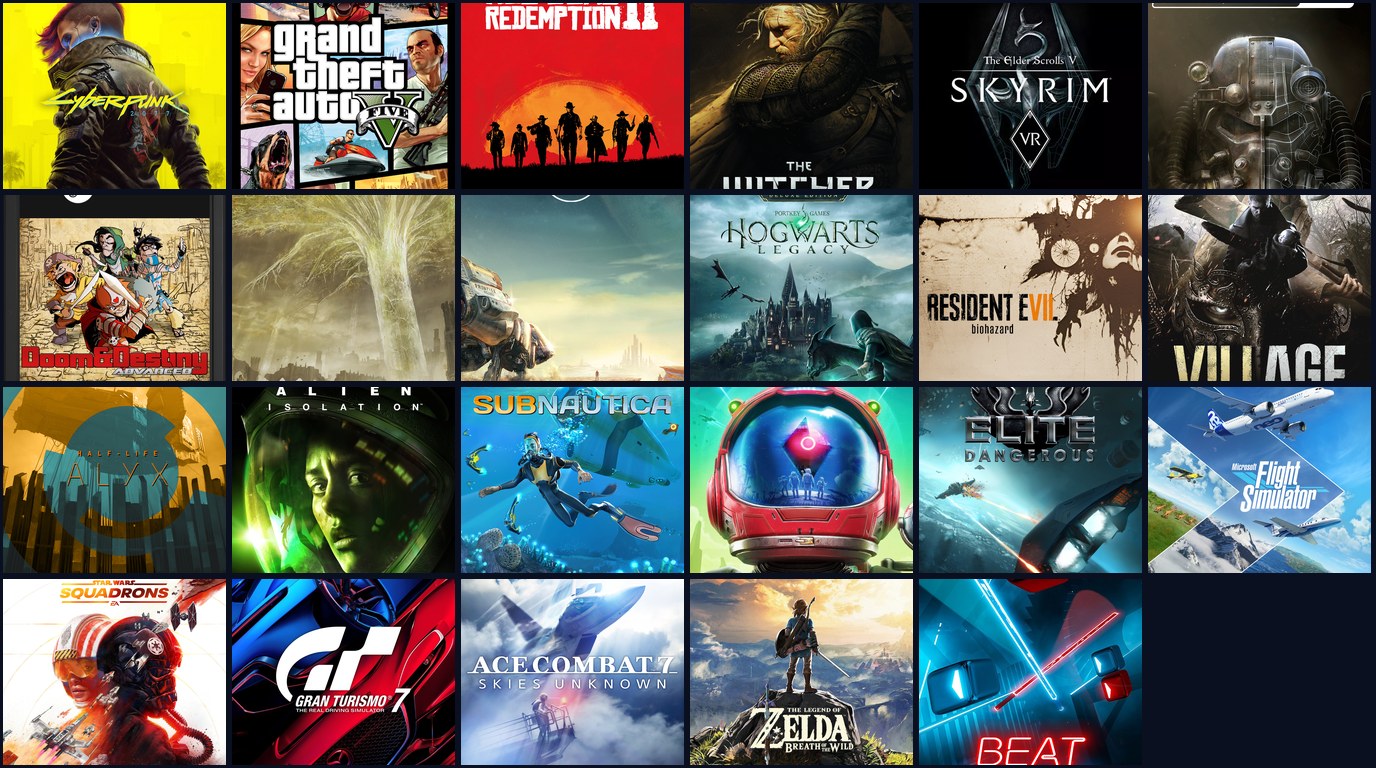
A good trailer is a threat. It shows you a world, tells you it’s yours, and then makes you wait two years to find out whether any of it was true. Most of us bought those promises sight unseen — Night City, Los Santos, the Northern Kingdoms, a burning Hyrule field — and most of us found out later that marketing renders and shipping games are different animals.
VR is the audit. Standing inside the thing strips away the cutaways, the camera moves, and the color grade, and leaves you with the only question that matters: is this world actually here when I am in it?
That’s the test I ran these trailers through. Not “does a VR mode exist,” but how much of the trailer survives contact. Some of these worlds hold up better than the game ever did on a monitor. Some collapse the second you look down at your own hands and find nothing there.
#1: Cyberpunk 2077
The Night City trailer sold density: crowds packed to the edges, a vertical city of neon bleeding onto wet asphalt, a camera that never stopped moving because there was always one more layer underneath. That is the one promise VR is genuinely good at, and there are two ways in. The CyberpunkVR Port is the one with hands: motion controllers, weapons you raise and fire, a city you stand inside. Luke Ross’s R.E.A.L. build is the established alternative — same head-tracked 6DoF view, gamepad input, Patreon-gated, version-locked to specific game builds. Either way your head sits at street level in a city built to be looked up at, and the scale lands. It also comes with a mess. There’s an ongoing fight where CD Projekt hit a paid VR mod with a DMCA and the modder refused to make it free. I’m not going to pretend that’s settled. No other world here rewards standing still and looking up quite as hard.
Read the full Cyberpunk 2077 review
#2: Grand Theft Auto V
Los Santos sold the fantasy of a city that keeps running when you stop looking at it — traffic, pedestrians, sunsets over the hills, a camera that could go anywhere. Luke Ross’s mod hands you the same city with your head on a swivel, and because GTA V’s world is old enough to run on almost anything, it holds frame rate in places Cyberpunk still sweats through. The catch is the same one every R.E.A.L. build carries: you are a floating camera holding a gamepad, so every gunfight and every car chase is still a flat-game input scheme bolted to a VR view. Driving in first person is the part that earns it. Shooting is the part that reminds you what you’re missing.
Read the full Grand Theft Auto V review
#3: Red Dead Redemption 2
Rockstar’s trailers sold weather, mud, and the specific loneliness of a rider crossing open country — a game that was already about slowing down. That is the best possible match for a mod that forces first person and gives you nothing to hold. Riding a horse through a storm with the camera on your own skull is the closest this medium gets to standing inside a painting, and no motion controllers are required to feel it. What you pay is GPU headroom — this is one of the heaviest things you can ask a headset rig to do — and the knowledge that every fistfight happens through a gamepad while your hands hang at your sides.
Read the full Red Dead Redemption 2 review
#4: The Witcher 3: Wild Hunt
“The Trail” sold a world with weather in it — villages that felt lived in, a horse that moved like an animal, a sky that did something. In VR the geography still works, and that’s the only reason this sits this high. There’s no official VR build, but there is witcher3-vr — tig3rmastr’s free open-source mod, updated as recently as 26 September 2026 at v0.9.8 — which replaced the old VorpX profile in July 2026. It gives you stereo rendering, 6DoF head tracking, and a first-person camera. What it does not give you is hands: the README says motion controls aren’t planned, so combat, signs, and menus all run through a gamepad. Novigrad at sunset is worth the experiment. Fighting your way through it still isn’t.
Read the full The Witcher 3: Wild Hunt review
#5: The Elder Scrolls V: Skyrim
The Dragonborn trailer promised one thing above all: a ridge, a shout, and a dragon coming over the mountain at you. Ten years of ports later that exact image is still the best argument for the whole medium, and Skyrim VR delivers it — the full game, on PSVR from November 2017 and PC VR from April 2018, with gesture-based melee if you want your arms involved. What it does not deliver is a game built for the headset. It’s a Special Edition port with VR bolted on: menus designed for a flatscreen, a resolution that was ugly on 2017 hardware and only got tolerable with better headsets, and combat that never quite believes you’re swinging something. The promise survives. The interface mostly doesn’t.
Read the full The Elder Scrolls V: Skyrim review
#6: Fallout 4
The E3 trailer sold a wasteland you could walk out of a vault door into, which is a fantasy that only works from the inside. Fallout 4 VR shipped on the Vive in December 2017 with the whole campaign intact and gunplay that actually uses your hands — which, for a 2015 open-world game, is more than the Skyrim port ever managed. The world holds. The ruins are the right size, the light through a collapsed roof is the right color. What breaks is the seam between a flatscreen game and a headset body, and Fallout 4 wears it badly — pip-boy menus, dialogue, and inventory all want a mouse, and the headset is the wrong place to do paperwork.
Read the full Fallout 4 review
#7: DOOM (2016)
The DOOM trailer is movement as violence: a shotgun that ends conversations, a body that never touches the floor, speed as the entire aesthetic. For years projection was the only way in, and it took all of that away. Then KHARVOX arrived. CactusVRStudios’ total conversion — v1.11 as of 29 September 2026 — hooks the Vulkan pipeline and presents the full campaign as an OpenXR application: room-scale 6DoF movement, tracked motion controllers, weapon calibration, separate eye buffers. The gun is in your hand. The glory kill is your arm. It is still a beta, with the texture of one — Windows Defender false positives on the launcher, the occasional freeze if you change graphics quality mid-level, a bad frame rate on the first launch after booting that settles down afterwards. VorpX is not the fallback here; it still can’t hook id Tech 6 cleanly and the geometry comes out broken. If KHARVOX won’t run, ReShade’s SuperDepth3D or Vk3DVision gives you a stereoscopic window, and a window is exactly what that is. Doom VFR remains a separate, shorter spin-off, not this game.
Read the full DOOM (2016) review
#8: Elden Ring
The reveal trailer was about scale and indifference — a golden tree over everything, ruins that were old before the myths, a world that did not care whether you were ready. That part translates almost suspiciously well, because R.E.A.L. converts the third-person camera into a first-person one and the only thing you lose is your own back. Stormveil at eye level stops being a backdrop and becomes architecture. Combat is the casualty. Every swing is a gamepad press, and a game this precise about timing feels the difference between watching your character commit to an animation and committing to one yourself.
Read the full Elden Ring review
#9: Starfield
Bethesda’s trailer promised the scale pitch of the decade: a thousand worlds, a ship you could walk through, a horizon on every one of them. Standing on those horizons is the entire dream, and since February 2025 the community has been the way in. starfield2vr, by Mutar, is a free REFramework-based conversion — v2.0.1 landed in May 2026 and is still the current build — with roomscale 6DoF, first- and third-person toggles, and a HUD you can scale and push back. It is gamepad-driven. No motion controllers, and it wants a high-end PC. But the horizons are real, and the horizon was the whole pitch.
Read the full Starfield review
#10: Hogwarts Legacy
The trailer was a walking-tour pitch — staircases that move, a hall that smells like candles, the specific childhood fantasy of being allowed to live in that building. Of everything here, it’s the one where the promise is almost entirely about architecture at human scale, which is exactly what VR does without breaking a sweat. The way in is UEVR, Praydog’s universal Unreal injector, which has been public since January 2024 and turns an Unreal game into a 6DoF headset game with minimal fuss. It’s not a native port. Motion controls arrive through the framework rather than from a game designed around them, and some scenes cost more frames than they should. But the castle lands, and the castle was the whole point.
Read the full Hogwarts Legacy review
#11: Resident Evil 7: biohazard
Capcom’s teaser sold claustrophobia as a feature — a house you cannot leave, a family that is already inside with you, a camera stuck at the height of a person who is not allowed to run. This is the rare case where the trailer was cut for the headset without saying so. Resident Evil 7 shipped on PSVR in January 2017 as the first full-length AAA game playable start to finish in VR, and the entire campaign works because it was designed for a first-person camera that never needed to be fast. Four hours in, the immersion stops being a selling point and becomes a problem, which is the highest compliment horror can receive. On PC the official version never came; REFramework mods carried it there later.
Read the full Resident Evil 7: biohazard review
#12: Resident Evil Village
The Village trailer cycle sold one image so effectively that it became a meme — a very tall woman in a very wide doorway — plus a castle, a village, and a winter that looks like it hurts. PSVR2 delivered it at launch on 22 February 2023, free to owners, with the headset’s eye tracking doing foveated rendering so the detail holds where you’re actually looking. That matters more here than in most games: the whole appeal is noticing how wrong the proportions are in a room you’re standing in, and eye-tracked rendering is what keeps that detail alive. It is a straight campaign port rather than a rebuild, so the shooting still feels like a controller. Still the cleanest example of a horror trailer paying off in a headset.
Read the full Resident Evil Village review
#13: Half-Life: Alyx
The Alyx announcement trailer did something no other trailer on this list could: it was shot from inside the headset. Every camera move in it is a head turn someone actually made. So when the game arrived on 23 March 2020 there was no gap to close — no flat game to translate, no third-person camera to force, no hands to simulate. You reach for a shell casing on a shelf and pick it up because that’s the whole vocabulary. That’s why it ranks here rather than at the top: the promise wasn’t survived, it was never in danger. What keeps it out of the top five is honesty about scope. It’s a corridor game with immaculate craft, not the open world the City 17 trailers of 2003 implied.
Read the full Half-Life: Alyx review
#14: Portal 2
Portal 2’s trailers sold jokes and architecture at the same time — a test chamber you could stand in, a voice that hates you, physics that behaved. A community VR mod arrived in 2022 and the good news is that puzzle games are the most comfortable thing you can put in a headset: no sprinting, no snap turns, no reason to move faster than a walk. Standing in a chamber and looking up at the portal you just put on the ceiling is a genuine payoff. The bad news is that a community mod is a community mod — rough edges, occasional breakage, and none of the polish Valve gave Alyx a decade later.
#15: Crysis
Crysis sold the nanosuit as a power fantasy you could feel: armor plating on a body you’re looking through, a cloak that makes the jungle go quiet, and vegetation that looked expensive from every angle. The visual promise aged better than the design promise — the island still looks like nothing else from 2007 — and fholger’s mod is the rare case where both halves survive. It’s a full room-scale OpenXR conversion of the original game, not the Remastered version: 6DoF tracking, motion controls, visible arms with inverse kinematics, physical melee, bHaptics support. You pull a rifle off your body, raise both hands to aim, and punch a soldier because your fist arrives. It’s been live since early 2025, it’s the developer behind the Half-Life 2 VR mod, and it’s the strongest flat-to-VR conversion on this list. VorpX is still there for the Remastered build the mod doesn’t touch, and for hardware that can’t carry the real thing — but that’s a consolation prize now.
#16: Alien: Isolation
Creative Assembly sold the original 1979 film’s texture — CRT monitors, condensation, a station that hums — and the promise that you would spend the whole game hiding from one animal that learns. An Oculus VR mode existed briefly in 2014 and was pulled, and MotherVR by Nibre put it back in 2017. That original version was seated and gamepad-driven with no hands, which is why JayP’s GRAND-MotherVR fork matters: true 6DoF motion controls, hand models that track yours, arms and body presence in Amanda Ripley’s space. You hold the motion tracker now, angle it at a door, bring your hand to your head for the flashlight. It still isn’t room-scale — Sevastopol’s cinematic moments assume a fixed player perspective — and none of that matters, because Alien: Isolation’s terror is audio and sightlines and a headset is the only place those get their full weight. The locker scene — the one the trailer cut around — is genuinely worse in VR, in the sense that you will remember it.
Read the full Alien: Isolation review
#17: Subnautica
Subnautica’s trailer sold the ocean as a place with depth in the literal sense — light falling away below you, something large moving at the edge of visibility, a life raft that is suddenly the only thing you own. Official VR support exists, and the water is the best argument for it: vertigo in a headset is easy to manufacture and hard to do tastefully, and looking down into open blue does it without a single jump scare. What official support gives you is a stereoscopic viewer with a gamepad — no hands, no VR UI, animations that break — which is why people actually use SubmersedVR, the community mod that adds full motion controls and hand-tracked interaction on top of it. Setup is an advanced job rather than a moderate one, and that mod is the reason the build-and-craft loop stops being abstract: you handle the materials, you place the pieces, and the swimming becomes something your body is doing.
Read the full Subnautica review
#18: No Man’s Sky
No Man’s Sky has the most complicated trailer history in this list, because the 2016 reveal sold a galaxy of wonder and the launch sold a very different, much emptier game. VR arrived in August 2019 with the Beyond update on both PC VR and PSVR, full game, and by then the studio had spent three years adding back the things the trailer implied. That’s why it sits mid-table rather than near the top: the promise did eventually get delivered, just not by the version of the game that made the promise. Standing on an alien ridge with a ship parked behind you is exactly what the trailer showed. It just took a very public reckoning and years of patches to get there.
Read the full No Man’s Sky review
#19: Elite Dangerous
Elite’s trailers sold the cockpit — a canopy, a galaxy map, the specific loneliness of being one small ship in a very large dark. VR was in from the December 2014 beta and the April 2015 launch, PC only, and it has always been the kind of game where a headset isn’t a gimmick but the correct display. Turning your head to track a target through the canopy is the entire interface. Then Odyssey arrived and split the experience in half: ships stayed full VR, and on-foot sections became a flat projected screen. That compromise is the most instructive thing on this list about what publishers will and won’t fund.
Read the full Elite Dangerous review
#20: Microsoft Flight Simulator
The 2020 trailer sold a planet: real weather, real cities pulled from satellite data, cloud layers you could descend through. VR landed in December 2020 with the Reverb G2 and spread to the wider SteamVR pool, and this is the entry where the promise is almost entirely optical — you sit down, you look out, and the world is there from 3,000 feet. No motion controllers, no hands, a HOTAS or gamepad in your lap, and none of it costs the fantasy anything because flying a plane is a seated activity with your hands on controls. The gap between trailer and headset is the smallest of any open-world game here. The gap between a 2020 mid-range GPU and a smooth frame rate is not.
Read the full Microsoft Flight Simulator review
#21: Star Wars: Squadrons
The Squadrons trailer was a childhood promise with a budget: an X-wing canopy, a TIE fighter screaming past, a war you could be inside of for forty-five dollars. It shipped on 2 October 2020 with full VR on PC and PSVR, cross-play, and it is cockpit-only by design — no walking around the hangar, no reaching for switches. That limitation is the smartest decision in the game. A cockpit is a fixed seat with a fixed frame of reference, which is the one VR configuration that doesn’t fight your inner ear, so the trailer’s promise survives almost intact. The only thing you lose is the bit the trailer never actually showed: legs.
Read the full Star Wars: Squadrons review
#22: Gran Turismo 7
Gran Turismo trailers have sold the same thing since the PS1 era — a car you will never own, photographed better than the manufacturer does it, on a road that behaves. PSVR2 support arrived free on 22 February 2023 and, unusually, it covers the whole game rather than a curated slice: everything except two-player splitscreen runs in the headset. That’s a real full-fat implementation, eye-tracked and 120Hz-capable, and it’s the single best demonstration of what the PSVR2 hardware can do with a first-party game. The compromise is the one racing always makes in VR: you’re seated, your hands are on a wheel you can’t see unless you own one, and the trailer’s cinematic camera work is replaced by a view from inside a helmet.
Read the full Gran Turismo 7 review
#23: Ace Combat 7: Skies Unknown
Ace Combat trailers are the purest form of the genre: a fighter jet, a contrail, a sky with weather in it, and a radio drama about a war you’re winning single-handed. There are two ways into this one and they trade different things. On PlayStation, PSVR got a slice rather than the meal — three purpose-built missions, roughly half an hour to forty-five minutes, handled well and over in an evening. On PC, UEVR plus Keton’s compatibility patch runs the whole thing: the full twenty-mission campaign and its DLC from inside the cockpit. That approach is an injection driver and it carries the fingerprints, but people have finished the campaign in it without going back to the flat mode. The missions are still the cheapest and most reliable thrill in the medium — a cockpit, a head you can turn, a horizon that rolls. The gap here isn’t missing content anymore. It’s the aircraft. Fly the F-22, the A-10, the Su-30 or the F/A-18 and the digital cockpit reads close to native: radar, ammo counters, damage readouts, all where your eyes expect them. Fly a MiG-21 or most of the non-digital roster and the radar display, the ammo counters, the gunsight reference simply aren’t there — on Soviet planes the gauges are in Cyrillic, which is authentic and unreadable. In a mission that expects radar awareness, that isn’t lost immersion, it’s lost information the game assumes you have.
Read the full Ace Combat 7: Skies Unknown review
#24: The Legend of Zelda: Breath of the Wild
Breath of the Wild’s trailer is the best cut trailer Nintendo has ever made: a field, a piano, a mountain you can see the whole shape of, and the promise that the horizon is a destination rather than a backdrop. Nintendo’s own answer was the Labo VR kit, and it was more than a demo — the whole game in stereoscopic 3D through a cardboard viewer, third-person, gamepad-driven, no positional tracking, a screen two inches from your nose. Twenty minutes of that and you’ve seen it. The real answer is BetterVR, a community mod that hosts the Wii U version in Cemu and rebuilds the experience as first-person VR: full 6DoF, your hands in the world, weapon swings, throwing and equipping by gesture, at v0.9.20. Climbing the first tower and craning back while the world extends in every direction is the moment the rectangle dies. The bill comes in two parts. Performance, because Cemu leans on single-threaded CPU and full stereoscopic rendering stacks on top of it, so a mid-range rig runs the open field and starts gasping the moment a town fills in. And legality, because it needs a dumped Wii U copy and Nintendo has never sanctioned any of this — it’s the most legally awkward thing in this piece.
Read the full The Legend of Zelda: Breath of the Wild review
#25: Beat Saber
Beat Saber is on this list as a control group. Its trailer was shot in VR, made for VR, and sold nothing that the headset couldn’t deliver, which means there is no gap to measure — and a list about the gap between trailer fantasy and playable reality has to put that at the bottom, because the exercise doesn’t apply. It’s also the one entry that needed no mod, no emulator, and no apology, which is either the best or the worst thing you can say about a VR game in 2026.
Read the full Beat Saber review
Trailer stats
| # | Game | Trailer year | Views |
|---|---|---|---|
| 1 | Cyberpunk 2077 | 2018 | 27.8M |
| 2 | Grand Theft Auto V | 2013 | 35.4M |
| 3 | Red Dead Redemption 2 | 2017 | 21.8M |
| 4 | The Witcher 3: Wild Hunt | 2013 | 19.1M |
| 5 | The Elder Scrolls V: Skyrim | 2011 | 19.1M |
| 6 | Fallout 4 | 2015 | 9.68M |
| 7 | DOOM (2016) | 2015 | 2.36M |
| 8 | Elden Ring | 2021 | 15.0M |
| 9 | Starfield | 2021 | 18.4M |
| 10 | Hogwarts Legacy | 2023 | 5.02M |
| 11 | Resident Evil 7: biohazard | 2017 | 1.06M |
| 12 | Resident Evil Village | 2020 | 2.86M |
| 13 | Half-Life: Alyx | 2019 | 14.5M |
| 14 | Portal 2 | 2010 | 6.93M |
| 15 | Crysis | 2020 | 774K |
| 16 | Alien: Isolation | 2014 | 2.57M |
| 17 | Subnautica | 2018 | 16.8M |
| 18 | No Man’s Sky | 2016 | 2.19M |
| 19 | Elite Dangerous | 2014 | 2.17M |
| 20 | Microsoft Flight Simulator | 2020 | 5.22M |
| 21 | Star Wars: Squadrons | 2020 | 7.72M |
| 22 | Gran Turismo 7 | 2021 | 6.12M |
| 23 | Ace Combat 7: Skies Unknown | 2018 | 3.53M |
| 24 | The Legend of Zelda: Breath of the Wild | 2017 | 32.8M |
| 25 | Beat Saber | 2018 | 1.05M |
Views and trailer upload years from YouTube Data API v3 (snapshot 2026-11-16T05:57:25Z, embedded trailer videos).
Thirteen of these worlds needed somebody outside the publisher to open the door. That’s the finding I keep coming back to. The trailers that sold VR hardest were, almost without exception, made by studios that never shipped a VR build, and the ones that did ship one mostly did it once and stopped. Every year the mod scene patches the gap a little wider, and every year the gap is still there, waiting for the next trailer to promise something nobody has funded yet.