
Best Rhythm Games to Play in VR
The best rhythm games in VR ranked by how well they turn motion controllers into instruments, weapons, and dance partners. From Beat Saber to Samba de Amigo, these are the titles that make a headset worth keeping charged.

Rhythm games were VR’s first real proof of concept. Before half the people buying a Quest could name a story-driven exclusive, they knew Beat Saber. The genre works in a headset for the same reason it works nowhere else: you aren’t pressing buttons in time, you’re swinging, ducking, drumming, and firing with your whole body. A good rhythm game makes the controller disappear. A bad one makes you aware of every tracking hiccup.
This list ranks the fifteen best native VR rhythm games by how well they use the medium, not by raw song count or flat-screen reputation. Multi-platform coverage where it matters, honest caveats where they’re due, and no pretending that every entry justifies its price tag equally.
#1: Beat Saber
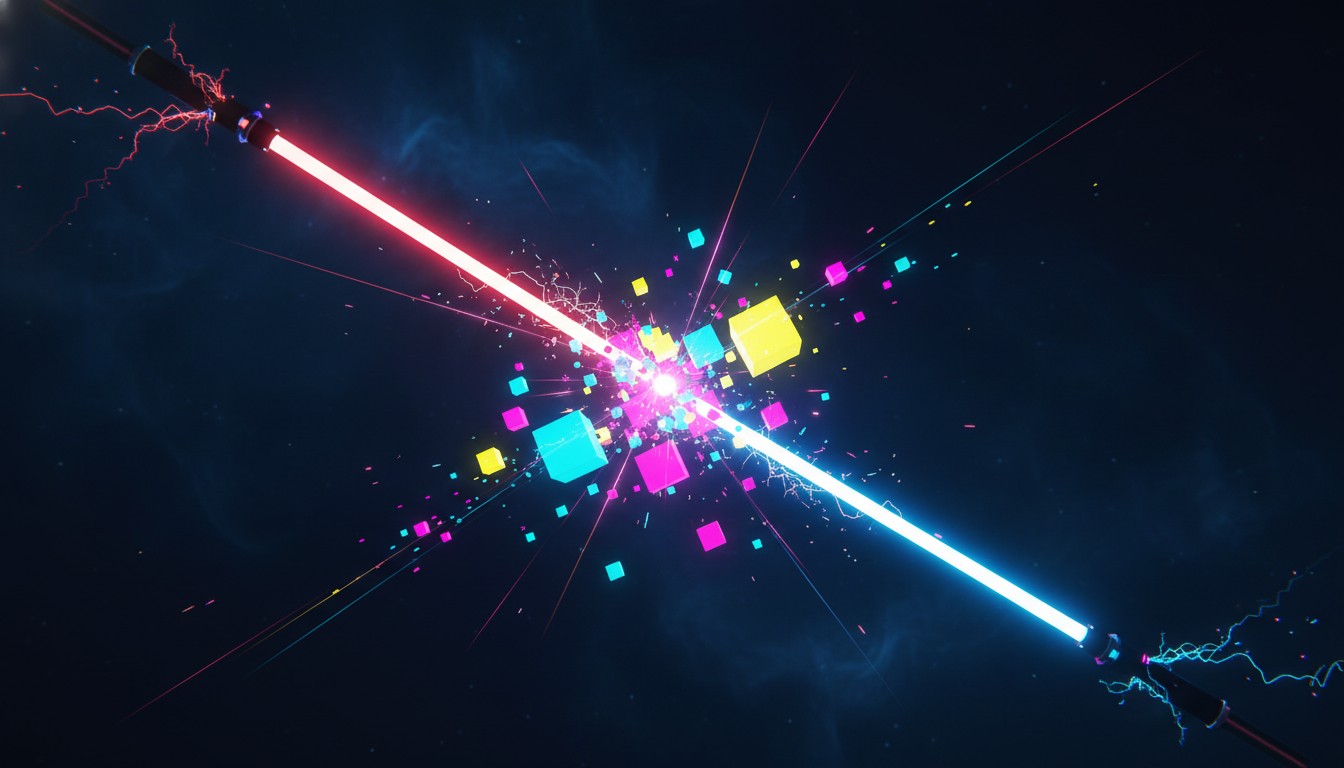
Beat Saber is still the game I point to when someone asks why VR isn’t a gimmick. Two lightsabers, blocks flying at you in time with the music, and a scoring system that rewards clean form as much as speed. The base tracks are good, the DLC has gotten ridiculous, and the mod scene on PCVR keeps the game alive years after release. On Quest it runs flawlessly. On PCVR it can be a visual spectacle. The Expert+ maps are genuinely athletic.
Precision makes it number one. The hit detection, the haptics, and the way the game reads a wrist flick versus a wild swing all add up to a feedback loop that’s hard to stop. I’ve lost evenings to this game without meaning to. That’s the test.
Read the full Beat Saber review
#2: Pistol Whip
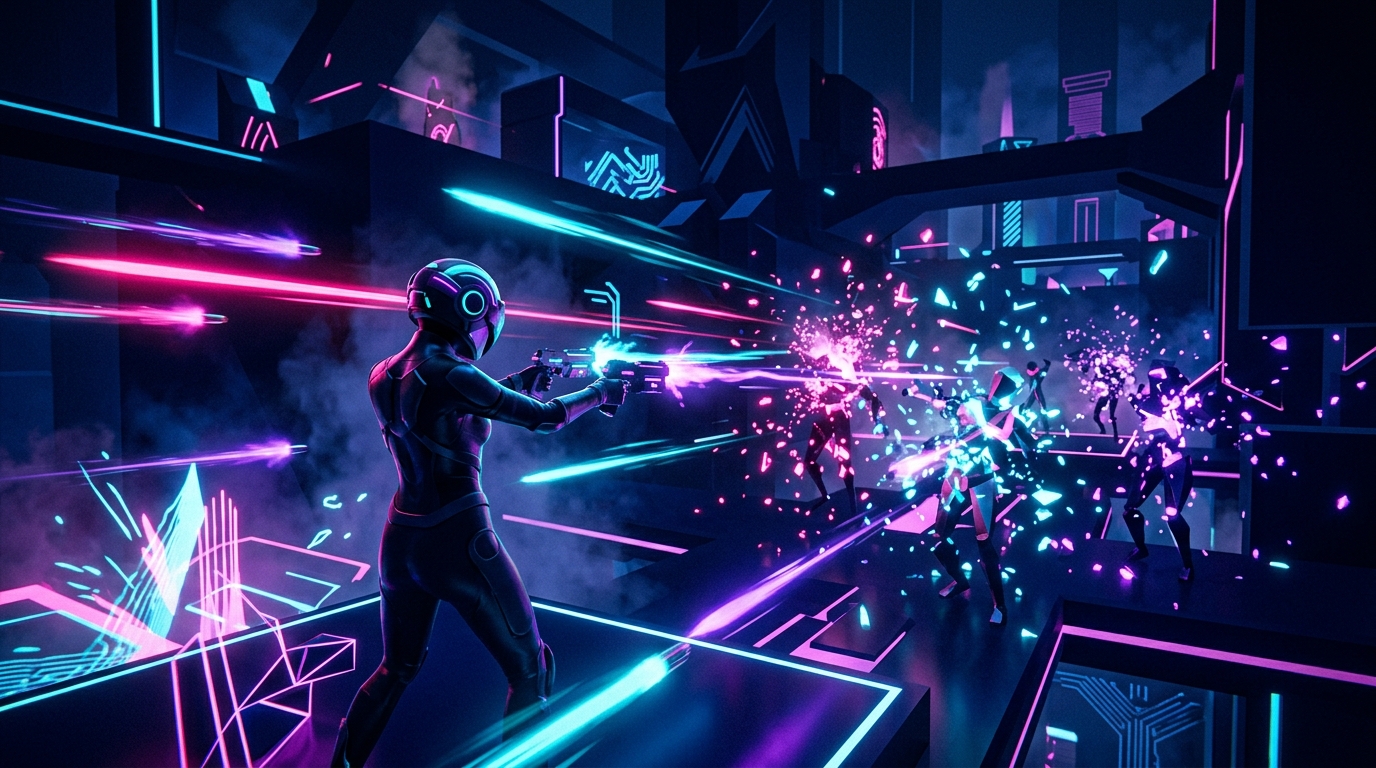
Pistol Whip sits at the intersection of rhythm game and rail shooter. The argument about which genre it really belongs to is part of why it works. You’re pulled through stylized corridors, shooting targets on the beat, dodging incoming fire, and occasionally pistol-whipping someone in the face because the music said so. The auto-aim is generous; the scoring is not. To rank high you have to shoot on beat, take risks, and move like the scene is choreographed.
The campaign structure gives it more legs than a simple song list. Each scene has a mood, a color palette, and a difficulty curve that teaches you the language of the game. It’s less physically exhausting than Beat Saber but just as compulsive. I usually recommend it to shooter fans who think they don’t like rhythm games.
Read the full Pistol Whip review
#3: Synth Riders
Synth Riders (2018)
Synth Riders is the beat-slasher for people who find Beat Saber too stiff. Instead of chopping blocks, you’re riding colored orbs with your fists, spinning through tunnels, and occasionally catching notes with both hands at once. The movement feels looser and more dance-like. The soundtrack leans into synthwave, electro, and electronic artists that feel like they were picked by someone who actually listens to the genre.
The custom song support and spin mechanics give it a distinct identity. It’s less about perfect precision and more about flow. On PCVR the visuals can get properly psychedelic. The Quest version sacrifices some of that, but the core loop survives intact. Beat Saber is a sport. Synth Riders is a club.
#4: Metal: Hellsinger VR
Metal: Hellsinger VR (2024)
Metal: Hellsinger was already a clever idea on flat screens: a first-person shooter where every shot, dash, and reload syncs to a metal soundtrack, and your damage spikes when you stay on beat. Put on a headset and that premise becomes physical. You’re not just tapping a key in time; you’re pumping shotguns, swinging a sword, and headbanging through hell while the HUD pulses around you.
The VR adaptation had some rough edges at launch — weapon positioning, comfort tuning, and the usual PCVR performance spread — but the underlying design is too good to ignore. When it clicks, you feel like the drummer and the lead guitarist in a demon-slaying band. It’s one of the few rhythm games that makes shooting feel musical instead of forcing music to act like gunfire.
#5: Ragnarock
Ragnarock (2021)
Ragnarock puts you at the front of a Viking longship, drumming to the beat so your crew rows faster. The drum pads are big, the haptics are heavy, and the soundtrack is a deliberate mix of folk metal, power metal, and sea-shanty energy that fits the theme perfectly. It’s one of the few VR rhythm games that builds a coherent world around the mechanic rather than decorating a note highway.
The multiplayer crew races are where it shines. Competing against other longships turns a solo drumming session into something social and a little ridiculous. The track list isn’t as deep as Beat Saber’s, but the identity outlasts most rhythm games I play.
#6: Against

Against cosplays as a noir action comic. You fight through hand-drawn cityscapes, punching, shooting, and dodging in time with the beat. The art style hooks you first — black-and-white panels with red splashes of violence, like Sin City drawn by someone who owns a Quest. Underneath the visuals, the gameplay is a hybrid of boxing, shooting, and rhythm timing that keeps you moving forward.
It’s not as mechanically deep as Beat Saber or Pistol Whip, and the campaign is short, but the style carries it. I would show Against to someone who cares more about vibe than leaderboards.
The replay value comes from chasing better scores, not from a mountain of content.
#7: Thumper
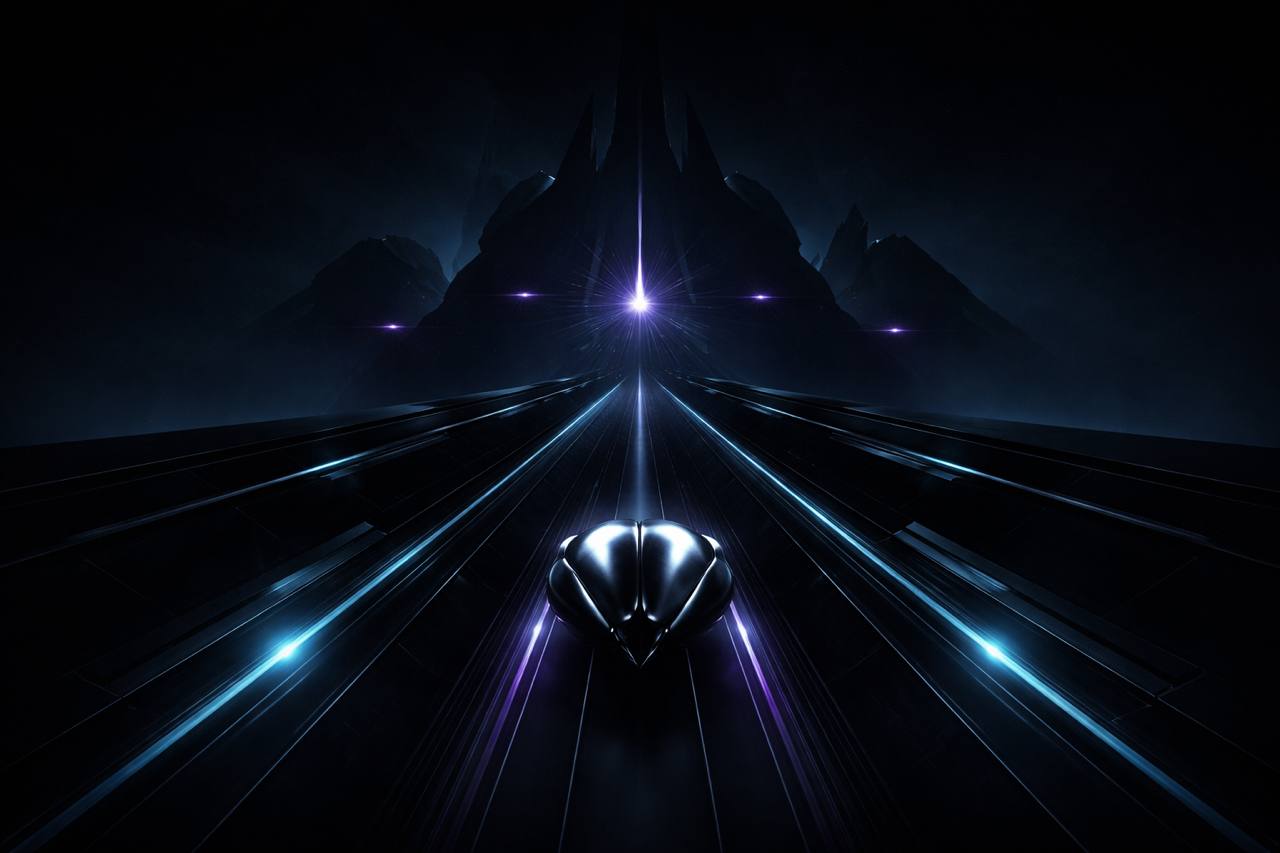
Thumper belongs here because it isn’t a traditional rhythm game. You guide a chrome beetle down a screaming neon track, hitting notes, turning corners, and slamming through bosses in a world that feels hostile and hypnotic. Put on a headset and the speed becomes overwhelming in the best way — the track wraps around you, the audio pounds from every direction, and the abstract horror of it all becomes physical.
It’s oppressive, loud, and deliberately stressful. Some people bounce off it immediately. Others can’t stop. I fall into the second camp. Thumper proves that rhythm games don’t need pop songs or dance moves to be effective — they need timing, tension, and a world that feels like it wants to eat you.
#8: Audica
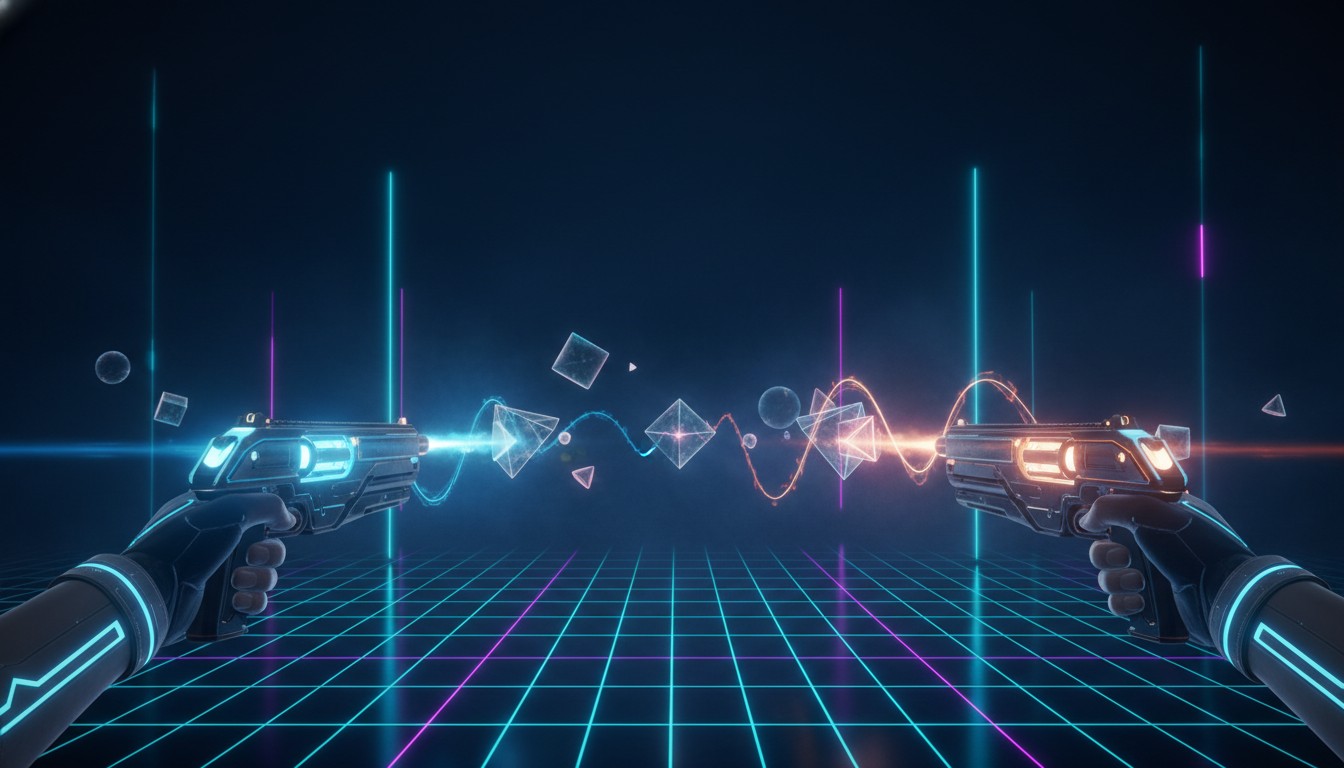
Audica comes from Harmonix, and it carries the DNA of Rock Band and Amplitude with it. Notes fly toward you from the distance, and you hit them with colored blasters — some require aiming, some require timing, some require both hands working in sequence. The shooting feels right, the soundtrack is curated with the usual Harmonix taste, and the difficulty curve is fair without being forgiving.
It never became the phenomenon Beat Saber did, partly because it launched earlier and partly because Beat Saber’s physicality is more instantly viral. To me, Audica is the tighter pure rhythm-shooter. The gunplay and the music are locked together in a way that feels designed, not bolted on.
#9: Rez Infinite
Rez Infinite has been slowly perfecting itself since 2001. The synesthesia concept finally makes complete sense in a headset: you fly through wireframe worlds, lock onto enemies, and fire pulses that become part of the soundtrack. The music builds as you play, the visuals pulse with the bass, and by the end of a good run you feel less like a player and more like a component in a breathing machine.
The VR mode is a feature, not the whole game, but it’s still the best way to experience Rez. Area X in particular — the new zone created for Infinite — justifies the price as a visual and auditory trip. It’s not the most physically active rhythm game on this list, but nothing else here pulls me out of my living room so completely.
Read the full Rez Infinite review
#10: Tetris Effect

Tetris Effect is Tetris with a rhythm-and-light show wrapped around it. Blocks fall, lines clear, and the music reacts to every move you make. The particle effects, the underwater stages, and the throat-tightening “Journey” mode all hit harder in a headset. It remains one of the best games ever made, and the audiovisual presentation turns a puzzle session into something closer to meditation.
The rhythm connection is looser here than in the rest of the list. You’re not hitting notes on a beat. The game clings to its soundtrack, and the VR version wraps around you instead of sitting in front of you. For relaxation over sweat, my pick is Tetris Effect, which rounds out the top ten without apology.
Read the full Tetris Effect review
#11: Maestro
Maestro (2024)
Maestro asks you to conduct a symphony with your hands. Notes stream toward a virtual orchestra, and you guide the tempo, cue sections, and shape dynamics with real conducting gestures. The idea is wildly specific, and I am still surprised the whole thing works. After a few songs you start to understand why conductors matter — the music genuinely responds to your timing and expression.
Conducting loses its novelty faster than slashing blocks, and the song library is limited compared to the bigger names on this list. Still, Maestro fascinates me as proof of what rhythm games can be when they leave the beat-saber template behind. I want more games to borrow from it.
#12: OhShape
OhShape (2019)
OhShape is what you get if you cross Beat Saber with Twister and a wall-smashing game show. Silhouettes fly toward you, and you have to match your body to the cutouts while also punching through colored panels. The result is silly, aerobic, and genuinely funny in a group. Watching someone contort to fit a shape has never failed to make me laugh.
The single-player mode is fine, but the real value is social. OhShape is a party rhythm game, not a serious score-chaser. The tracking demands can be finicky on older headsets, and the song list is thinner than the top-tier entries. Keep it around for guests, not for your daily workout.
#13: Dance Central
Dance Central (2019)
Dance Central in VR revives the Xbox Kinect franchise as a headset experience where you mirror a virtual dancer’s moves in a neon club. The choreography is real, the soundtrack is hits-heavy, and the presentation carries the gloss I expect from Harmonix. On paper it ranks as the strongest VR dance game.
In practice, the Quest exclusivity and reported server-side features have made its long-term status shaky. The version that exists is good — probably still the best pure dance instruction in VR — but it’s hard to recommend without caveats about availability and whether the social features you remember are still alive. Owners should keep playing. New buyers should check current store status first.
#14: Smash Drums
Smash Drums (2021)
Smash Drums is VR drumming with a rock-and-roll attitude. You sit behind a kit and bash through songs on a stage, complete with crowd noise and pyrotechnics. The drumming mechanics hold up, the haptics make hitting a crash cymbal land, and the track selection leans toward guitar-heavy rock that fits the fantasy.
It doesn’t reach the same heights as Ragnarock because the identity is less distinctive and the song library is smaller. As a pure drum simulation in VR, it gets the job done and it can be fun. Good for players who specifically want to hit things with sticks rather than swing sabers or shoot pistols.
#15: Samba de Amigo: Virtual Party
Samba de Amigo: Virtual Party (2023)
Samba de Amigo: Virtual Party brings Sega’s maraca-shaking arcade franchise into VR, and the physical comedy of shaking two controllers in time lands immediately. The maraca detection forgives more than you’d expect, the music is upbeat and party-ready, and the virtual-party framing makes it clear this is meant for groups.
Longevity drags it down. The maraca mechanic is shallow compared to the precision games higher on the list, and the track list hasn’t kept pace with competitors. It works as a thirty-minute party starter, not as a game you’ll grind for weeks. I ranked it last because it does less with the rhythm-VR formula than the rest, not because it’s bad.
Honorable Mentions
These didn’t make the cut, but they’re worth knowing about.
Audio Trip — A dance-focused rhythm game with choreographed full-body movement. Rougher around the edges than the top tier, but the ambition is admirable.
Drums Rock — Another VR drumming option with a rock soundtrack. Competent, but Smash Drums and Ragnarock cover the same ground more memorably.
Unplugged — Air guitar via hand tracking on Quest. Clever idea, inconsistent tracking, and a love-it-or-hate-it premise.
Electronauts — More musical instrument than game, letting you remix tracks live in VR. Great for creative players, not for score-chasers.
PianoVision — A piano trainer, not a game. Useful if you own a real keyboard and want to learn in VR, but outside the scope of a rhythm-games ranking.
The list was built from time in the headset, not from store ratings. Rankings reflect VR-specific design, replay value, and how well each game turns music into physical play. For more on how we evaluate VR games, see our review methodology.