
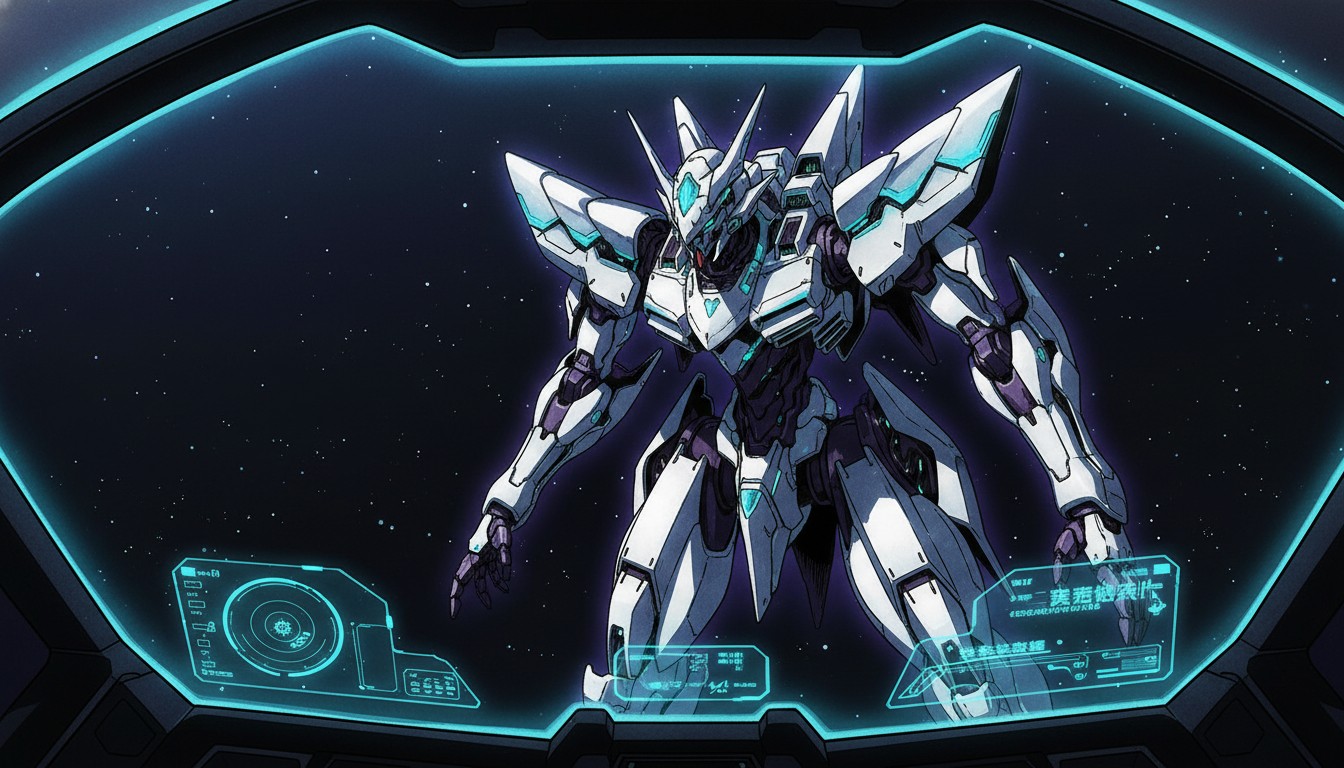
The first time you look down and see Jehuty’s control panels wrapping around your legs, you get it. This is what Zone of the Enders was always supposed to feel like. Not watching a tiny mech from above, but sitting inside it, staring through the windshield as homing lasers streak past your face and enemy orbital frames explode against your canopy. Konami’s official VR mode for Zone of the Enders: The 2nd Runner M∀RS understands the fantasy completely. Whether it delivers on it is another question.
Here’s what you’re actually getting: the entire game — not a demo, not a side mode, the full campaign — playable from a first-person cockpit view. On PC VR and the original PSVR, you can strap in and experience every mission, every boss fight, every melodramatic cutscene from Jehuty’s pilot seat. On PSVR2, you can’t. Konami never updated the game for Sony’s newer headset, and PSVR2’s lack of backward compatibility means this is effectively a dead title on current PlayStation hardware. If you own a PSVR2 and were hoping to pilot Jehuty on your new kit, you’re out of luck. That alone reshapes who this article is for.
Assuming you’re on PC VR or still holding onto a PSVR1, the experience opens strong.
The Cockpit Fantasy, Delivered
The cockpit is detailed and surprisingly readable — you can see Jehuty’s arms respond to your inputs, the holographic HUD projects enemy positions in true 3D space, and the sense of scale when a boss frame fills your viewport is genuinely arresting. Konami didn’t half-ass the presentation; this feels like a mode designed by people who understood why someone would want to play this game in VR.
When Speed Breaks the Spell
But the fantasy starts fraying the moment the action picks up. The 2nd Runner is a fast game. Dashing, boosting, spinning, and target-switching across a 3D battlefield at arcade speeds. In the original third-person view, you track your mech and the camera independently. In VR, you’re locked to the cockpit, and the battlefield becomes a blur of particle effects and sudden direction changes. Konami added a holographic Jehuty projection to help with spatial orientation — a small wireframe model in the corner showing your mech’s position relative to the camera — and you’ll need it. Without that aid, tracking your own movement while simultaneously reading enemy tells and managing subweapon selection is genuinely disorienting.
The combat demands your eyes stay forward. But some of the UI — subweapon selection, energy management, lock-on indicators — pulls your attention to the edges of the cockpit display. In flat mode, you glance at a corner of the screen. In VR, you physically turn your head away from the fight to read a number. It doesn’t ruin the experience, but it adds friction that flat mode doesn’t have.
Built Around the Game, Not Through It
Then there are the cutscenes. Every story beat — and this is a Hideo Kojima production, so there are many — plays on a small virtual screen floating in front of you. Not immersive cinema, not even a decent virtual theater. A floating rectangle that snaps you out of the cockpit and reminds you that Konami built this mode around the game, not through it. You can skip them, of course, but if you’re here for the narrative, the presentation is jarring. One minute you’re inside a war machine breathing recycled air; the next you’re watching anime on a plane.
A 2003 Engine in 2018
Performance is the bigger concern. The Steam version carries “Mostly Positive” reviews overall, but recent feedback trends mixed, and VR players in particular have reported rough frame pacing even on capable hardware. This is a 2018 remaster of a 2003 game built on an engine that predates modern VR pipelines. It runs, but it doesn’t run well consistently. Frame drops in a cockpit mech game aren’t just annoying — they’re uncomfortable. Your brain expects smooth motion when the horizon is tilting at boost speed, and when the delivery stutters, so does your stomach.
The visual presentation is similarly uneven. Character models and mech designs by Yoji Shinkawa hold up beautifully — seeing Jehuty’s detailed frame in true scale is one of the mode’s undeniable highs. But environments betray the game’s PS2 roots: flat textures, simple geometry, and bland skyboxes that look serviceable on a monitor but expose their age when wrapped around your peripheral vision. It’s not ugly, but it’s not convincing either. You’re inside a beautiful cockpit looking out at an okay battlefield.
Control-wise, the game expects a gamepad. There are no motion controls, no hand tracking, no gesture-based weapon selection. You play with a standard controller — DualShock, Xbox pad, whatever you’ve got — and the game maps Jehuty’s complex input scheme to it. That works fine. The original game was designed for a gamepad, and translating that to VR doesn’t create new problems. But it also doesn’t create new possibilities. You’re not reaching out to grab controls or flipping switches. You’re holding a plastic controller and watching your on-screen hands respond. Functional, not transformative.
Konami added a “VR Mode” difficulty setting that simplifies some mechanics — stronger auto-lock, more forgiving energy management — which helps when the added intensity of first-person combat overwhelms the original balance. It’s a thoughtful inclusion, though it raises the question of whether the VR mode was properly tuned at all. A dedicated difficulty for your own official VR implementation suggests the team knew the transition was rough around the edges.
Who This Is For
So who is this for? If you already love The 2nd Runner, if you’ve memorized the boss patterns and can quote the dialogue, the cockpit mode is a fascinating alternate lens. It doesn’t replace the original experience — the third-person view remains the optimal way to play at high level — but it offers something no mod could: an officially built, fully playable mech cockpit that works from start to finish.
If you’re a VR-first player looking for a great mech combat experience, though, the case is harder to make. The performance issues, the dated environments, the floating-screen cutscenes, and the complete absence of PSVR2 support all point to a mode that Konami shipped and moved on from. There’s no indication of active support, no patches on the horizon, no community modding scene picking up the slack. What exists is what you get.
That leaves this in an odd place: a genuinely cool official VR mode for a genuinely great game, wrapped in enough technical baggage that recommending it without reservation feels dishonest. I wanted to love this. I wanted to tell every mech fan to buy it immediately. But the truth is messier. It’s thrilling when the frame rate holds, frustrating when it doesn’t, and completely inaccessible if you’re on modern PlayStation hardware. A perfect idea, imperfectly executed, quietly abandoned.
For PC VR owners with a tolerance for retro visuals and occasional stutter, it’s worth experiencing — especially on sale. For everyone else, including every PSVR2 owner reading this, it’s a reminder that sometimes the mech cockpit of your dreams is locked behind hardware that no longer exists.