
The Legend of Zelda in VR: The Foundation of Action-Adventures Reborn in 3D
The Legend of Zelda didn’t just launch a franchise—it established the entire vocabulary of action-adventure games. When Miyamoto and his team at Nintendo crafted this Famicom Disk System title in 1986, they created something unprecedented: a nonlinear overworld to explore, dungeons to conquer, items to discover, and secrets hidden behind bombable walls and burnable bushes. It was the first console game with battery save functionality, and it remains one of the most influential designs in gaming history.
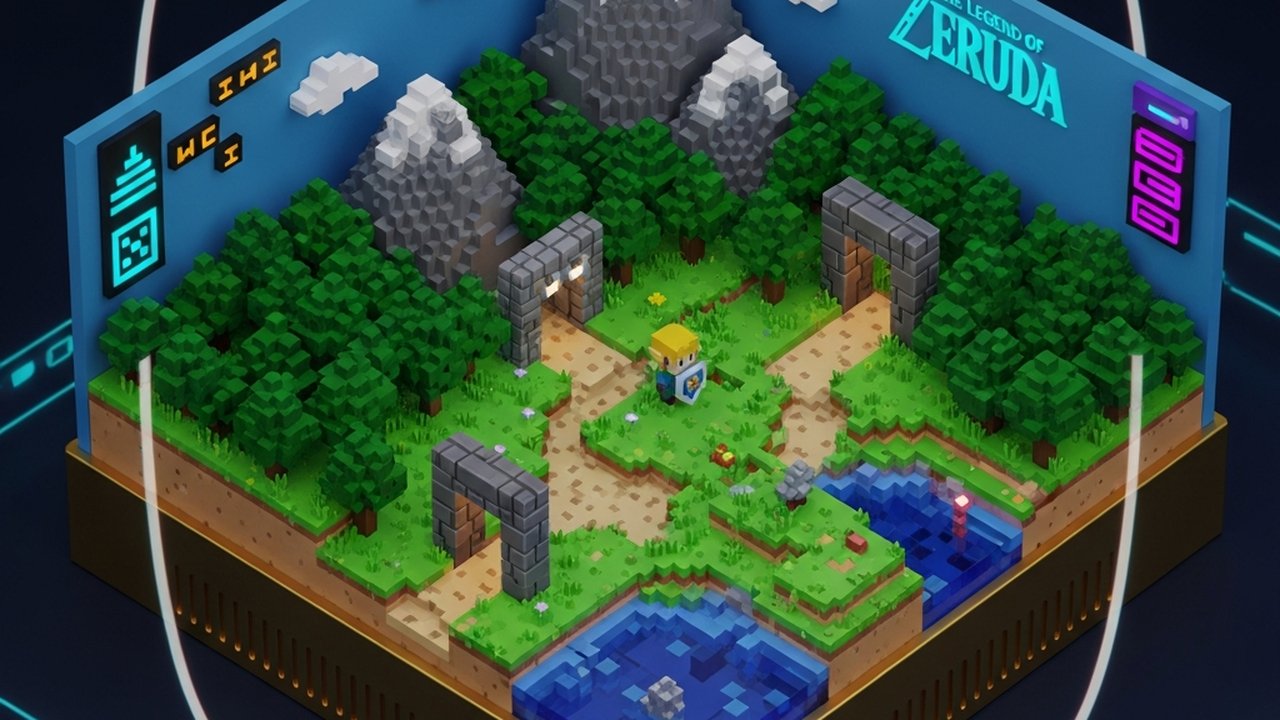
Playing the original Zelda in VR through 3dSen VR creates something remarkable. The top-down perspective that once flattened Hyrule into a map-like abstraction now gains genuine depth. Mountains rise. Dungeons descend. The voxel transformation doesn’t just add novelty—it fundamentally alters how you perceive space in a game where spatial awareness has always been everything.
This guide covers every viable VR option for experiencing the game that started it all.
VR Routes Comparison
| Route | Platform | Experience Type | Setup Difficulty | Cost | Best For |
|---|---|---|---|---|---|
| 3dSen VR | PCVR | Voxel diorama | Easy | $24.99 | The definitive 3D Zelda experience |
| 3dSen VR MR | Quest | Mixed reality diorama | Easy | $24.99 | Playing Zelda in your actual room |
| EmuVR | PCVR | Virtual retro bedroom | Medium | Free | Nostalgia, authentic CRT experience |
What VR Routes Exist
3dSen VR — Voxel Transformation
3dSen VR is a specialized NES emulator that converts classic 2D games into explorable 3D voxel environments. It’s not stereoscopic 3D—the game’s sprites, backgrounds, and objects are algorithmically extruded into actual 3D geometry.
For The Legend of Zelda, this transformation is particularly effective:
- The overworld gains genuine elevation—mountains become peaks you can visually appreciate
- Dungeons develop cavernous depth—the flat labyrinths become layered spaces
- Water, trees, and rocks gain dimensional presence
- Link, enemies, and items exist as actual 3D models in space
The game plays identically to the NES original—the puzzles, combat, and exploration are untouched—but the visual presentation fundamentally changes how you perceive the space you’re navigating.
3dSen VR Mixed Reality — Hyrule in Your Living Room
This uses the same voxel engine as standard 3dSen VR, but experienced through Quest’s passthrough cameras. The game world appears floating in your actual room, with your real walls and furniture visible behind and around the diorama.
The effect is striking—you’re sitting in your physical space, but there’s a miniature Hyrule growing out of your coffee table. You can walk around it, lean in close to examine dungeon layouts, or let it fill your view. It’s the same game, but the spatial placement creates a magical object quality that full VR doesn’t quite capture.
EmuVR — The Authentic 90s Bedroom
EmuVR takes a completely different approach. Rather than transforming the game itself, it transforms your environment into a virtual 80s/90s bedroom complete with a CRT television, NES console, and game cartridges.
You physically pick up The Legend of Zelda cartridge, insert it into the NES, grab the controller, and play on a virtual CRT with authentic scanlines, shadow masks, and phosphor glow. The game itself remains purely 2D, displayed on a screen in virtual space.
This route prioritizes nostalgia for the experience of playing retro games rather than transforming the games themselves. For Zelda specifically, there’s something fitting about experiencing it this way—the original game was designed for that exact context: a child in a bedroom, hunched close to a CRT, map drawn on graph paper beside them.
How 3dSen VR Plays
The core question for any flat-to-VR conversion: does it preserve what made the original special while justifying the VR overhead?
For 3dSen VR’s Legend of Zelda implementation, the answer is a clear yes.
The Voxel Advantage
Top-down games benefit disproportionately from 3dSen’s voxel conversion. Where side-scrollers gain visual polish, top-down adventures gain spatial comprehension. The original Zelda’s overworld is a maze of identical-looking screens—knowing where you are and where you’re going has always been part of the challenge.
The voxel transformation makes this easier and more satisfying:
- Mountains and lakes have actual elevation, creating visual landmarks
- Dungeon rooms gain depth—you can see the walls rising around you
- Different terrain types (forest, graveyard, desert) develop distinct visual profiles
- The sense of scale shifts from “map representation” to “actual world”
Reviewers have noted the resemblance to 3D Dot Game Heroes, the PlayStation 3 title that paid homage to the original Zelda with voxel graphics. Playing Zelda in 3dSen VR achieves something similar: the same fundamental experience, but with dimensional depth that makes it feel contemporary without losing its retro soul.
Controls and Input
3dSen VR is not a native VR action-adventure—you’re not swinging the sword with motion controls or physically reaching for items. You play with a gamepad (or keyboard), just as you would with any emulator.
The VR value comes from:
- The visual presentation
- The ability to position yourself at the “perfect” viewing angle
- The sense of presence within Hyrule’s world
- Optional mixed reality mode that places the game in your real environment
If you were hoping for motion-controlled Zelda combat, this isn’t that. Think of it as the definitive way to play the original, not a VR reinterpretation.
Viewing Modes
3dSen VR offers several ways to experience the game:
Classic View: Positioned at a comfortable distance, similar to playing on a screen, but with genuine 3D depth
Immersive View: Closer to the action, filling more of your field of view
Free Camera: Unlocked viewing angles—examine the world from any position (great for appreciating the voxel geometry, less practical for actual gameplay)
Mixed Reality: On Meta Quest, you can place the game world in your actual room using passthrough
Performance and Stability
The Legend of Zelda runs flawlessly in 3dSen VR. This is emulation of a nearly 40-year-old 8-bit game—performance demands are minimal. Even modest PCVR setups handle it without issue. The emulator itself is stable, with regular updates from an active developer who has supported the project since 2015.
How 3dSen VR Mixed Reality Plays
The mixed reality mode deserves special attention because it genuinely changes the experience from “playing a VR game” to “having a magical object in your room.”
The Spatial Effect
In MR mode, the game world appears as a physical diorama in your real space. You can place it on a table, let it float in front of you, or scale it to fill your room. The passthrough cameras keep your real environment visible, creating a fascinating blend of familiar domestic space and impossible digital object.
For Zelda specifically, this creates an interesting dynamic—you’re exploring a vast world, but it exists as a contained object in your space. The contrast between the epic adventure and the miniature presentation is part of the charm.
Practical Benefits
- Comfort: Some users find MR more comfortable than full VR because they retain spatial awareness of their real room
- Social: Others can see you and the game world simultaneously
- Multitasking: Easy to pause and interact with your real environment without removing the headset
- Reference: Having the game world visible while consulting guides or maps on another device
Limitations
Passthrough quality depends on your Quest model. Quest 3’s color passthrough looks significantly better than Quest 2’s grayscale. Lighting in your room affects how well the passthrough cameras work.
How EmuVR Plays
The EmuVR experience is entirely different. You’re not playing a transformed game—you’re recreating the ritual of retro gaming.
The Virtual Bedroom
EmuVR places you in a customizable 80s/90s bedroom. You can decorate with posters, change the wood paneling, arrange furniture, and set up multiple consoles. For The Legend of Zelda, you’ll be interacting with a virtual NES.
The physicality is the point:
- Browse cartridges on shelves or in boxes
- Pick up the gold Legend of Zelda cart and examine the label
- Insert it into the NES (with authentic insertion feel)
- Power on the console
- Grab a virtual controller (or use your real gamepad)
- Play on a CRT with authentic scanlines, curvature, and phosphor glow
The Emulation Backend
EmuVR uses RetroArch for actual emulation, meaning accuracy is excellent. The Legend of Zelda runs exactly as it would on accurate NES hardware. The visual quality is determined by the virtual CRT settings—you can adjust scanlines, curvature, shadow masks, and other retro display characteristics.
Multiplayer and Social Features
One of EmuVR’s unique strengths is netplay. You can invite friends to your virtual bedroom, and everyone sees the same screen. For Zelda, this means taking turns exploring dungeons, watching friends attempt the final Ganon confrontation, or simply sharing the nostalgia of experiencing a classic together.
What Works Well
3dSen VR:
- Top-down games benefit disproportionately from voxel conversion
- The overworld feels genuinely expansive with dimensional depth
- Dungeons gain atmosphere from the cavernous presentation
- Performance is flawless on any VR-capable system
- Mixed reality mode on Quest adds genuine novelty
- Developer actively supports the game with regular updates
- Zelda II also supported for the complete NES experience
3dSen VR Mixed Reality:
- The spatial placement makes the game feel like a collectible diorama
- More comfortable for some users than full VR
- Easy to integrate with real-world activities
- Social visibility (others can see your headset and game simultaneously)
- Unique “toy in your room” feeling suits the adventure theme
EmuVR:
- Unmatched nostalgia for the retro gaming experience
- The gold Zelda cartridge is iconic—seeing it virtually recreated has appeal
- Authentic CRT emulation with extensive customization
- Multiplayer “couch co-op” in VR with friends
- Free to download and use
- Supports the full RetroArch library (thousands of games)
- Regular updates and active community
What Doesn’t Work
3dSen VR:
- Requires gamepad play—not motion controlled
- $24.99 purchase (though frequently on sale)
- You must provide your own ROMs (legal gray area)
- Not actually “inside” Zelda—you’re viewing a 3D diorama
- The top-down camera means you’re looking down on the world, not standing in it
3dSen VR Mixed Reality:
- Passthrough quality varies by headset (Quest 2 = grayscale/low res)
- Still requires gamepad, not motion controls
- Room lighting affects passthrough performance
- Can feel less immersive than full VR mode
EmuVR:
- Game remains 2D—you’re playing on a virtual screen
- Setup is more complex than 3dSen
- Requires ROM management and RetroArch configuration
- No actual 3D transformation of the games
- PCVR only—no standalone Quest support
The Comparison: Which Route for Which Player?
Best Overall Experience: 3dSen VR
For most users wanting to play the original Legend of Zelda in VR, 3dSen VR offers the best balance of polish, ease of use, and transformative visual appeal. The voxel diorama is technically impressive, and for top-down games specifically, it enhances rather than merely alters the experience.
Best for Mixed Reality Enthusiasts: 3dSen VR MR Mode
If you specifically want to see Hyrule floating in your living room, this is your route. The passthrough integration is well-executed, and the “adventure diorama” feeling is unique.
Best for Nostalgia Purists: EmuVR
If what you miss is the ritual of retro gaming—the gold cartridge, the CRT, the physicality of the experience—EmuVR delivers. It’s free, authentic, and social.
Who This Is For
3dSen VR is perfect for:
- Zelda fans who’ve played the original and want to see it transformed
- VR enthusiasts looking for unique experiences that justify the hardware
- Players who appreciate how top-down games benefit from dimensional depth
- Anyone with a Meta Quest who wants mixed reality gaming
- Those who want the “definitive” way to replay the original NES classic
3dSen VR Mixed Reality is perfect for:
- Users who find full VR uncomfortable or disorienting
- People who want to integrate VR into their real environment
- Social gamers who want visibility with others in the room
- Anyone who loves the “magical object” aesthetic
EmuVR is perfect for:
- Retro gaming collectors who want to recreate their childhood setup
- Players who value authenticity over transformation
- Groups of friends who want to hang out and experience classics together
- Anyone building a comprehensive retro gaming library across multiple systems
None of these are for:
- Players seeking native VR action-adventure with motion controls (no official solution exists)
- Those who want modernized graphics or gameplay (these are still the original game)
- Players unwilling to source their own ROMs (where required)
- Users sensitive to motion sickness
The Verdict
Tier: A
Game Quality: A+ The original Legend of Zelda remains one of the most perfectly designed games ever created. Its nonlinear exploration, dungeon structure, item progression, and sense of discovery established templates that the series—and the entire action-adventure genre—still follows today. The first quest offers dozens of hours of exploration. The second quest remixes everything for veterans seeking greater challenge. This is not nostalgia talking—the game is still genuinely compelling nearly four decades later.
3dSen VR Implementation Quality: A The voxel transformation is technically impressive and particularly well-suited to top-down games. Where side-scrollers gain polish, Zelda gains spatial comprehension. The overworld feels more navigable. Dungeons feel more atmospheric. The developer has clearly given this profile specific attention, and it shows.
EmuVR Implementation Quality: B+ EmuVR succeeds at its stated goal: recreating the retro gaming experience. The virtual bedroom, physical interactions, and CRT emulation are excellent. For Zelda specifically, however, the lack of 3D transformation means you’re playing on a very fancy virtual screen—which is still cool, but less transformative than 3dSen’s approach.
Overall Tier: A
The Legend of Zelda in 3dSen VR represents flat-to-VR conversion at its best for the top-down genre. The voxel transformation doesn’t just add novelty—it enhances spatial awareness in a game where understanding the space you’re navigating has always been central to the experience. Seeing the overworld with actual elevation changes, or descending into dungeons that feel genuinely cavernous, recaptures some of the discovery that players felt in 1986.
For the price of a few lattes, you can experience one of gaming’s most important titles in what may be its definitive form. The original Zelda was already timeless. In 3dSen VR, it becomes something else entirely: the same foundational adventure, but viewed through a lens that makes its achievements even more apparent.
Whether you choose the dimensional diorama of 3dSen, the spatial novelty of mixed reality, or the nostalgic ritual of EmuVR, there’s a VR experience suited to how you want to return to Hyrule.
The kingdom has never looked better.