Zelda II: The Adventure of Link in VR: The Side-Scrolling Black Sheep Gets a Third Dimension
Zelda II: The Adventure of Link has always been the outlier. While every other mainline Zelda game follows the top-down or 3D action-adventure formula, this 1987 NES release went sideways — literally. Side-scrolling combat, an RPG leveling system, and a difficulty curve that makes Dark Souls look forgiving. It’s the black sheep, the controversial one, the game that split the fandom.
Now, through 3dSen VR, you can experience this divisive classic in virtual reality. But is that experience worth seeking out?
What This VR Option Actually Is
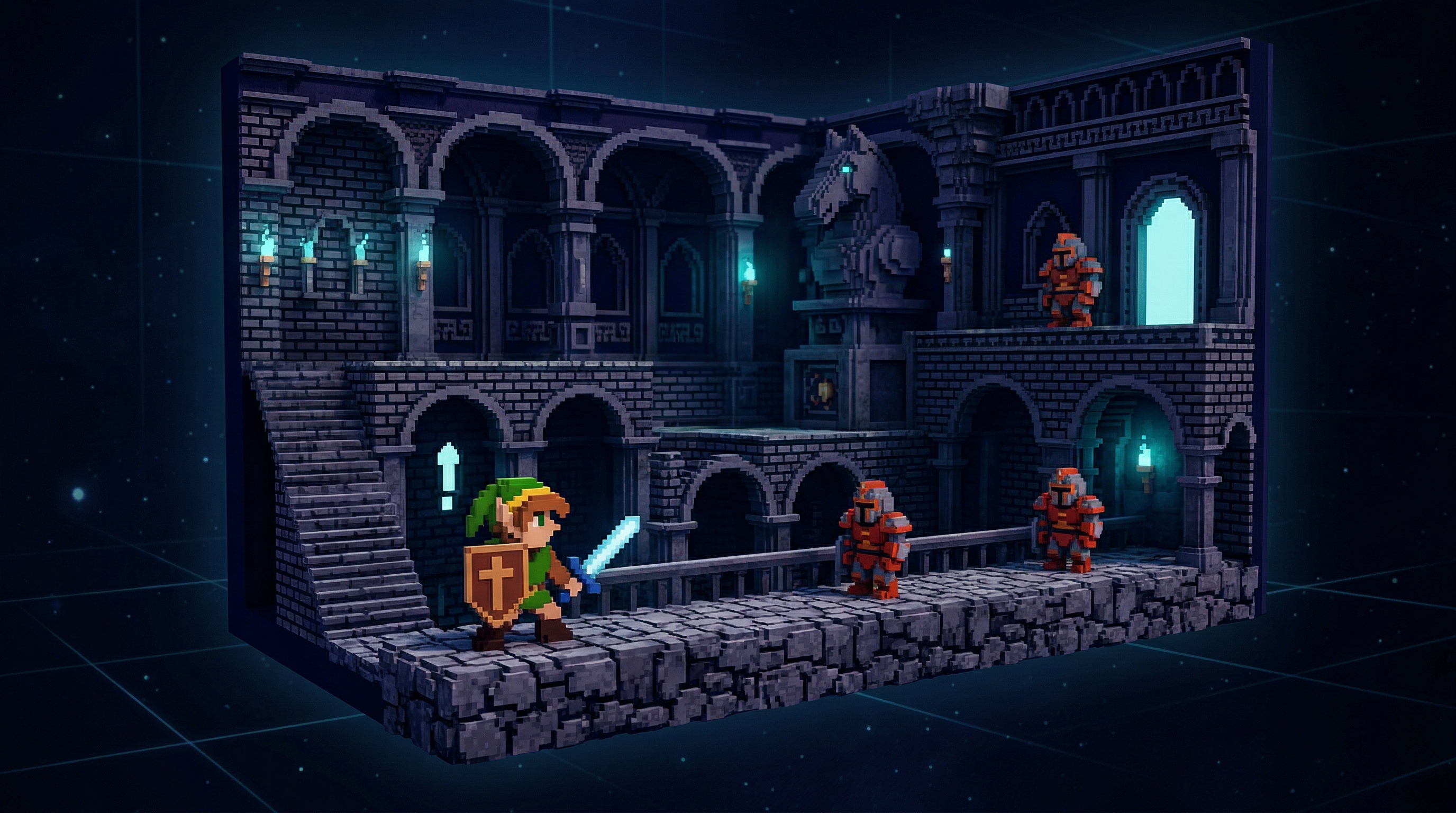
Zelda II in VR runs through 3dSen VR, a unique emulator that transforms flat NES games into playable 3D voxel dioramas. This isn’t a native VR port or a traditional emulator — it’s a real-time 2D-to-3D conversion engine that rebuilds NES graphics as voxel environments.
For Zelda II, this means:
- The side-scrolling action becomes a 3D stage you can view from multiple angles
- Characters and enemies exist as voxel figures rather than flat sprites
- You can zoom in, out, and tilt the camera to find your preferred perspective
- The overworld map retains its top-down view but gains 3D depth
3dSen VR requires a PC VR setup (SteamVR-compatible) and your own legally-obtained NES ROM. The emulator itself is available on Steam and supports a growing list of NES titles with custom 3D profiles.
What it provides:
- Stereoscopic 3D with head tracking
- Full camera control around the voxel scene
- Save states and rewinds (optional)
- Multiple skybox/environment options
What it doesn’t provide:
- Motion controls — you play with a gamepad
- VR-native UI — menus are flat and minimal
- Any modifications to the original game design
How It Plays
Controls
Zelda II in 3dSen VR is played with a standard gamepad. There’s no motion controller support — this is classic NES gameplay with a VR viewing window. You’re controlling Link through precise sword jabs, shield blocks, and platforming jumps, but you’re doing it with a traditional controller while the 3D world floats before you.
The control scheme maps naturally:
- D-pad for movement
- Face buttons for sword attack, jump, and magic
- Shoulder buttons for shield positioning
The VR aspect is purely visual. You’re not reaching out to grab items or swing a sword — you’re watching the action unfold in 3D space while controlling it conventionally.
Comfort
This is where 3dSen VR shines. Side-scrolling games in VR could easily cause motion sickness, but 3dSen solves this elegantly:
The game world is stationary. You’re viewing a fixed diorama that doesn’t move around you. The camera stays stable unless you move it yourself. There’s no artificial locomotion, no sudden perspective shifts, no VR-induced motion at all.
You control the viewpoint. Zoom in for detail, zoom out for the full stage, tilt to see around obstacles. If something feels disorienting, you can adjust until it doesn’t. The voxel world stays put while you find your comfort zone.
A 2D mode is available. If the 3D transformation ever causes discomfort, you can switch to a flat 2D display within VR — essentially playing the original game on a virtual screen.
For most players, Zelda II in 3dSen VR will be comfortable to play for extended sessions. The fixed viewpoint and lack of artificial movement make it one of the more VR-friendly ways to experience classic games.
Performance
3dSen VR is extremely lightweight. The voxel conversion happens in real-time, but NES graphics are simple enough that any modern VR-capable PC will run this without issue. There’s no performance difference between playing Zelda II and any other NES game in the emulator — the technical demands are minimal.
If your system can run SteamVR, it can run this.
Stability
The emulator itself is stable and mature. 3dSen has been in development for years, and the VR version is a polished product on Steam. Zelda II is well-supported within the emulator’s game profiles.
Save states work reliably. Rewind features are available if you want to mitigate the game’s notorious difficulty. There are no crashes or game-breaking bugs to worry about.
What Works Well
The voxel transformation is visually impressive. Seeing Zelda II’s side-scrolling environments rebuilt as 3D dioramas gives the game a tangible, toylike quality. Link, enemies, and environmental elements gain real presence. The transformation isn’t just a visual gimmick — it changes how you perceive the game world.
Camera control adds strategic value. Being able to tilt and zoom the view helps with platforming sections and combat encounters. You can peek around foreground elements and get a better sense of spatial relationships in complex rooms.
Comfort is excellent. The fixed-world approach means no motion sickness, even for VR-sensitive players. This is one of the most comfortable ways to play classic games in VR.
Setup is straightforward. 3dSen VR is on Steam. Provide a ROM, launch the game, enter VR mode. No complex configuration required.
The original game’s strengths remain. Zelda II’s combat system — with its high/low blocking, precise sword work, and advanced techniques like downthrust and upthrust — is still satisfying. The RPG leveling gives you meaningful progression. The soundtrack is legendary.
What Doesn’t Work
The game is still brutally difficult. 3dSen VR doesn’t change Zelda II’s core design. The game features:
- Punishing enemy placement
- Limited continues that send you back to the start
- Experience points lost on death
- Cryptic progression that requires guides or trial-and-error
- The infamous final palace and Thunderbird boss
VR doesn’t make any of this easier. If anything, it makes the challenge more immediate and personal.
No VR-native features. This isn’t a VR game — it’s a NES game viewed through a VR window. There’s no hand presence, no sword swinging, no motion-based interaction. You’re a spectator to the voxel diorama, controlling it with a gamepad.
Dated design elements. Zelda II’s 1987 design shows its age:
- No in-game map
- Limited save system (in original form)
- Grinding required for level-ups
- English localization issues that obscure hints
- Required spells that are easy to miss
Side-scrolling limits VR’s impact. While the voxel transformation is cool, side-scrolling games gain less from VR transformation than top-down games. You’re still viewing action from the side — the 3D depth is pleasant but not transformative.
No Quest native version. 3dSen VR requires PC VR and SteamVR. Quest users need a PC VR connection via Virtual Desktop or similar.
Platform Differences
PCVR (SteamVR): Primary platform. Full feature set, stable performance, straightforward setup.
Quest (via PC VR streaming): Works through Virtual Desktop or similar. The pass-through AR mode lets you project the game into your real environment. Requires a capable PC and good network connection.
There’s no native Quest standalone version. This is PC VR only.
Who This Is For
Good for:
- NES enthusiasts curious about VR transformation of classic games
- Zelda completionists who want to experience the black sheep in a new way
- Players who enjoy challenging retro games
- VR users seeking comfortable, low-motion experiences
- Anyone interested in emulation and preservation
Not for:
- Players frustrated by difficult retro games
- Those expecting motion controls or VR-native interaction
- People who don’t already own or want to obtain NES ROMs
- Players seeking a traditional Zelda adventure — this isn’t it
The Verdict
Tier: B
Game Quality: B Zelda II is a fascinating historical artifact — a bold experiment that divided the Zelda fanbase. The combat system has genuine depth, the RPG elements add meaningful progression, and the challenge is real. But dated design, cryptic progression, and brutal difficulty limit its appeal to modern players. It’s a “good” NES game, not a great one, and its reputation as the series black sheep is earned.
VR Implementation Quality: A For what it is — a VR viewing window for NES games — 3dSen VR is excellent. The voxel transformation is visually impressive, the camera controls work well, comfort is top-tier, and setup is painless. Side-scrolling games gain less from VR than top-down titles, but the implementation is as good as it could be.
Overall Tier: B The product of game and VR implementation: a compelling but niche experience. If you’re curious about Zelda II and have VR hardware, this is a novel way to play it. The voxel diorama view adds a tangible quality that makes the 1987 adventure feel more present. But if you’re not already interested in this notoriously difficult NES game, VR won’t change your mind.
3dSen VR makes Zelda II more interesting to look at. It doesn’t make it easier to love. For NES enthusiasts and Zelda historians, this is a worthwhile experience. For everyone else, it’s a curiosity — an impressive technical demonstration wrapped around a divisive classic.