
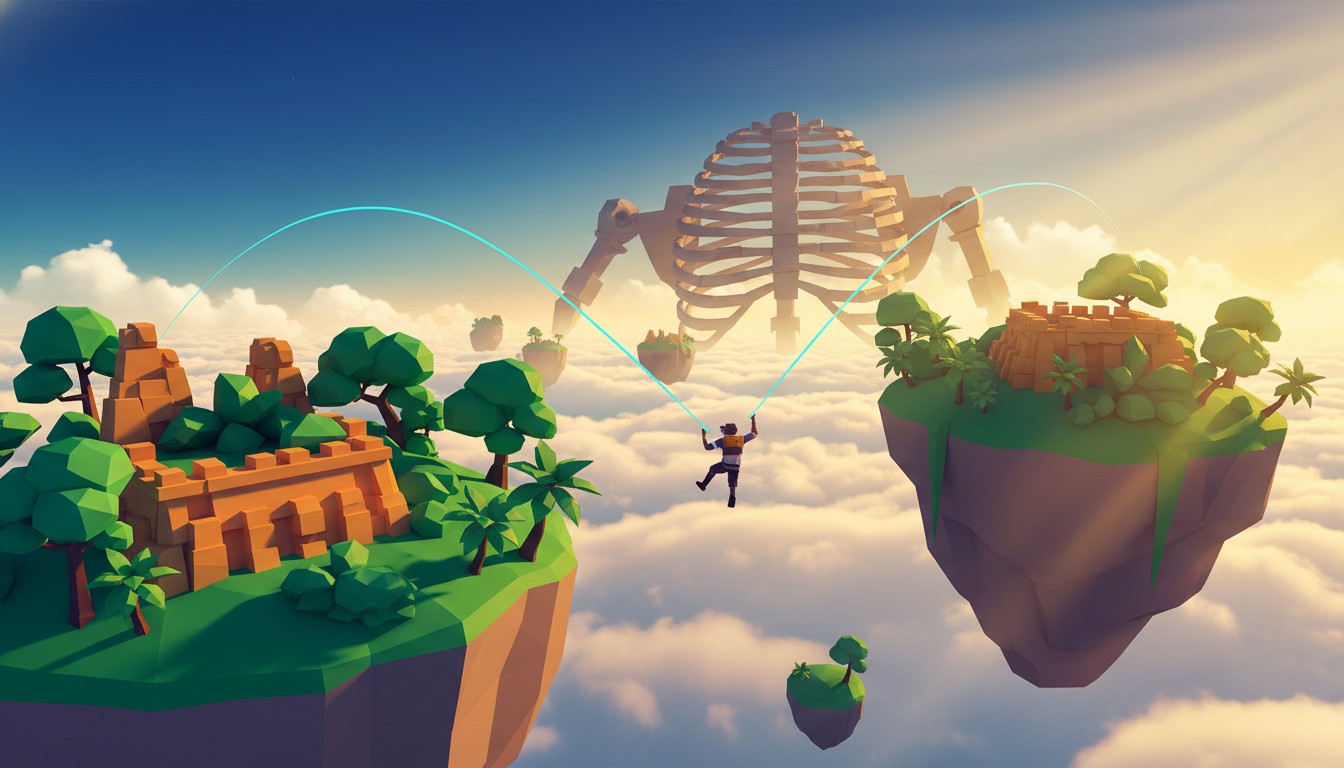
The first time you launch out of a crumbling tower, both grappling hooks anchored to distant green canopies, arcing through a sky filled with floating islands and ruined bridges, you understand why Windlands became an early VR touchstone. Psytec Games didn’t just build a platformer with motion controls. They built a kinetic argument for what first-person VR movement could be — risky, physical, genuinely thrilling — at a time when most developers were still treating virtual reality like a seated viewing experience with a gamepad in your lap.
This was a 2016 Oculus Rift launch-era title, released when consumer VR was still figuring out its own grammar. The fact that it still feels mechanically fresh nearly a decade later says something about how rarely developers have matched what Psytec got right on their first attempt.
What This Actually Is
Windlands is a native VR grappling-hook exploration game built from the ground up for tracked headsets. You have a hook in each hand. You aim, fire, and swing. Momentum carries you across chasms, up cliff faces, and through the ribcages of ancient Titans. The objective is deliberately simple: collect scattered crystals and tablets to awaken dormant colossi and unlock new biomes — Jungle, City, Sky. There is no combat. No inventory. No dialogue trees. Just you, two retractable cables, and a world designed to reward anyone willing to master the arc of a swing.
The game offers three difficulty modes that fundamentally change how you traverse. On Easy, your hooks can attach to any solid surface — walls, ruins, rock faces. On Normal and Hard, you’re restricted to specific green leafy grapple points, which turns traversal into a puzzle of positioning and timing rather than a freedom sandbox. Most players will want to start on Easy, learn the feel of the hooks, and then graduate to Normal where the real game lives. Hard mode strips away your safety nets and demands precision that borders on masochistic. The difficulty names undersell the gap between them.
The Physical Reality of Swinging
The core mechanic is genuinely excellent. You look at a surface, pull the trigger, and your hand-mounted hook fires out and anchors. Release to detach. Chain two hooks together and you’re penduluming across impossible gaps. Add jumps, wall-bounces, and mid-air re-anchors and you start to understand why people compared this to being Spider-Man in a headset long before any official Spider-Man VR title existed.
The sense of speed and verticality is what sells it. You are not walking through levels. You are soaring above them, dropping to snag a collectible, then launching back into the canopy before your momentum dies. When the flow clicks — hook, swing, release, hook, swing, vault — it produces a physical satisfaction that flat-screen platformers simply cannot replicate. Your body learns the timing. Your hands start making decisions before your brain catches up.
But the same mechanic that makes Windlands exhilarating also makes it punishing. This is fast, unrelenting, first-person artificial locomotion at speeds that would make most VR comfort tutorials blanch. You are constantly accelerating, decelerating, and changing direction in mid-air. Your inner ear receives motion information that conflicts with what your eyes see. The result is predictable: motion sickness hits hard and hits fast for a significant portion of players.
Psytec knew this. The game opens with an explicit comfort warning before you reach the main menu. The options menu includes segmented snap turning, a comfort vignette that darkens your peripheral vision during movement, and various field-of-view filters. These help. They do not eliminate the problem. If you are prone to VR sickness, Windlands may be unplayable in anything but five-minute sessions separated by recovery breaks. Even comfortable veterans report needing acclimation time. I cannot stress this enough: the stomach is the gatekeeper here. If your VR legs are still developing, this is not the game to test them on.
The World You’re Swinging Through
Visually, Windlands opts for a stylized low-poly aesthetic that was partly a practical concession to 2016 hardware and partly a genuine design choice. The environments are colorful, readable at speed, and architecturally interesting — floating ruins, overgrown jungle canopies, vertigo-inducing sky temples. The art style holds up because it was never trying to be photorealistic. It was trying to give you clear grapple targets at a glance while you are hurling yourself through space at thirty miles an hour. On that count, it succeeds.
The sound design deserves mention. Ambient music swells during long swings and fades during exploration, giving the whole experience a meditative quality that contrasts nicely with the physical intensity of the movement. There is little narrative beyond environmental suggestion — you’re an explorer awakening ancient Titans, apparently, but the story is wallpaper. The game knows what you’re here for and doesn’t waste your time pretending otherwise.
What the original Windlands lacks is longevity. The campaign is short — expect a few hours to completion depending on your skill level. Time trials and leaderboard chasing extend the experience for players who want to master the movement system, but if you’re not motivated by shaving seconds off speedrun splits, the content runs thin. This is an experience game, not a systems game. It gives you a verb, teaches you to use it, and then asks you to repeat it across increasingly demanding architecture until the credits roll.
Platform Notes and Sequel Context
Windlands launched on PCVR through Steam and the Oculus PC store, with a PlayStation VR port following later in 2016. A Quest version arrived through SideQuest before making its way to official storefronts. Across all platforms, the core experience is consistent, though tracking precision matters — the PSVR’s dated Move controllers reportedly struggle with the rapid hand repositioning the game demands, making some advanced techniques harder to execute than on PCVR with modern inside-out tracking.
Setup is frictionless. Buy it, launch it, play. No mods, no dependencies, no controller binding nightmares. For a medium that often demands thirty minutes of configuration before you see a menu, that simplicity is notable.
It is worth mentioning Windlands 2, released in 2018, which addresses several of the original’s limitations by adding bow-based combat, four-player co-op, voiced characters, and a more developed narrative. The sequel is a more complete package. But the original Windlands remains the purer expression of the grappling-hook idea — no combat systems to learn, no multiplayer logistics, just the movement and the world. If you want the distilled experience that made people fall in love with the concept, this is still the entry point.
The Call
Windlands occupies a specific place in VR history. It is not the most content-rich game from the launch era. It is not the most comfortable. It is probably not the one you hand to a VR newcomer unless you want them to hand the headset back in ninety seconds. But it is one of the few titles from 2016 that still feels mechanically unmatched — a movement system so good that developers have been chasing its highs ever since.
Play this if: You have established VR legs and want to experience one of the medium’s most exhilarating locomotion systems. You enjoy mastery-based traversal — learning a physical skill and gradually graduating from clumsy survival to effortless flow. You want a low-stakes, combat-free exploration experience that rewards precision and courage.
Skip this if: You are sensitive to motion sickness or still building VR tolerance. You want substantial narrative content, combat variety, or long campaign length. You prefer your VR experiences grounded, slow, and contemplative — this is the opposite of that.
Windlands is a B-tier recommendation not because the core mechanic is flawed, but because the comfort barrier and limited content scope narrow its audience significantly. When it works for you — when your stomach cooperates and the hooks catch just right — it produces moments of genuine joy that few VR games have replicated. When it doesn’t, it’s a expensive reminder that not every great VR idea is universally accessible. The verdict depends on which side of that divide you land.