
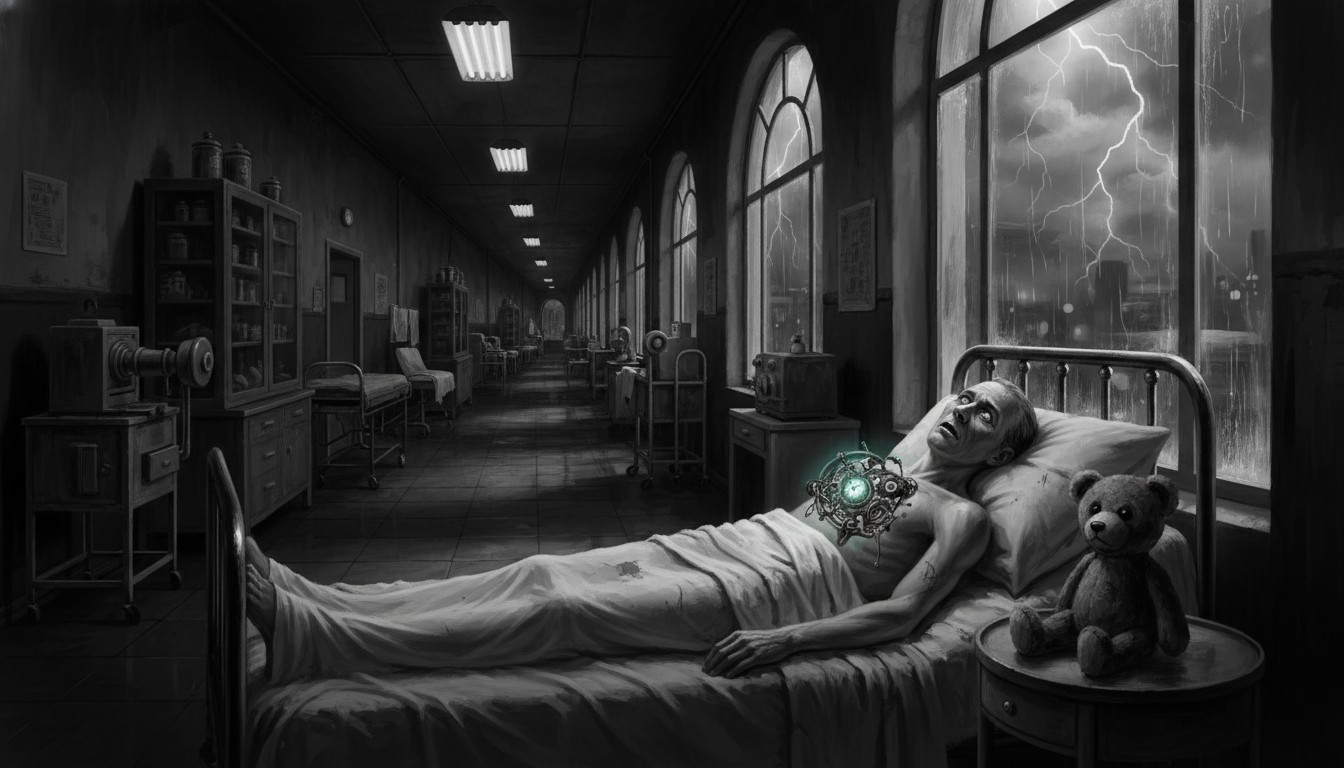
You wake up in a hospital bed, the room washed in stark blacks and whites like someone dialed the saturation out of reality itself. Storm clouds roll past the window. Rain hammers the glass. And then you look down at your chest and see that your heart — your actual, beating heart — has been replaced by a mechanical orb that pulses with an unnerving glow. That is the opening beat of Wilson’s Heart, and it never really lets you catch your breath.
Twisted Pixel’s 2017 debut into VR is a native, standalone experience built exclusively for the Oculus Rift and Touch controllers. There is no flat version, no pancake fallback, no mod to make it work elsewhere. If you want to play it, you need a PCVR setup running through the Meta/Oculus ecosystem. What you get for that commitment is one of the most deliberately cinematic horror experiences ever constructed for a headset — a psychological thriller that channels 1940s monster movies and Twilight Zone paranoia into something that feels genuinely authored rather than assembled from VR cliches.
The black-and-white aesthetic is not a gimmick. Removing color allowed Twisted Pixel to push larger textures and more detailed character models, and the result is a world that looks painterly and precisely art-directed rather than merely retro. Shadows swallow corridors whole. Lightning flashes across stone walls. A stuffed bear with button eyes sits innocently on a shelf until it very much does not. The hospital — part medical facility, part fever dream — shifts and reconfigures as you progress, turning mundane spaces into impossible architecture. It is the rare VR environment that earns its atmosphere through craft rather than jump-scare volume.
You play as Robert Wilson, voiced by Peter Weller with the gravelly authority of a man who has seen too much and refuses to flinch. The supporting cast is legitimately stacked: Rosario Dawson as a fellow patient with secrets of her own, Alfred Molina as a looming presence, and strong turns from Kurtwood Smith, Michael B. Jordan, and Paul Reubens. In 2017, this level of voice talent in a VR title was virtually unheard of, and it pays dividends. Conversations feel performed, not read. Dawson in particular delivers work that grounds the absurdity of the premise in something human and desperate.
The Touch controllers are your hands here, and the interaction design is mostly intuitive. You open drawers, turn keys, pick up newspapers, and examine objects with natural gestures. The game orients you toward points of interest using a node-based teleportation system — silhouettes of Robert appear at valid locations, and you snap to them. It is restrictive by modern standards, but it serves the experience. This is a story-first game, and free locomotion would have turned its carefully composed spaces into missed corners and unnecessary backtracking. The teleportation keeps the pacing tight and the nausea nonexistent.
Where Wilson’s Heart stumbles is exactly where you wish it would not. Combat, which arrives in the form of monster encounters and boss battles, is repetitive and frequently frustrating. You punch enemies or throw your mechanical heart at them, and the novelty wears thin fast. Enemy attack patterns become predictable, and some boss fights drag on well past their welcome, marrying one-hit-kill tension with controls that do not have the precision to support that level of punishment. PC World called the boss battles “almost always bad,” and while that is harsh, it is not baseless. The fighting feels like a concession to genre expectations rather than something the design team fully solved.
The puzzles fare better, though they trend toward the simple side. Most involve finding the right object or manipulating the environment in obvious ways. They keep you engaged with the world without ever truly testing you. For a game this invested in momentum, that is arguably the right call — hard stops for head-scratchers would have broken the spell — but players hoping for genuine brain-teasers will leave disappointed.
The narrative is the real draw, and it commits. What starts as a haunted hospital story spirals into something stranger and more ambitious, touching on mad science, personal demons, and reality-bending set pieces that only work because VR puts you inside them. Standing in that black-and-white world as it comes apart around you is genuinely affecting in a way that a monitor cannot replicate. The sound design deserves particular mention: thunderstorms, distant screams, and Christopher Young’s score all wrap around you with the spatial precision that only a headset provides.
Who should play this? Anyone with an Oculus Rift or Quest PC Link setup who values atmosphere, narrative, and production values over action refinement. Horror fans who prefer slow dread to constant jump scares. Players who want to see what early high-budget VR storytelling looked like when a studio bet big on authorship rather than iteration. If you need tight combat loops or open-world exploration, this is not your game. If you want to spend an evening inside a beautifully unpleasant monochrome nightmare, it absolutely is.
Wilson’s Heart is not perfect. Its combat is uneven, its puzzles are slight, and its Oculus exclusivity locks it away from a huge swath of the VR audience. But what it does well — atmosphere, performance, visual identity, and narrative ambition — it does so well that the flaws feel like blemishes on something genuinely special. In a VR landscape still figuring out what immersion means, this game understood that presence starts with a world worth believing in. Step into that hospital. Just do not expect your heart to stay where you left it.