
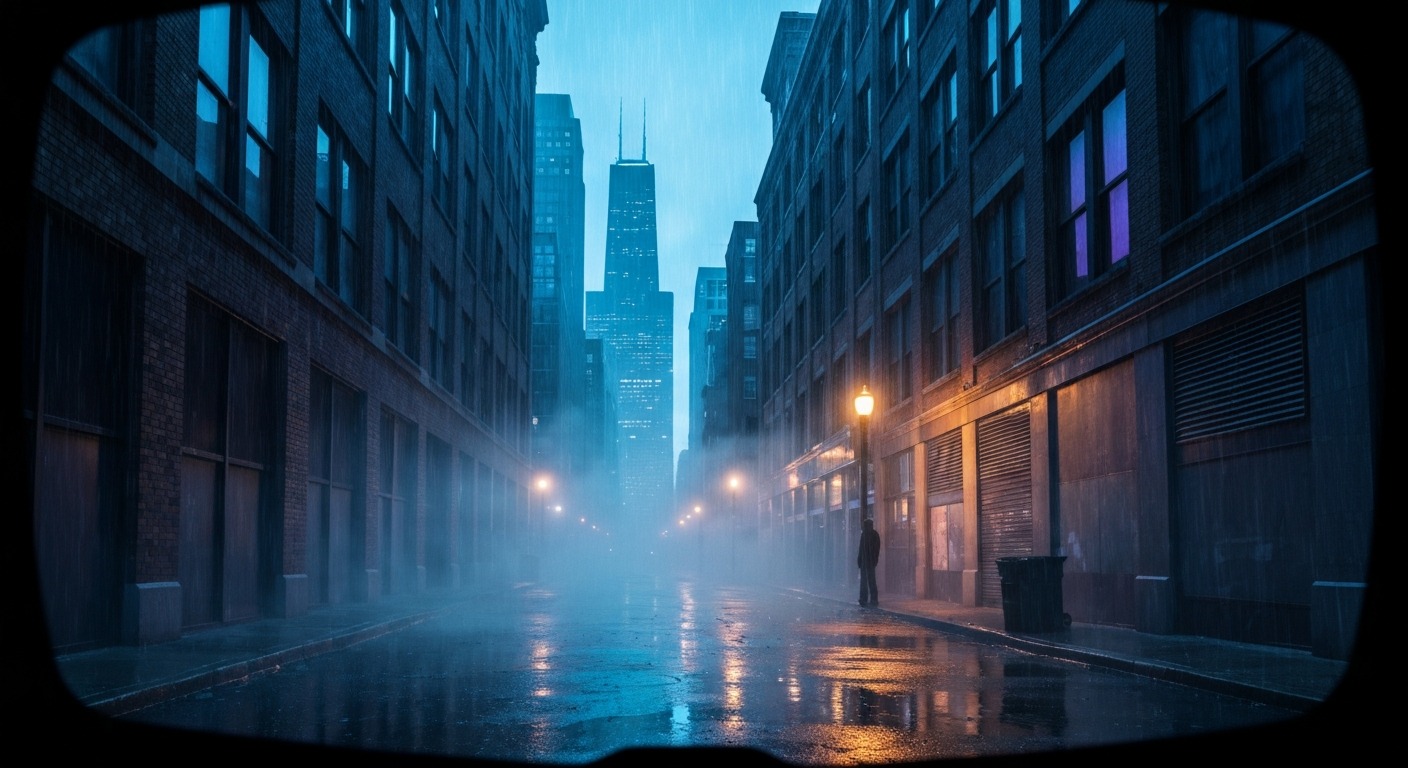
There’s a moment in the Watch Dogs R.E.A.L. VR mod where you’re driving down Lakeshore Drive in a tricked-out muscle car, Chicago’s skyline filling your peripheral vision, rain sheeting across the windshield, and you stick your head out the side window like a golden retriever in a pickup truck. It’s stupid. It’s wonderful. And it’s the clearest possible signal that this ten-year-old open-world game was always meant to be looked at up close, even if it was never meant to be played inside a headset.
Here’s the thing: Luke Ross’s injection driver doesn’t transform Watch Dogs into a native VR experience. It won’t give you motion controls, hand presence, or a first-person camera. What it does — and what it does surprisingly well — is drop a stereoscopic 3D viewport into the game’s existing third-person over-shoulder camera and let your head drive the view. The result is somewhere between “virtual tourism” and “playing a PlayStation 4 game strapped to your face.” Whether that’s compelling depends entirely on what you’re showing up for.
The Setup Reality
If you’ve used any of Luke Ross’s previous mods — Cyberpunk 2077, Red Dead Redemption 2, Elden Ring — the installation process will feel familiar. Drop the framework files into the game directory, launch the injector, strap in. By injection-driver standards, it’s about as painless as it gets. The game itself is a decade old and was never a hardware hog, so even a mid-range PC pumps out a smooth stereo feed without breaking a sweat. The built-in upscaling support doesn’t hurt either.
There’s a catch, of course: access to the mod requires subscribing to Ross’s Patreon. That’s been the model for years, and while the broader R.E.A.L. suite saw a wider release in early 2026, the gating mechanism still flavors the experience. You’re paying to beta-test a hobbyist’s passion project, and the terms of that arrangement should sit right with you before you dive in.
What Actually Works
Let’s start with what genuinely shines: the city itself. Ubisoft Chicago built a staggeringly dense urban playground in 2014 — back alleys, L-train overpasses, restaurant interiors, parking garages, rooftop gardens. In flat screen, it’s impressive. In stereoscopic 3D with head tracking, it’s something else entirely. Leaning toward a diner window to read the menu board, peering around corners during a firefight, watching pedestrians react to chaos at street level — there’s a tangible sense of place here that most native VR open worlds still struggle to match. Ian Higton’s Eurogamer preview nailed it: the muffins look delicious. That’s not a joke. The environmental detail rewards scrutiny.
Then there’s the hacking. In the flat game, profiling NPCs and triggering environmental traps requires aiming a phone interface with a thumbstick. In the R.E.A.L. mod, targeting is gaze-based — look at a person, a traffic light, a transformer box, and the reticle snaps there. It’s immediate and satisfying in a way that makes you wonder why the original designers didn’t build it this way. After a few minutes, you’ll forget you ever steered a targeting cursor around a flat HUD. It’s the one mechanical improvement the mod introduces, and it lands.
Where It Frays
But here’s where I have to be honest: the rest of the experience fights the headset more than it embraces it.
The third-person camera is the obvious culprit. Watch Dogs was built as an over-shoulder action game, and the mod preserves that framing. Your head is floating behind Aiden Pearce at a fixed distance, which means every step he takes, every sharp turn in a car, every sprint across a rooftop — your viewpoint follows at a slight delay. The disconnect between your head’s position and the character’s body creates a low-grade vection conflict that builds over time. Walking around the city? Manageable. Driving at speed through downtown? That’s where stomachs start to complain.
Cutscenes fare worse. The injection driver hooks the live gameplay camera, not the cinematic rigs. So whenever a story sequence triggers, the camera warps to whatever predetermined angle the director chose — often clipped inside geometry, occasionally wildly misaligned for stereo 3D, and almost always immersion-breaking. You’ll learn to brace for them.
The UI compounds the problem. Minimap, mission prompts, phone interface, hacking menus — all flat-screen elements hovering in space. They’re readable enough with some headset adjustment, but they glow and glare in a way that native VR interfaces simply don’t. Bright white text against a dark world at night? It’s like having a flashlight pointed at your retinas.
And then there’s the input situation. Gamepad or keyboard and mouse. Full stop. No motion controllers, no hand tracking, no gesture-based interaction. You’re wearing a headset to look at a game you’re still controlling with a controller from 2013. It works. But every time you reach for a button prompt and remember your hands aren’t in the world, the illusion cracks a little wider.
Who This Is For
I’m going to level with you: this is not the definitive way to play Watch Dogs. If you’ve never touched the game and you’re hoping for an open-world VR masterpiece, you will leave disappointed. The action sequences feel disconnected, the driving is a comfort gamble, and the story’s cinematic ambition constantly reminds you that you paid for front-row seats to a movie screened in a tornado.
But.
If you love virtual tourism — if you get genuine joy from standing in a convincing virtual space and simply looking — this mod offers something special. Chicago in the R.E.A.L. framework feels like a place. A flawed, violent, occasionally ridiculous place, but a place nonetheless. Spend an evening cruising neighborhoods at dusk, profiling random citizens for their terrible secrets, triggering traffic pileups from a park bench just to watch the physics unfold. That’s where the mod earns its keep. Not as a game. As a destination.
Players with solid VR legs and a high tolerance for third-person camera drift will get the most out of it. Sim-sickness sufferers should tread carefully, especially around vehicles. And if you’re the type who needs motion controls and hand presence to feel “in” a world, this will feel like watching a very pretty aquarium from the wrong side of the glass.
The Bottom Line
Watch Dogs in VR is a beautiful contradiction. The city blooms in stereoscopic 3D. The gaze-based hacking feels like a genuine upgrade. And yet every core system — movement, driving, combat, cutscenes — was designed for a rectangle two meters away, not a headset strapped to your skull. Luke Ross’s injection driver does heroic work bridging that gap, but it can’t rebuild the game from the ground up. What you get is a vivid, occasionally nauseating, undeniably memorable tour through one of Ubisoft’s best-built cities. Treat it like a scenic train ride through a crime simulator, not the crime simulator itself, and you’ll walk away happy.
If you’re hunting for a native-feeling open-world VR experience with motion controls and first-person immersion, this isn’t it. But if you’ve ever looked at Chicago’s rain-soaked streets on a monitor and thought, “I wish I could stand there,” this is the closest you’re going to get.