
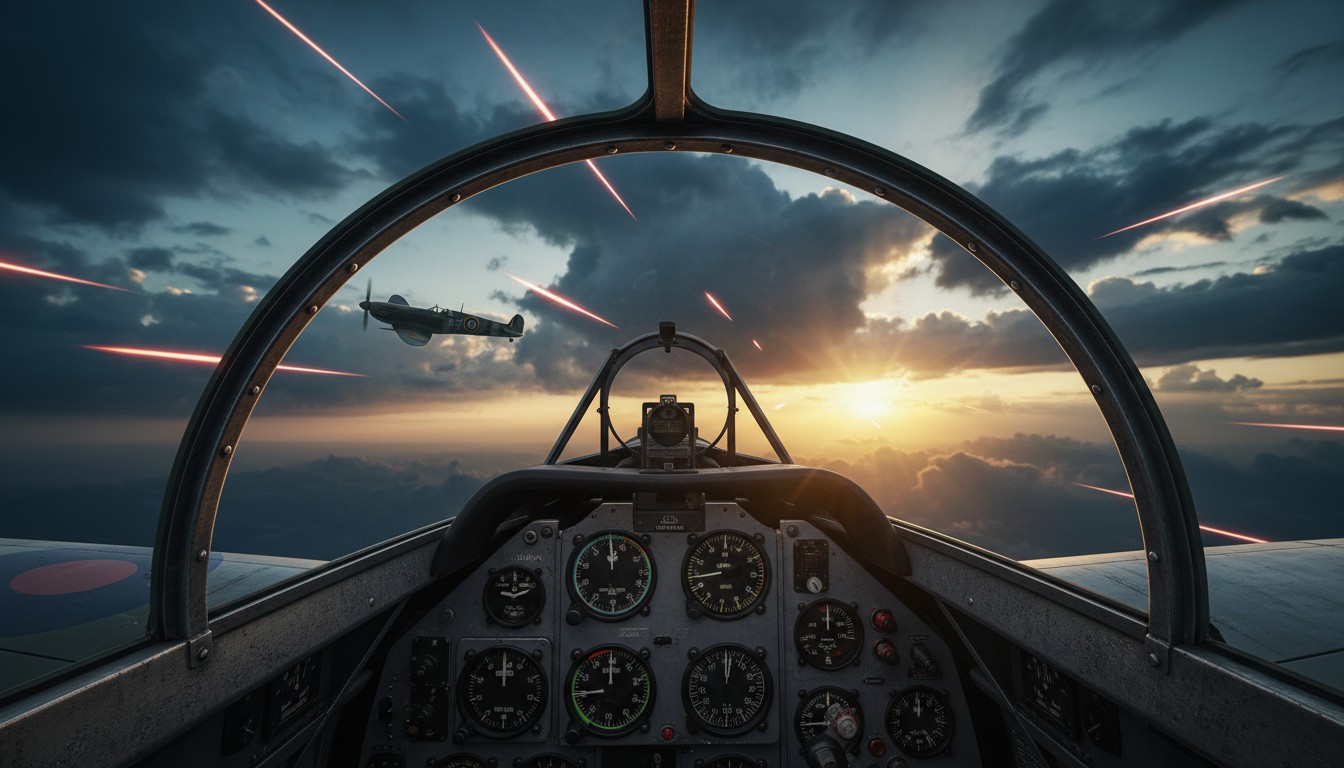
There’s a moment in War Thunder’s Sim Battles when you pull up hard from a dive and the landscape tilts beneath you — trees, rivers, enemy aircraft all sliding across your vision as G-force pins you to the seat. In VR, that moment doesn’t feel like a camera trick. It feels like you’re actually there, canopy frame rattling, engine screaming, desperately scanning for the bandit that just dropped off your six.
That moment is why people bother with War Thunder in VR. It’s also about the only reason.
Gaijin Entertainment added VR support to War Thunder years ago, transitioning to the OpenXR standard more recently to broaden headset compatibility. But let’s be clear about what this actually is: a VR camera strapped onto a game built for monitors. The implementation doesn’t reimagine the experience for headsets. It doesn’t add motion controller support worth using. It doesn’t smooth the camera or rebuild the UI for stereoscopic viewing. What it does is give you a cockpit you can look around in, and for aerial combat specifically, that’s sometimes enough.
The Air Combat Difference
War Thunder spans three vehicle types — aircraft, ground vehicles, and naval vessels — but VR only genuinely works for one. Air battles in Sim mode are where the headset earns its keep. The cockpit view locks you in first-person, which means head tracking becomes your primary tool for situational awareness. Spotting enemies by actually turning your head, tracking tracer fire across the sky, feeling the scale of a bomber formation as it passes overhead — these aren’t gimmicks. They’re tactical advantages wrapped in genuine immersion.
The sense of presence is real. Enemy fighters don’t feel like icons on a radar; they feel like metal and rivets screaming past your canopy. Ground attack runs become visceral in a way flat screen can’t replicate because you’re actually looking down at the terrain rushing beneath you. For players who already own a HOTAS setup, combining that hardware with a headset creates something surprisingly close to a dedicated flight sim experience, except the entry price is zero dollars.
But that experience comes with strings attached.
The Comfort Problem
War Thunder’s VR mode has no camera smoothing, which means every tiny head movement translates directly to the view. In normal flight this is fine. The moment you zoom in to line up a shot, though, the image starts rocking with micro-movements and the whole view becomes a nausea generator. Zooming while maneuvering is practically asking for discomfort.
The HUD compounds this. Vital information is scattered around the cockpit in ways that require real neck craning to read. You shouldn’t have to contort your head to check your airspeed, but here we are. After extended sessions, the physical strain of constantly repositioning to read instruments adds up.
Then there’s the motion sickness question. High-G maneuvers, rapid rolls, and aggressive pitch changes — the things that make dogfighting exciting — are exactly the things most likely to send you reaching for the headset’s power button. Experienced sim pilots with strong VR legs will adapt. Newer users may find their sessions ending abruptly.
What Doesn’t Work
Ground battles in VR are a mixed bag at best. The sense of scale is genuinely improved — tanks feel appropriately massive, terrain reads better at ground level — but the tactical advantages of VR largely vanish. Third-person camera angles, which many ground players rely on, become awkward in a headset. Targeting at distance suffers. The interface, designed for mouse navigation, doesn’t translate well to head-tracked cursor control.
Naval combat is actively worse in VR. The frequent need to zoom, combined with the slower pace that invites more head movement, makes for an uncomfortable combination. Several community reports describe naval VR as genuinely unpleasant compared to flat screen. If you primarily play boats, there’s no reason to put the headset on.
And about those VR controllers: don’t. War Thunder’s control scheme assumes a keyboard’s worth of keybinds and a joystick’s precision. Motion controllers are effectively unusable for anything beyond menu navigation. A HOTAS setup is strongly recommended for Sim Battles; mouse and keyboard will work for Arcade and Realistic modes but sacrifice much of what makes the VR experience compelling.
Performance Reality
War Thunder isn’t the heaviest VR title, but it’s not lightweight either. Running through SteamVR has produced mixed reports of frame drops and visual artifacts for some users. The Gaijin standalone client, with VR mode enabled in its launcher settings, tends to produce more stable results. On mid-range hardware you can expect playable frame rates with reasonable settings, though you’ll likely need to compromise on visual fidelity compared to flat-screen play.
Stability has been a recurring concern. Black screens, freezes after updates, and occasional launch failures appear in community reports with enough frequency to mention. The VR mode isn’t actively broken, but it doesn’t feel actively maintained either. Gaijin’s development attention has clearly shifted toward their dedicated VR spin-off, Aces of Thunder, released earlier this year as a purpose-built VR combat flight sim.
The Bottom Line
War Thunder in VR is a free-to-play combat flight sim with two thousand aircraft, enormous multiplayer battles, and a Sim mode that genuinely benefits from a headset. It’s also a game where VR support never expanded beyond its most obvious application, where comfort issues require real management, and where the developer’s focus has moved elsewhere.
For flight sim enthusiasts who already own a HOTAS and have their VR legs, Sim Battles in War Thunder represent legitimate value. The immersion is real, the gameplay is deep, and the price is impossible to beat. But the experience demands specific hardware, specific tolerance for discomfort, and specific interest in aircraft. Ground players, naval players, VR newcomers, or anyone without proper flight controls should look elsewhere — including, potentially, at Aces of Thunder if you want a more polished dedicated VR combat sim.
War Thunder’s VR mode is good enough at one specific thing to be worth knowing about. It’s not good enough at anything else to be worth recommending broadly.