
My usual advice for someone’s first VR game is “don’t start with something that’ll make you sick, don’t start with something that’ll frustrate you, and definitely don’t start with something that requires a PhD in BepInEx.” For five years now, Walkabout Mini Golf has been my actual answer.
This is a native VR title from Mighty Coconut that launched on Quest and Steam in September 2020 and has quietly become one of the most essential games in VR. No mods. No injection. No setup hell. You put on the headset, grab a putter, and putt. The miracle is how much depth lives inside that simplicity.
The Physics Are the Whole Point
The first putt feels wrong in the best way — it’s too accurate. Walkabout Mini Golf has the most realistic putting physics in VR, full stop. Ball weight, green slope, surface friction, rim physics around the cup — it all behaves like you’d expect. After three holes you stop thinking about the controller in your hand and start reading greens like you’re actually standing on a miniature course with a beer in your other hand.
That fidelity matters because it makes the game honest. A bad putt is your bad putt. A great putt feels earned. The putter auto-adjusts to your height, so whether you’re six-foot-four or playing seated, the stroke mechanics feel natural. The club won’t clip on environment geometry either — no accidentally hitting a virtual wall mid-swing. It’s a small detail that saves a thousand micro-frustrations.
Comfort First, But Not Boring
Here’s the thing about accessibility: this game supports teleportation and smooth locomotion, snap and smooth turning, standing and seated play, and even one-handed operation. Most VR games pick a philosophy and force it on you. Walkabout lets you build your own comfort profile.
That matters because this is the game I hand to people who’ve never touched VR before. I’ve watched motion-sickness-prone players teleport around a pirate ship course for an hour without a hint of discomfort. I’ve also seen experienced VR users enable smooth locomotion and flight mode to explore the detailed environments between holes, finding hidden collectible golf balls tucked behind waterfalls or under bridges.
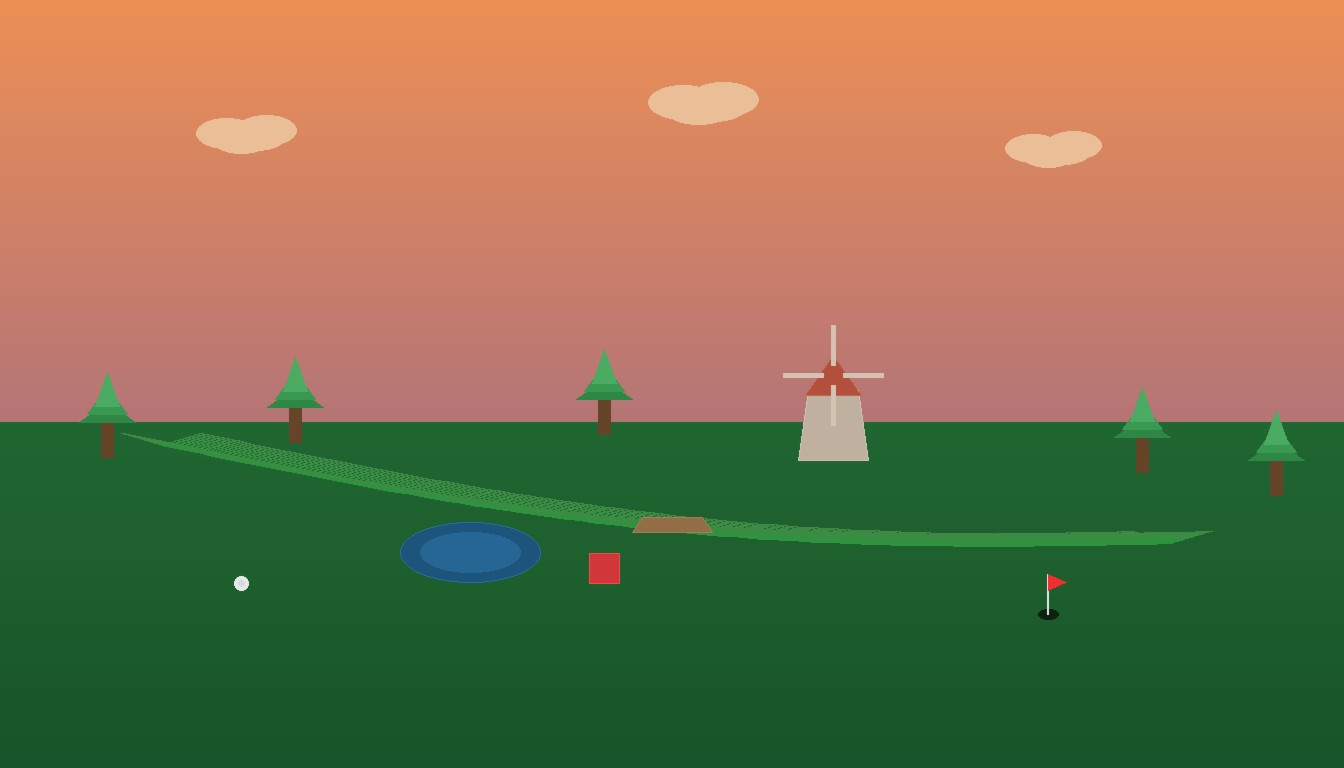
The flight mode is worth mentioning specifically — it’s not a gimmick, it’s how you explore. Courses are interconnected dioramas with secret areas, and flying lets you appreciate the craftsmanship. The low-poly art style is charming rather than crude, with dynamic lighting that makes each course feel distinct. The PSVR2 version leverages HDR to make colors genuinely vibrant; the PCVR version can be sharpened with supersampling for pixel-perfectionists.
The Social Experience Is Why You Stay
The base game includes fourteen 18-hole courses, which is already substantial. But the real economy here is multiplayer. Private rooms support up to eight players. Quick match pairs you 1v1. Full cross-play means your Quest-owning friend and your PSVR2-owning friend and your Index-owning friend can all play together without friction.
Mighty Coconut built something rare: cross-play that actually works and doesn’t require a tutorial to set up. On PSVR2 you toggle cross-play on in the Welcome Island settings. That’s it. Everyone’s in the same lobby.
The Guest Pass feature is even more generous. If you own a DLC course, you can invite friends who don’t own it to play with you for free in private rooms. Only the host needs to buy it. Guests can’t collect lost balls or participate in foxhunts on those courses, but they get the full gameplay experience. In an era where DLC often fractures friend groups, this is pro-consumer design that should be standard.
The Content Pipeline Is Absurd
As of early 2026, there are over forty courses available, including licensed collaborations with Myst, Meow Wolf, Wallace & Gromit, Journey to the Center of the Earth, and others. Each course has a standard version and a Hard Mode with remixed geometry and tougher pin placements. At roughly thirty to sixty minutes per course, you’re looking at well over a hundred hours of content if you chase everything.
New DLC courses run about five dollars. The base game alone is worth the price of admission. Mighty Coconut has committed to releasing courses through 2028, and the pace has been remarkably consistent. This isn’t a live service game in the predatory sense — it’s a mini-golf course that keeps building new wings.
Platform Reality
Performance is excellent across the board. The Quest version runs flawlessly on standalone hardware. PCVR is efficient enough to run on modest systems. PSVR2 is smooth and stutter-free, though some users report slightly softer image quality compared to a well-tuned PCVR setup. The trade-off is wireless freedom versus visual fidelity versus HDR color pop — pick your priority, the core experience doesn’t change.
The one real platform gripe is no cross-buy or cross-save. If you own it on Quest and want it on Steam, you’re buying twice. Your unlocks don’t transfer. It’s a nuisance in an otherwise frictionless experience.
Who This Is For
Play this if you want a low-stakes, high-quality social experience that works for VR newcomers and veterans alike. It’s the best conversion tool for skeptical friends, the best wind-down game after an intense session, and the best argument that VR doesn’t need to be complicated to be excellent.
Skip it if you need narrative progression, competitive ranked systems, or mechanical complexity. This is mini-golf. The depth comes from physics fidelity and social dynamics, not from unlocking skill trees or fighting bosses.
Walkabout Mini Golf doesn’t reinvent anything. It just executes a simple concept with such care that it becomes indispensable. After five years and forty courses, it still feels like the game VR was built for.