
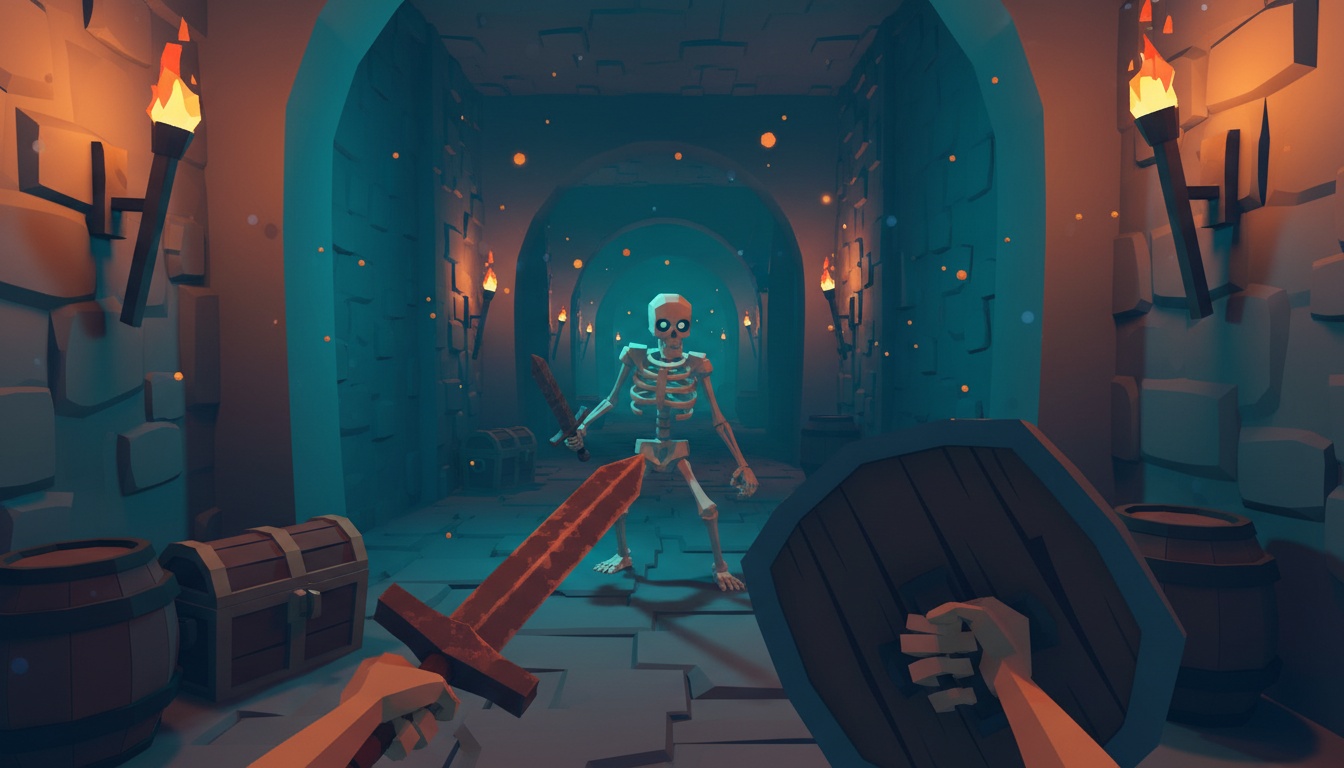
The first time a skeleton swings a rusted blade at your head and you physically duck, you understand what Vanishing Realms was trying to prove. Released in 2016 as one of the earliest room-scale VR titles and graduating from Early Access in 2019, this native PCVR dungeon crawler from solo developer Kelly Bailey asked a simple question: what if a fantasy RPG actually required your body to play it?
The answer is still compelling, even if the edges have dulled.
Vanishing Realms is a VR-only action RPG built from the ground up for SteamVR. There is no flat version, no mod, no injection layer — you buy it on Steam, strap on a headset, and step inside. It supports the full range of PCVR hardware through OpenVR, from the original HTC Vive to the Valve Index and modern headsets streamed via Virtual Desktop. Installation is as straightforward as any native VR title, and performance is forgiving on a broad range of hardware thanks to its relatively lightweight, stylized visuals.
What you get is approximately two to three hours of first-person dungeon crawling split across two chapters, with an expansion — The Sundered Rift — adding another chunk of content that pushes the total closer to five or six hours for a thorough playthrough. That runtime is the first thing that demands honesty. Vanishing Realms is short. Not “lean and tightly designed” short, but noticeably slight, with a second chapter that leans heavily on a repetitive battle-pit structure that feels like padding against a deadline.
But within that modest runtime is some of the most physically satisfying melee combat PCVR has ever produced.
Combat operates on a genuine one-to-one physics basis. You swing your sword, you block with your shield, you physically step aside to dodge. Enemy attacks come at you with real spatial presence — that skeleton’s blade occupies actual volume in your playspace, and survival means reading timing, managing distance, and treating your room boundary as part of the mechanics. The tactical rhythm between strike and parry has a weight and authenticity that many newer VR RPGs still struggle to match. When you land a clean block and feel the controller vibrate with the clang of metal, the haptic feedback is tuned with a precision that makes the clash feel consequential.
The room-scale integration goes beyond combat. You physically crouch to search barrels. You bend down to pick up coins. You sidestep around corners to ambush enemies. The game treats your playspace as the game world, not as a control scheme, and that physical embedment remains its most distinctive quality nearly a decade later.
Exploration rewards curiosity. Hidden treasure chests, mystic writings, and environmental secrets are tucked into corners the game never explicitly flags. There are no waypoints or objective arrows — you read the environment and make your own path. That trust in the player’s spatial reasoning is refreshing, even if the visual language can feel sparse. The low-poly, cartoonish art style was serviceable in 2016 and remains readable today, but up close the flat textures and simple geometry betray their age. It is not ugly, but it is undeniably dated.
The sound design, however, holds up beautifully. Audio cues telegraph enemy behavior with clarity, and the haptic-audio pairing during combat is genuinely excellent design. You can often fight effectively with your eyes closed, which speaks to how thoughtfully the sensory layer was constructed.
What does not hold up as well is the game’s movement and systems framework. Vanishing Realms uses teleportation exclusively. There is no smooth locomotion option, no sprint, no artificial turning beyond what your physical body provides. In 2016 this was a sensible default that eliminated motion sickness and let players focus on room-scale combat. In the current VR landscape, where smooth locomotion and multiple comfort options are standard, the rigidity feels restrictive. The lack of choice is a limitation, not a design statement.
The inventory system exemplifies the same hands-on philosophy — you physically grab items and attach them to slots around your torso — but in practice it can be fiddly during tense encounters. Grip mechanics for non-weapon items like torches have been reported as unreliable, and the UI for navigating between chapters is less intuitive than it should be. These are small frictions, but they add up in a short experience where every moment carries weight.
Enemy AI is basic. Skeletons and other undead foes will close distance and attack, but their behavior patterns are simple and their spatial awareness can break in unexpected ways — occasionally staring blankly from across a room or pathing awkwardly near boundary edges. The game compensates with hard mode, which makes enemies faster, stronger, and more aggressive, but this is a numbers adjustment rather than a behavioral one. There is no meaningful character progression beyond finding better gear. You do not level up or unlock abilities. The RPG label here refers more to the fantasy framing and loot scavenging than to any deep build system.
The narrative is similarly light. Rhyming dialogue and riddled exposition set a playful tone, but the storytelling is thin and the rhymes can wear thin quickly. The incentive to push forward comes from the combat and the tactile pleasure of exploration, not from any attachment to the world or its characters.
Development status deserves a clear-eyed assessment. Vanishing Realms spent years in Early Access with sporadic updates, leading to periodic community concern about abandonment. The Sundered Rift expansion in 2019 helped, and the developer has continued to post occasional updates including Index controller support and experimental new systems. As of late 2025, Bailey is reportedly still working on the game with aims toward a more open-world structure and refined physics-based enemy animation. That commitment is admirable, but the pace is glacial. Buy this for what it is today, not for what it might become.
So who should step into these realms? If you are new to PCVR and want an accessible, comfortable introduction to room-scale gaming with genuinely excellent melee combat, this is one of the best starting points available. The teleportation-only movement means zero motion sickness risk, and the physical combat teaches VR fundamentals better than most tutorials. If you are a seasoned VR player who values tactile swordplay and wants to experience one of the medium’s foundational RPGs, the combat alone justifies the price on sale.
Who should skip it? Players looking for a deep RPG with character progression, meaningful choices, or a substantial campaign. Anyone requiring smooth locomotion or modern comfort options. Those expecting contemporary visual fidelity or sophisticated AI. And if you are sensitive to value-per-hour calculations, the brevity is a real consideration unless you catch it discounted.
Vanishing Realms is a foundational piece of VR history that remains genuinely fun to play. Its combat is still among the best in the genre, its room-scale integration is still ahead of many newer titles, and its accessibility makes it an ideal first dungeon crawl for VR newcomers. But its short length, dated systems, and lack of modern movement options place it firmly in the “worth experiencing, with eyes open” category rather than the essential shelf. It proved that VR could do melee combat right. The games that followed learned from it. Play it to understand where the medium came from — and to discover that, in the moments when a skeleton swings and you duck, the magic is still there.