
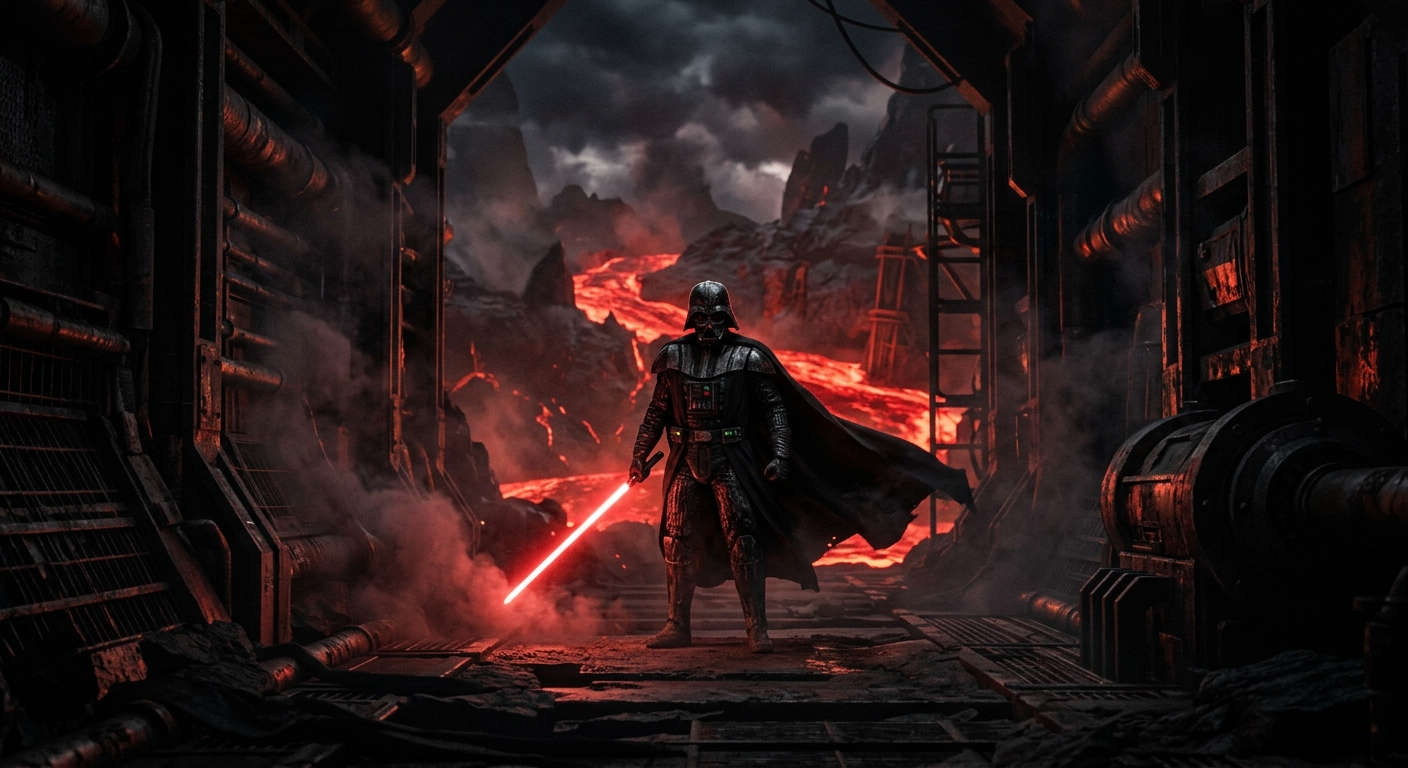
There is a moment in Vader Immortal: Episode I when the smoke clears on Mustafar and Darth Vader steps into your space. Not on a screen fifteen feet away. Here. The helmet is inches taller than you. The respirator fills the room. James Earl Jones’s voice comes from the mask with the kind of low register that vibrates in your chest even when you know the acoustics are digital. It is the most convincing argument yet for what a first-party Star Wars production can do inside a headset.
ILMxLAB — Industrial Light & Magic’s dedicated VR division — has built something that looks and sounds like a film production, except you are inside it. You play a smuggler whose ship has been ripped out of hyperspace by Vader’s forces and dragged to his fortress on Mustafar. David S. Goyer, who wrote The Dark Knight and Man of Steel, handles the script, and the pedigree shows in the pacing and the restraint. The story lets silence do work. It lets Vader’s physical presence carry scenes instead of exposition.
But let’s be direct about what this is, because the marketing can mislead. Vader Immortal is a narrative experience first and a game second. Episode I runs roughly 45 to 60 minutes. You will walk through corridors, interact with objects, make a handful of light choices, and watch well-directed set pieces unfold. The interactivity is present — you manipulate panels, pull levers, and use rudimentary Force powers to move obstacles — but you are on rails. If you are expecting Jedi Knight combat depth, open exploration, or meaningful branching, this is not that product.
What it lacks in mechanical complexity, it compensates for with craft. The environments have scale. Mustafar’s lava flows glow against industrial architecture that feels physically grounded. Character models hold up at close range, which matters because the experience puts you in intimate proximity with droids, allies, and Vader himself. The direction understands that VR’s strength is spatial presence, not information density. It gives you room to look around, to feel the heat of the fortress, to sense the height difference between yourself and a Sith Lord.
The standout mechanical element is the lightsaber. During the campaign you get brief combat sequences, but the real payoff is the Lightsaber Dojo, an unlockable training mode that becomes the replayable core of the package. You stand in a chamber while training drones fire blaster bolts and attack from multiple angles. You block, deflect, and slice. The motion controls map cleanly to wrist angle and blade position. Deflecting a bolt back at a drone carries the satisfying snap of timing and physics that VR handles well. The dojo adds difficulty tiers and challenges, giving the package legs beyond the single-sitting story.
There are Force powers, too — pulling objects, pushing mechanisms — and they feel tactile in the way that hand-tracked gestures should. The input scheme is intuitive because the game was built natively for Oculus Quest and Rift. There is no abstraction layer or port compromise. You reach, grab, and swing exactly as the hardware expects.
Comfort is handled sensibly. Movement is node-based, shifting you between fixed positions rather than subjecting you to smooth locomotion through volcanic corridors. You spend most of your time standing in place or making small physical shifts. For a medium that still struggles with user comfort, that makes Vader Immortal one of the few high-quality VR experiences you can hand a brand-new headset owner without a second thought — it is the natural first thing to show someone to prove what this hardware is for. Performance on Quest is locked and stable; on Rift, the visual fidelity increases but the framerate stays consistent. ILMxLAB optimized for the hardware rather than pushing beyond it.
The catch is length and structure. Episode I is the first of three planned installments, and it ends before the narrative reaches any real resolution. What you get is a prologue — a well-made prologue, but a prologue nonetheless. The Lightsaber Dojo extends the value, yet the core story is a short, cinematic ride. The price asks you to pay for production value rather than volume. That tradeoff is legitimate, and knowing you are buying a high-end theme park attraction rather than a full campaign is what makes the price feel fair.
For Star Wars fans, the calculation is easy. Standing in a room with Darth Vader, hearing that voice from the correct spatial position, and holding a lightsaber that hums in your hand is a fantasy the flat screen cannot replicate. For Quest owners looking for a flagship exclusive that is not another wave shooter or stationary gallery, this is a polished, accessible showcase. And because it asks so little of the player while delivering that much spectacle, it is also the ideal first experience to hand someone who has never worn a headset — few polished titles make the case for VR as cleanly.
None of that means it is for everyone without a thought. If you do not carry nostalgia for the franchise, the rails feel tighter and the limited agency becomes more obvious — this is a guided tour, not a sandbox. And if you are waiting for a substantial VR action game, the sixty-minute story is the one thing to know: it is a short, cinematic ride rather than a campaign. The Lightsaber Dojo and the production values are what make those minutes worth the price, and for most players they do.
Vader Immortal is a statement of intent from ILMxLAB. It proves that Star Wars in VR can look, sound, and feel like a first-party production when the studio building it understands the hardware. The Lightsaber Dojo gives it purpose beyond the credits, but the heart of the package is cinematic presence — standing close enough to a Sith Lord to feel the temperature drop. It is not a deep game, and it was never meant to be. It is the Star Wars fantasy VR exists to deliver: short, complete, and good enough that almost anyone who puts it on will come away glad they did.