
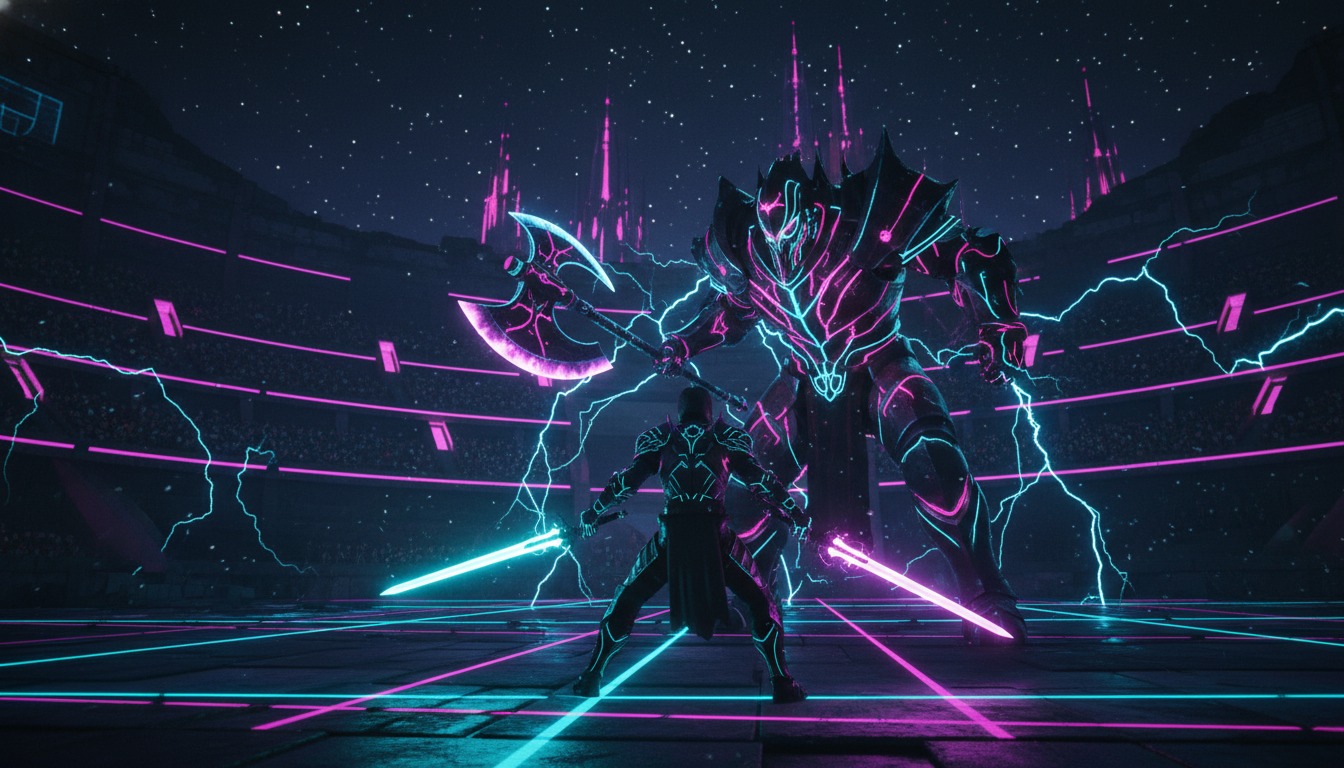
The first time an armored knight brings a greataxe down toward your skull and you actually catch the blow on your blade, arms trembling in real space, something fundamental clicks about what VR melee combat can be. Until You Fall, out now on SteamVR for Rift, Vive, and Index, isn’t interested in button-mashing abstraction. It wants your whole body in the room. Developed by Schell Games — a studio previously known for polished puzzle and educational VR titles — this is a native VR roguelite hack-and-slash that treats your motion controllers like actual weapons instead of glorified cursors.
Combat That Demands Your Body
The structure is pure roguelite: fight through procedurally generated rooms of increasingly hostile fantasy enemies, eventually die, spend your accumulated Aether currency on permanent weapon upgrades back at the hub, and throw yourself into the next run. That loop is standard fare on a monitor, but here every swing, block, and dodge is executed physically. You raise your arms to intercept strikes, step sideways to evade, and slash when openings appear. If your real arms are slow, your virtual arms are slow. There is no shortcut around physical competence.
The combat system carries a satisfying heft that most VR melee games have failed to capture. Enemies display visible shields that must be broken before their health bars take damage, which enforces a defensive-to-offensive rhythm rather than encouraging the wild flailing that ruins so many VR sword games. The weapon selection in the current build centers on one-handed arms — swords, axes, maces, and daggers — with dual-wielding as the default posture. Each weapon type carries distinct stats, special abilities, and upgrade paths through the Rune Forge, giving the progression system genuine depth even in these early months.
What elevates the experience is how naturally physical exertion and tactical decision-making merge. This is not a fitness app wearing a roguelite costume. It is a genuine combat system that happens to leave you drenched in sweat after a forty-minute session. The synthwave soundtrack and neon-drenched fantasy aesthetic lend the whole thing a memorable personality, somewhere between an 80s arcade fever dream and a medieval armory. The visual clarity matters — reading enemy attack telegraphs in your peripheral vision is essential, and the clean art direction makes that readable even during frantic exchanges.
Where the Edge Dulls
The game does show its Early Access seams in places. Enemy variety and room configuration can feel repetitive after multiple runs, and anyone looking for narrative motivation will find essentially none. The progression loop is compelling enough to carry the experience, but the content breadth will need to expand to sustain long-term interest. These are not fatal flaws — they are the predictable growing pains of a game built on a rock-solid mechanical foundation.
The physical intensity is also a genuine filter, not a marketing bullet point. This is a standing, room-scale experience that demands space to swing, duck, and sidestep. A seated play session is essentially impossible, and limited play space will quickly become frustrating when you need to physically dodge a sweeping horizontal strike. Comfort options exist, including locomotion preferences and dash-based movement, but the game is honest about its nature: this is intense, and no menu toggle can fully change that.
Performance on PCVR hardware sits in the moderate-demand range. The neon environments and combat particle effects can stress mid-range GPUs when multiple enemies cluster together, and maintaining stable framerate is critical here in a way it isn’t for sedentary VR experiences. A dropped frame while you’re mid-swing, trusting the tracking to carry your block, breaks the illusion instantly. On capable hardware the experience is clean and responsive; on older systems, expect to dial back settings.
The larger significance is that Schell Games has built something which feels native to the medium rather than adapted from elsewhere. Every design decision — the shield-break rhythm, the physical stamina requirement, the upgrade persistence across deaths — serves VR specifically. There is no flat version of this game because a flat version would make no sense.
For players with the space, the hardware, and the willingness to treat gaming as a physical activity, Until You Fall is one of the most mechanically satisfying VR combat experiences on PC right now. For anyone seeking a seated, low-intensity, or narrative-heavy experience, the fit is poor. But if you have room to move and you want a roguelite that genuinely demands your body as the input device, this is an easy recommendation.