
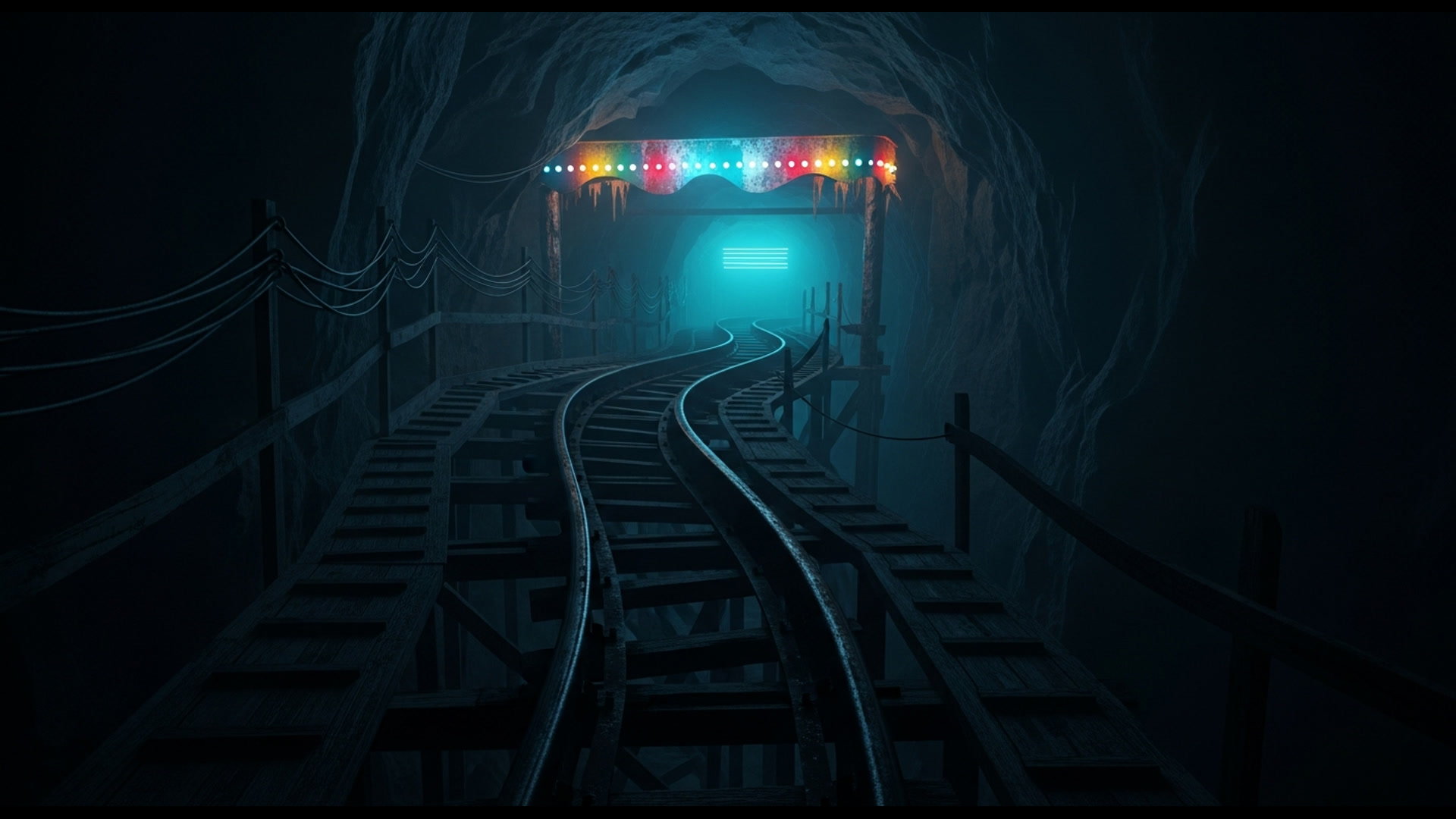
Until Dawn: Rush of Blood: The Carnival Ride Through Hell
Here’s the thing about Until Dawn: Rush of Blood — it isn’t Until Dawn in VR. Supermassive Games didn’t port their choice-driven horror narrative into a headset and call it a day. They built something weirder: a literal carnival dark ride where you sit in a mine cart, dual-wield pistols, and shoot everything that jumps out at you while the track drags you through seven themed circles of nightmare. It shares the universe — the mountain lodge, the asylum, the Wendigo, Dr. Hill’s unsettling therapy sessions — but this is an arcade rail shooter first and a narrative experience a distant second. That distinction matters, because going in expecting more Until Dawn is the fastest way to feel cheated.
I want to be clear about what this is, because the marketing and the branding invite confusion. Rush of Blood is a standalone PSVR title, not a mode or DLC for the 2015 flat game. You don’t need Until Dawn to play it. You need a PSVR headset, two PS Move controllers (or a PS Aim controller if you prefer a shotgun), and the stomach for jump scares delivered at arm’s length in a dark room. It launched alongside the original PSVR in October 2016 and has never been ported to PSVR2 — it runs on PS5 only through backwards compatibility, which keeps it alive but not exactly future-proofed.
The setup is practically frictionless by PSVR standards. Put on the headset, calibrate your tracking space, pick up your controllers, and you’re in. No BepInEx wrangling, no OpenXR configs, no community mod threads to dig through. This is a first-party-adjacent launch title, and it shows — the tutorial is brisk, the calibration is minimal, and within five minutes you’re riding a cart through a clown-infested carnival while Dr. Hill monologues at you about your fears. The on-rails movement eliminates the comfort issues that plague free-locomotion VR horror; the cart moves for you, smoothly and predictably, while your job is purely aim and shoot. For players new to VR who want horror without the motion sickness, this is one of the more approachable entry points on the platform.
The shooting itself is where Supermassive’s design instincts shine. Dual PS Move controllers map naturally to semi-automatic pistols — one in each hand, independent aim, independent reload by pointing the controllers downward. The physical reload gesture becomes muscle memory fast, and the ability to cover two directions at once adds a layer of spatial awareness that flat-screen rail shooters can’t replicate. The PS Aim controller offers an alternative: a pump-action shotgun with tighter tracking stability and a satisfying physical pump reload, trading the dual-wield fantasy for more deliberate, powerful shots. Both control schemes work, though the dual-pistol setup is what most players remember — it’s the “intended” experience, and the one that best justifies why this had to be in VR at all.
The seven chapters escalate in intensity and visual ambition, moving from carnival grounds through the asylum, the mountain lodge, dark mines, and finally confrontations with the masked killers and the Wendigo itself. Each ride lasts ten to twenty minutes, putting the full campaign at roughly two to three hours on a first playthrough. That’s short by conventional game standards, and it’s the first real caveat — this is an arcade experience priced and structured like a full release, and not everyone will be comfortable with that tradeoff. The branching path system mitigates this slightly: an early choice sends you down one of two routes for later chapters, meaning you’ll miss content on a single playthrough and need at least two runs to see everything. Combined with a five-tier difficulty system, hidden collectibles, and online leaderboards for score chasing, there’s enough mechanical incentive for players who gel with the arcade loop to squeeze more time out of it. But the core content is finite, and the shooting gallery formula doesn’t evolve dramatically across those seven chapters.
What does evolve is the horror. Rush of Blood weaponizes PSVR’s sense of presence in ways that still hold up. Enemies grab at you from the periphery, forcing physical turns. Jump scares land from behind your actual head, not just the camera’s field of view. Dr. Hill’s fourth-wall-breaking therapy sequences feel genuinely invasive when he’s staring at you in the headset rather than at a flat screen. The dark environments and flashlight effects benefit from the PSVR’s OLED black levels, and the creature design — particularly the Wendigo up close — carries a weight that the original Until Dawn’s cinematic framing couldn’t quite match. This isn’t deep psychological horror; it’s carnival haunted-house horror, designed to startle and unsettle rather than disturb. But it commits to that tone with confidence, and in VR, the startles land harder.
The technical execution is notably polished for a 2016 launch title. Frame rate holds steady, loading is reasonable, and the tracking integration — while limited by the PS Camera’s constraints — is thoughtfully implemented. PS Move drift is a known hardware limitation, and you’ll feel it during longer sessions or in suboptimal lighting, but the game compensates with generous aim assist and a control scheme that doesn’t demand pixel-perfect precision. The PS Aim controller sidesteps some of the drift issues entirely, though at the cost of the dual-wield immersion that defines the experience for most players.
The limitations are honest ones, and they should shape your decision. This is a rail shooter — not an open horror experience, not a narrative continuation of Until Dawn’s branching story, and not a game that transforms significantly on repeat playthroughs beyond score optimization and collectible hunting. The narrative is minimal scaffolding: you’re a carnival attendee trapped in a literal ride through hell, with Dr. Hill narrating your psychological unraveling. The connection to Until Dawn is atmospheric and nostalgic rather than substantive. If you come to this expecting choices that matter, you’ll be disappointed. If you come expecting a tight, polished, occasionally terrifying arcade shooter that happens to be set in a universe you recognize, you’ll get what you paid for.
The absence of a PSVR2 version is the lingering question. Backwards compatibility keeps the original PSVR version playable on PS5, but without the enhanced resolution, improved tracking, headset rumble, and eye-tracking that a native port could offer. Supermassive did build a spiritual successor — The Dark Pictures: Switchback VR, released on PSVR2 in 2023 — which offers a similar on-rails horror shooter experience on the newer hardware. It’s not the same game, but it fills a similar niche for PSVR2 owners who want the Rush of Blood formula on current-gen hardware.
So who is this actually for? It’s for PSVR owners who want a confident, low-friction showcase piece that demonstrates what motion-controlled horror can feel like at its best. It’s for Until Dawn fans who want to step inside that universe’s nightmares rather than watch them unfold cinematically. It’s for players new to VR who need a comfortable, guided experience without artificial locomotion. And it’s for arcade shooter enthusiasts who don’t mind a short campaign if the mechanical loop is tight enough to justify score chasing.
Who should skip it? Anyone seeking substantial narrative content, anyone expecting Until Dawn’s choice-driven storytelling, anyone who finds jump scares unpleasant rather than thrilling, and anyone without access to the original PSVR hardware. This is not a must-play for the broader VR ecosystem — it’s a strong execution of a narrow concept, bound to a platform generation that has since moved on.
The bottom line: Until Dawn: Rush of Blood is a B-tier experience executed with A-tier polish. Supermassive built something specifically for VR rather than adapting around it, and that purpose-built quality shows in every reload gesture, every jump scare, every smooth cart transition. It’s short, it’s simple, and it’s honest about both of those things. For the right player — someone with the hardware, the stomach for horror, and expectations calibrated to “arcade shooter” rather than “narrative sequel” — it’s one of the better ways to spend a few hours in PSVR. For everyone else, it’s a compelling curiosity that probably isn’t worth buying hardware for. Know what you’re getting into, and it delivers exactly what it promises.