
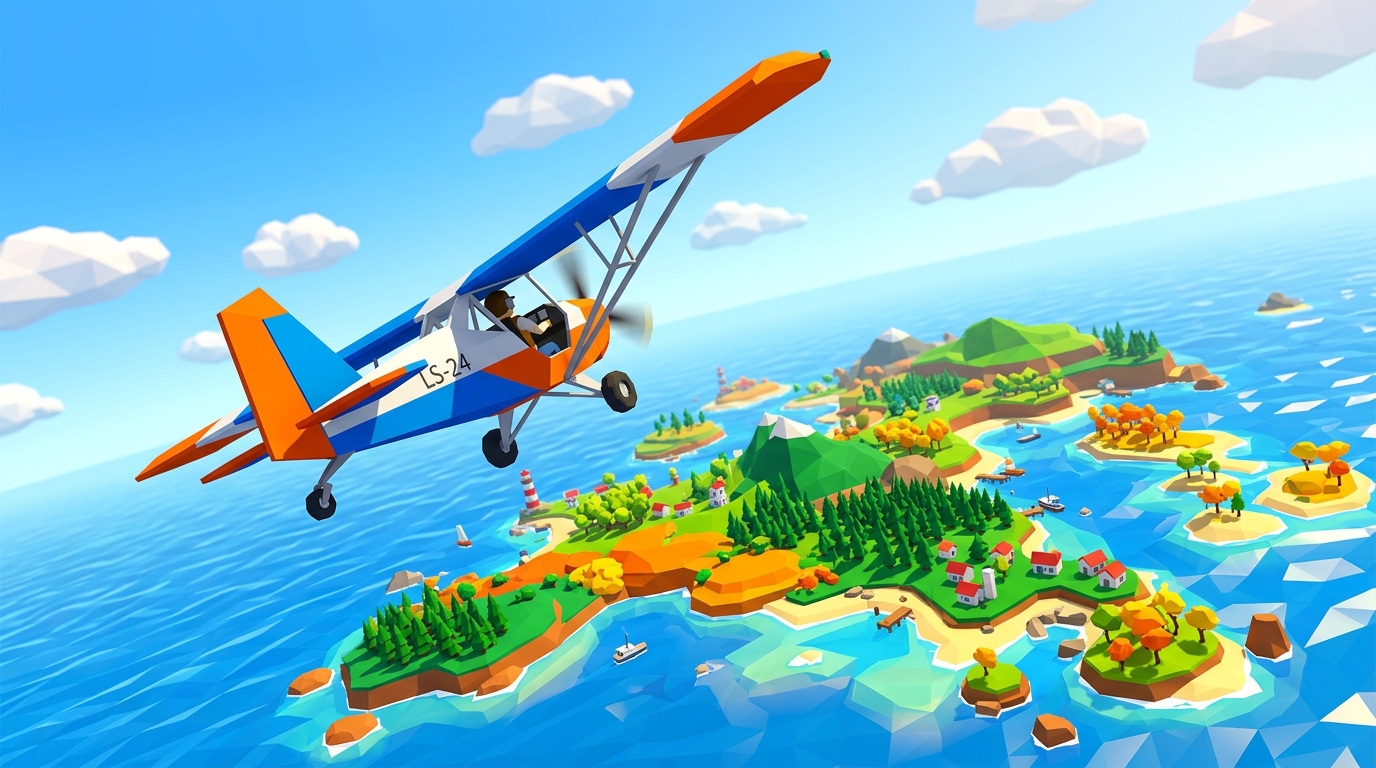
The first time you wrap your fingers around a virtual flight stick and pull back, something clicks. It isn’t the realism — Ultra Wings is stylized, arcade-leaning, and built on blocky islands floating in a bright blue void. It’s the physicality. Developer Bit Planet Games didn’t set out to build a flight simulator. They built a toy cockpit that happens to fit over your head, and the result is one of the most approachable VR flying experiences on the market.
Released in 2017 for PC VR and later PSVR and Quest, Ultra Wings is a standalone VR title with no flat-screen counterpart. You pilot light sport aircraft across an archipelago of islands, completing missions to earn cash, unlocking new planes and airports along the way. There are no enemy jets to shoot down, no complex avionics to master, and no narrative campaign to speak of. Just you, a handful of aircraft, and a sky full of balloons, rings, and photo opportunities.
The heart of the experience is the motion control system. On PC VR and Quest, you grab the virtual stick and throttle with your hands, flick switches, and physically lean into turns. PSVR players can use Move controllers for the same effect, though the tracking fidelity on that platform makes the controls fussier. Even on the better-tracked headsets, the flight stick can feel finicky — it has a habit of not releasing cleanly or drifting slightly when you think you’ve centered it. It isn’t broken, but it demands a lighter touch than you’d expect. After a few flights, you adapt. The adjustment period is part of the charm, like learning to handle a real aircraft’s quirks.
The flight model splits the difference between arcade and simulation. There’s a toggle if you want more realism, but the default setting is forgiving enough that you won’t stall on every landing attempt. That accessibility is the point. Ultra Wings wants you in the air, not in a manual. The planes feel distinct — the ultralight is twitchy and responsive, the glider demands you read thermals, and the larger aircraft carry more weight through their turns. None of it is DCS-level fidelity, but each craft has enough personality that switching between them keeps the early hours fresh.
Missions are where the game lives or dies for you. The structure is simple: pick an airport, select a job, complete it for cash, repeat. Jobs range from popping balloons and flying through rings to taking photographs of landmarks, performing spot landings, and handling emergency touchdowns with your engine out. Early on, the variety is engaging. The ring races require precision, the photo missions force you to manage altitude and angle simultaneously, and the emergency landings create genuine tension. But the loop eventually thins out. The tasks are functionally identical across islands, just relocated to prettier backdrops. After ten or twelve hours, you’ll have seen every mission type multiple times, and the grind to afford the next plane starts to feel like padding.
That said, the world itself is a pleasure to move through. The art style is clean and stylized — low-poly islands with bold colors, simple buildings, and water that glints in the sun. It isn’t trying to be photorealistic, and that works in its favor. The simplified geometry keeps performance stable even on modest hardware, and the quick loading times mean you’re rarely waiting between flights. The music is pleasant but loops too aggressively; you’ll probably mute it after a few sessions.
Comfort is the elephant in the cockpit. Ultra Wings is a full six-degrees-of-freedom flight game with no comfort vignetting by default, and it will test your VR legs. The sense of speed and altitude is real — banking hard around a cliff face or dropping into a canyon feels genuinely vertiginous. For experienced VR users, that’s the selling point. For newcomers, it’s a trial by fire. Bit Planet includes comfort settings, but they blunt the experience. If you’re prone to motion sickness, start with short sessions and work your way up.
The game runs well across its platforms. PC VR players get the sharpest image and best controller tracking, Quest players get the benefit of untethered flight, and PSVR owners get a solid if slightly blurrier experience with the caveat that Move tracking introduces more control friction. There is no PSVR2 version of the original Ultra Wings — the sequel, Ultra Wings 2, occupies that space — but the original remains available on the first-generation headset for those still using it.
Who is this for? Anyone who has looked at VR flight games and been intimidated by the complexity of full simulators. Ultra Wings is the gateway drug — approachable enough to pick up in an evening, deep enough to keep you chasing faster lap times and cleaner landings for weeks. It is not for players who need narrative structure, competitive multiplayer, or military-grade systems depth. It is also not for VR newcomers who have not yet found their comfort legs; the freedom of flight here comes with a real motion sickness cost.
At its best, Ultra Wings delivers something rare: the feeling of genuine skill expression in a virtual cockpit, earned through practice rather than memorized button combinations. The motion controls give your hands a role to play that a gamepad simply cannot replicate. The mission variety runs out of steam before the mechanics do, and the grind is undeniable. But when you’re threading a ring at low altitude, throttle open, sun in your eyes, the stick vibrating in your grip, the complaints fade into background noise. This is a game that understands why people want to fly in VR — not to dominate a battlefield, but to feel the stick in their hand and the sky all around them.