
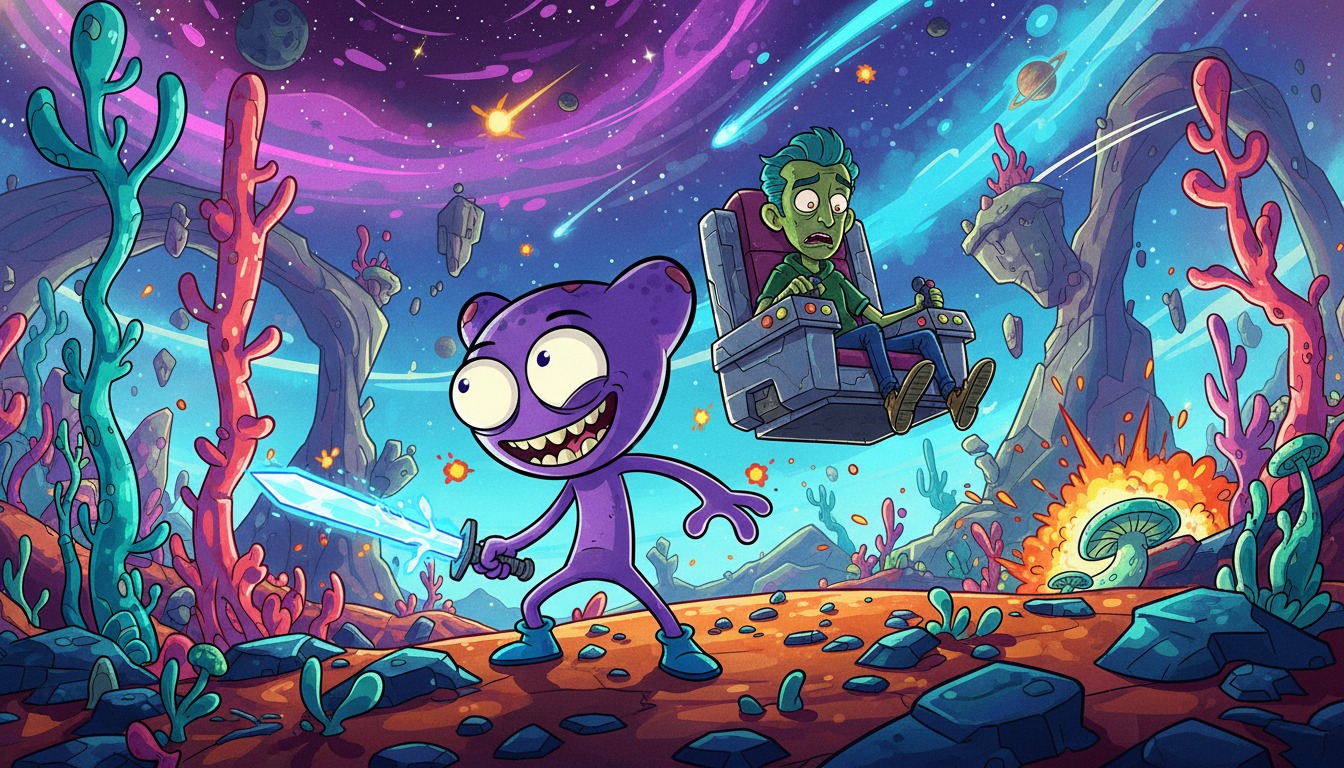
The first thing that hits you in Trover Saves the Universe is the voice. Not the tutorial voice, not the atmospheric score — Justin Roiland’s voice, babbling out of every character, breaking the fourth wall, making fun of you for sitting in a headset, and generally refusing to let the game be a normal video game. This is not a subtle experience. This is a comedy grenade dressed up as a platformer, and in VR, that grenade goes off about six inches from your face.
You are a Chairorpian, a purple alien permanently glued to a floating chair. Your dogs have been stolen by an evil being named Glorkon, and your only hope is Trover, a foul-mouthed, eye-hole-plugging creature who takes your commands and runs, jumps, and smashes his way through bizarre planets. The narrative setup is intentionally stupid, which is the point. The game is not trying to sell you on epic stakes. It is selling you on the pleasure of watching a tiny monster insult you while you command him to murder innocent bystanders because they might have a collectible.
The genius of the VR design is that your character never moves. You teleport between fixed nodes to follow Trover, while he does all the actual platforming. For anyone who has ever felt queasy watching a tiny mascot leap across chasms in first-person, this is a revelation. You get the spatial presence of being in the world without the stomach-churning camera lurch. Your chair can rise and lower, giving you vertical flexibility to look around obstacles or find hidden paths, but you are never artificially sliding through space. It is one of the most comfort-conscious full-length VR experiences available, and it makes the game accessible to players who typically cannot handle motion in a headset.
That presence matters because the world is built to be looked at. Squanch Games has packed every environment with weird detail — aliens having existential crises in the background, signage with genuinely unhinged writing, and NPCs who will not stop talking to you. In VR, you are not watching this absurdity; you are sitting in it, being addressed directly by characters who know you are a person in a headset. The comedy lands harder when a villain pauses mid-monologue to ask if your “eye screens” are bothering you, or when Trover yells at you to stop looking at the wall and pay attention. The flat-screen version is perfectly playable — the game was designed to work both ways, and you can swap between them seamlessly — but the second-person perspective and direct address lose some of their punch when you are watching from across a living room. In a headset, you are the straight man in a cosmic comedy routine, and that role is genuinely unique.
The humor is relentless, and whether that is a selling point or a warning depends entirely on your tolerance for Roiland’s specific brand of improvisational, loosely-scatalogical absurdism. There is a plot, technically, about saving the universe, but the game treats it as an inconvenience. The real substance is the dialogue, which is so densely packed that missing a line because you looked at the wrong alien feels like a genuine loss. This is a game that wants to make you laugh first and platform second.
The platforming, unfortunately, is second in quality as well as priority. Trover controls well enough — he runs, double-jumps, glides, and swings a lightsaber-style weapon at enemies — but the mechanics never evolve beyond competent. Combat is basic melee slashing with occasional projectile deflection. Puzzles are straightforward environmental challenges that rarely require more than moving a block, throwing an object, or hitting a switch. The game is only five to eight hours long, and by the third hour you have seen most of what the systems have to offer. What keeps you moving is the writing, not the gameplay loop. It is tempting to compare it to Astro Bot Rescue Mission because both are third-person platformers in VR, but Astro Bot is a precision instrument and Trover is a sledgehammer made of joke books. They are doing entirely different things.
On PlayStation VR, the experience is built around the DualShock 4, which feels natural for a third-person platformer. On PC VR, the situation is more complicated. Motion controller support exists — you can play with Oculus Touch or Vive wands — but the mapping is awkward. Rotating objects, performing specific attack inputs, and navigating menus all feel smoother on a gamepad. The motion control implementation works, but it is clearly not the primary design target. If you have a gamepad nearby, use it. This is not a motion-control showcase; it is a comedy experience that happens to support VR.
Performance is not a concern. The art style is colorful and cartoonish rather than technically demanding, and the fixed-camera design means the engine is never struggling to keep up with rapid player movement. Framerates stay stable, load times are reasonable, and the game never crashes the immersion with a stutter. On Quest, the port holds up surprisingly well, though the visual detail takes a predictable hit compared to PC and PS4 Pro.
The real question is whether the comedy is worth the relatively shallow gameplay, and in VR, the answer leans toward yes. If you love Rick and Morty, absurdist humor, or the idea of being heckled by aliens while sitting in a virtual chair, this is an easy recommendation. If you want tight platforming, deep combat systems, or a twenty-hour adventure, look elsewhere. Trover Saves the Universe is a B-tier platformer elevated by A-tier comedy, and in VR, that comedy finds its perfect stage.