
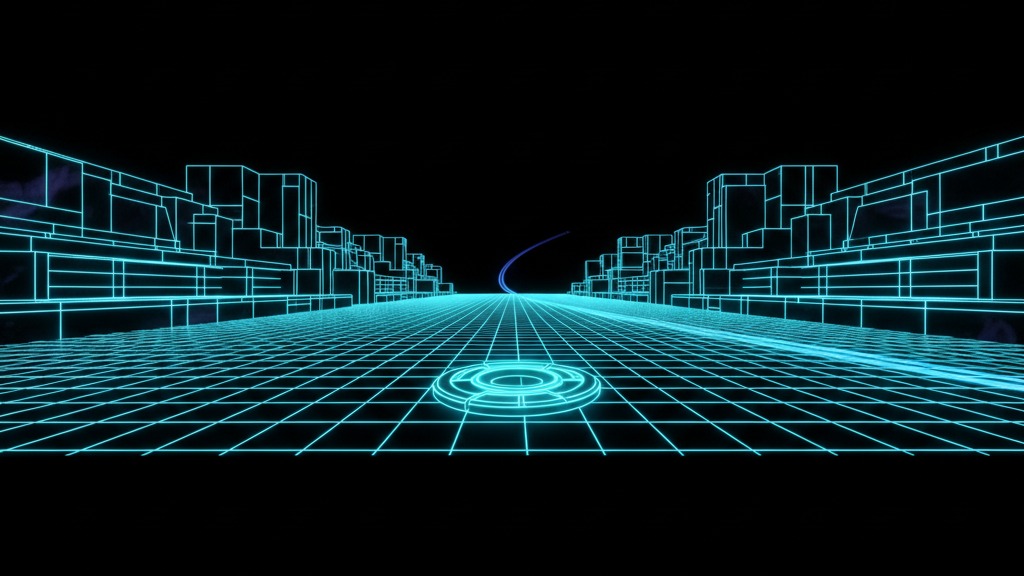
Some games were born to be seen in stereoscopic 3D. TRON 2.0, Monolith Productions’ 2003 first-person shooter, is one of them. The neon grid lines, glowing architecture, and infinite pitch-black voids of its computer-world aesthetic don’t just work in VR — they practically demand it. Seeing the Grid wrap around you in head-tracked 3D is the closest most people will get to actually standing inside the 1982 film.
Here’s the thing: there is no official VR support, no community mod with rebuilt systems, no motion controls. The way to play TRON 2.0 in a headset is through VorpX, the paid injection driver that forces stereoscopic 3D and head tracking into flat games. That means the experience comes with every limitation the format implies. You get head tracking. You get genuine depth perception. You do not get hands. You do not get physical interaction. You are playing a two-decade-old keyboard-and-mouse shooter with a gamepad, inside a VR viewport.
VorpX carries a built-in profile for TRON 2.0, which removes much of the usual injection-driver guesswork. The profile is mature enough that, for most users, it hooks automatically and handles field-of-view adjustments without manual editing. There is a catch: VorpX needs write access to the game’s installation folder to apply its tweaks, which means installing TRON 2.0 outside of Windows’ protected program directories. If you park it on a secondary drive or a user-accessible folder, the profile typically just works. If you don’t, you’ll get a zoomed-in, slightly nauseating FOV that no amount of menu fiddling will fix. One restart usually resolves it, sometimes two.
On modern hardware, performance is a non-issue. A twenty-year-old shooter built for 2003 GPUs runs at high frame rates without breaking a sweat, and the clean, high-contrast art style with its bold neon-on-black palette masks the age of the polygonal assets. The game looks striking in VR precisely because its aesthetic was already abstract and geometric — low-poly glowing architecture ages better than photorealistic attempts from the same era.
Once it’s running, the visual impact is immediate and substantial. The Grid’s architecture stretches upward in genuine depth. Corridors that felt claustrophobic on a monitor become vertiginous vertical spaces. Light cycles streak past with actual positional presence rather than flat-screen parallax. The identity disc combat — throw against a wall, ricochet around a corner, recall it to your hand — gains a spatial quality that the flat screen never provided. For anyone who grew up with the film, this is genuinely affecting. It doesn’t feel like a native VR game, but it does feel like you’ve stepped onto the soundstage.
The controls are where the compromise becomes impossible to ignore. VorpX maps gamepad or keyboard-and-mouse input to VR controller buttons, but there is no motion-control aiming, no hand presence, no physical disc throwing. The recent motion-gesture updates to VorpX don’t change the core reality: you’re playing a 2003 shooter with a gamepad, and your head is the camera. For a slow, deliberate corridor shooter, this is acceptable. For anyone who has experienced native VR combat, the abstraction feels thin. You aim with a stick, you shoot with a trigger, and you occasionally remember that you’re wearing a headset because the depth is pretty.
There is also a persistent visual bug that VorpX users have reported consistently: the weapon and hand models can render at comically large scale, sometimes floating at the player’s feet or occupying half the lower screen. The identity disc, which should be a sleek glowing frisbee at the edge of your vision, can become a dinner plate blocking your view. The standard workaround — hiding the weapon model entirely with a launch parameter — removes the problem but also strips away your on-screen disc, which is central to the game’s visual identity. Some players experiment with player-model FOV adjustments instead, but this is trial-and-error territory with no clean solution. It’s not a dealbreaker, but it’s a recurring annoyance that reminds you, every time you look down, that this was never built for headsets.
The game underneath the injection layer holds up better than its age suggests. Monolith built a shooter with a genuine RPG skeleton — subroutines that slot into your build like skills, a shared energy pool that forces weapon-choice strategy, and the identity disc that remains viable from the tutorial to the final encounter. The level design is linear but atmospheric, full of verticality and environmental storytelling that fits the computer-world fiction. The light cycle sequences, presented as arena duels rather than racing, are brief palate cleansers that break up the shooting. The story follows Jet Bradley into the computer world to stop a virus, and it commits to its source material with a sincerity that Disney’s later TRON projects rarely matched.
Comfort is generally manageable, which matters for a game that takes eight to twelve hours to complete. TRON 2.0 has no sprint mechanic, no sudden camera cuts, and no forced head movement. The flat UI and menus are readable but clearly not designed for VR — expect to lean in slightly for inventory management. The light cycle sequences, with their tight turning radius and close camera, can induce mild discomfort, but they’re short and infrequent. The Killer App Mod, a fan patch that adds widescreen support and modern resolution compatibility, pairs well with VorpX and is worth installing for the visual polish, though it doesn’t change anything about the VR implementation itself.
So who is this actually for? TRON 2.0 in VR is a recommendation with a very narrow addressable audience. If you already own VorpX and you have any affection for the TRON universe, this is one of the best uses of the driver — the visual payoff is genuine, the profile is stable, and the underlying game is worth the time. If you don’t own VorpX, buying a paid injection driver solely for a twenty-year-old Disney shooter is a harder sell. The experience is atmospheric and occasionally stirring, but it’s still an injection-driver profile with no motion controls, a visible weapon-model bug, and the persistent knowledge that you’re playing through a translation layer.
The honest bottom line: TRON 2.0 in VR is a beautiful curiosity, not a destination. It proves that some aesthetic visions transcend their technical era, and that head-tracked stereoscopy can be enough when the world itself is this visually distinctive. But it also proves that injection drivers have a hard ceiling, and this game bumps against it in nearly every combat encounter. Play it if the Grid means something to you and the cost of entry is already paid. Everyone else should admire the concept and spend their time on something built for the hardware.