
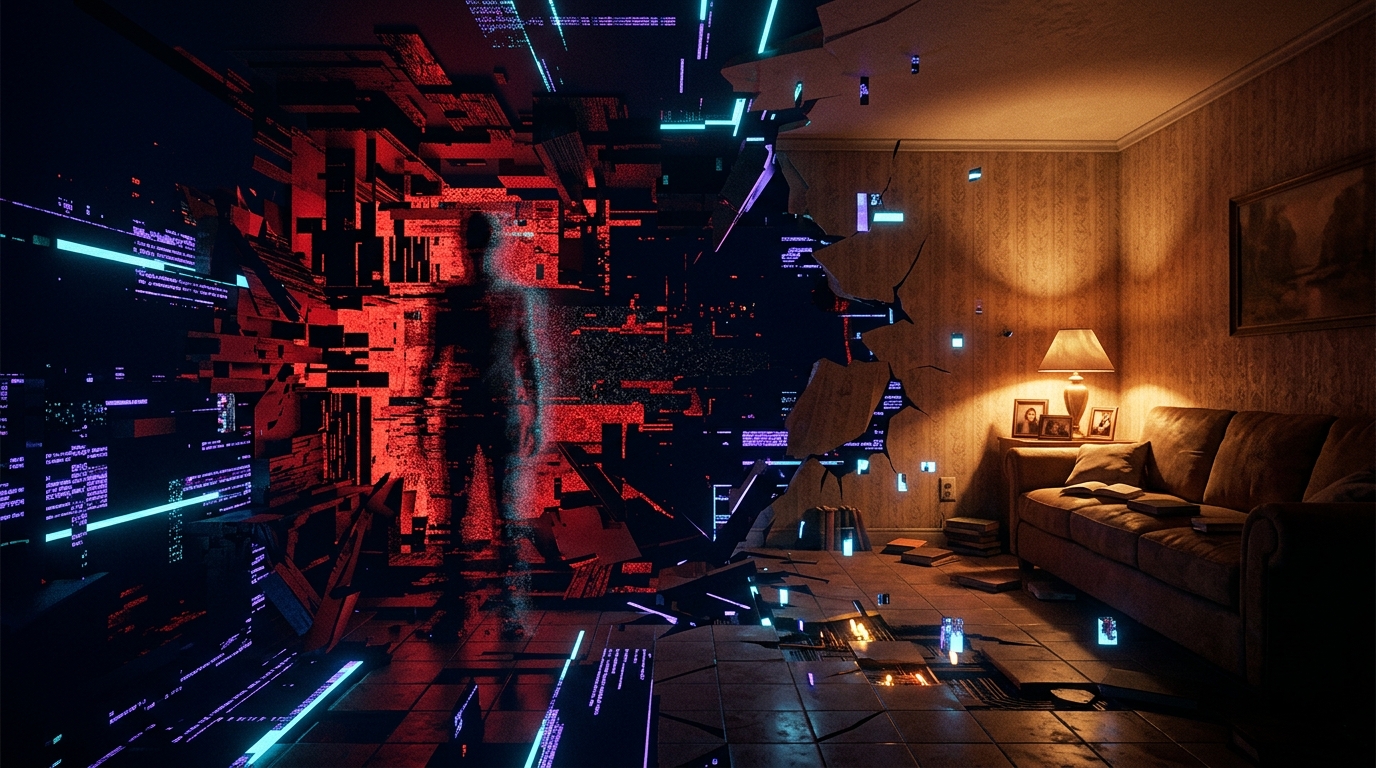
Raymond Hayes wants you to know he has solved death. In the opening live-action clip of Transference, the scientist stares into the camera with the unsettling calm of a man who has already crossed a line he cannot uncross. He has digitized consciousness. He has preserved his family forever. He has, in his own words, built paradise. What he has actually built is a corrupted simulation where doors glitch into voids, hallways loop back on themselves, and the people you love scream at you from inside the walls.
That is where you come in.
Transference is a collaboration between Ubisoft Montreal and SpectreVision, the film production company co-founded by Elijah Wood. That Hollywood DNA matters. This is not a game with cinematic aspirations — it is a film that happens to be a game, and in VR, that distinction collapses entirely. You are not watching a family unravel. You are standing in their apartment while it happens around you, and the headset makes every creaking floorboard, every flickering light, and every distorted voice feel like it is happening inside your own skull.
The premise is deceptively simple. Hayes has uploaded the consciousness of himself, his wife Katherine, and his son Benjamin into a shared virtual space — a replica of their family home. Something went wrong. The simulation is degrading. Rooms exist in multiple states simultaneously. Objects appear and disappear depending on whose memory you are standing in. You solve environmental puzzles by flipping light switches to toggle between two versions of the apartment: one warm and lived-in, the other soaked in a red-black corruption of glitch textures and broken geometry.
The puzzles are straightforward. You carry key objects between realities. You tune radios, press buzzers, align clocks. None of it is mechanically demanding, and that is the point. The game wants your mind free to absorb the atmosphere, not occupied by brain-teasers. When a solution clicks, it usually reveals something worse — a hidden recording, a distorted memory, a glimpse of the thing stalking the corridors.
Because yes, there is a thing. Transference is not a pure walking simulator. It is a psychological thriller with genuine horror moments, including a handful of jump scares that land with real force in VR. You cannot fight back. You cannot even run — your movement is deliberately slow, methodical, almost dreamlike. When the creature appears, your only option is to keep moving and hope it loses interest. The restraint works. The terror comes from helplessness, not combat.
The live-action footage is woven into the world seamlessly. Video recordings of Hayes, played with unnerving conviction by Macon Blair, flicker to life on screens and walls. Environmental storytelling fills in the gaps — a child’s drawing, a broken photograph, an audio log of a dinner argument that spirals into something darker. Pick up a family photo and Raymond might remember a vacation fondly. Switch to Katherine’s perspective and the same photo carries the weight of resentment. The apartment is small, but the emotional space it contains is enormous.
At about 90 minutes to two hours, Transference is undeniably short. At a twenty-five dollar launch price, that stings. Some will finish it in a single sitting and wish there were more. Others will argue that the tight pacing is exactly what the experience needs — any longer and the tension might deflate into tedium. Both positions are fair. What is not debatable is that the game uses every one of those minutes with precision. There is no filler here. Every room, every recording, every corrupted hallway serves the same purpose: to make you feel like you are trapped inside someone else’s breakdown.
The VR implementation is polished, which is what you should expect from an official Ubisoft release. You can play the entire game seated or standing. The game auto-detects your height. Comfort options include adjustable vignette blinders, variable snap-turn angles, and smooth turning for those who can handle it. Object interaction uses standard motion controller grabbing — your hands appear as ghostly blue outlines, visible enough to be functional but translucent enough to avoid breaking the mood.
Performance is stable across platforms. On PC, the game runs efficiently on hardware that was mid-range even in 2018. The visual fidelity punches above its weight, with detailed textures, excellent lighting, and a sound design that is genuinely some of the best in VR horror. Spatial audio places voices behind you, above you, inside walls. Headphones are not optional.
The one caveat worth noting is that this is a hybrid release — the same build exists in VR and flat-screen versions on PC, PS4, and Xbox One. You can play it without a headset. You should not. The flat version preserves the story and puzzles, but it loses the spatial presence that makes Transference work. Standing in that apartment, physically turning to follow a voice down a hallway, reaching out to touch a photograph that changes depending on who you are — these are not gimmicks. They are the entire reason the game exists.
This is not an experience you replay. There are no branching paths, no multiplayer modes, no New Game Plus. Once you have seen the ending, you have seen it. What Transference offers instead is a single, concentrated dose of psychological unease, delivered by people who understand that the most frightening thing in any room is not the monster — it is the silence before you realize where the monster is standing.
For VR players who want a narrative experience that respects the medium, Transference is a strong recommendation. Just go in knowing you are buying a short, intense evening, not a weekend. And maybe do not play it alone in the dark. Hayes already proved that some doors, once opened, cannot be closed.