
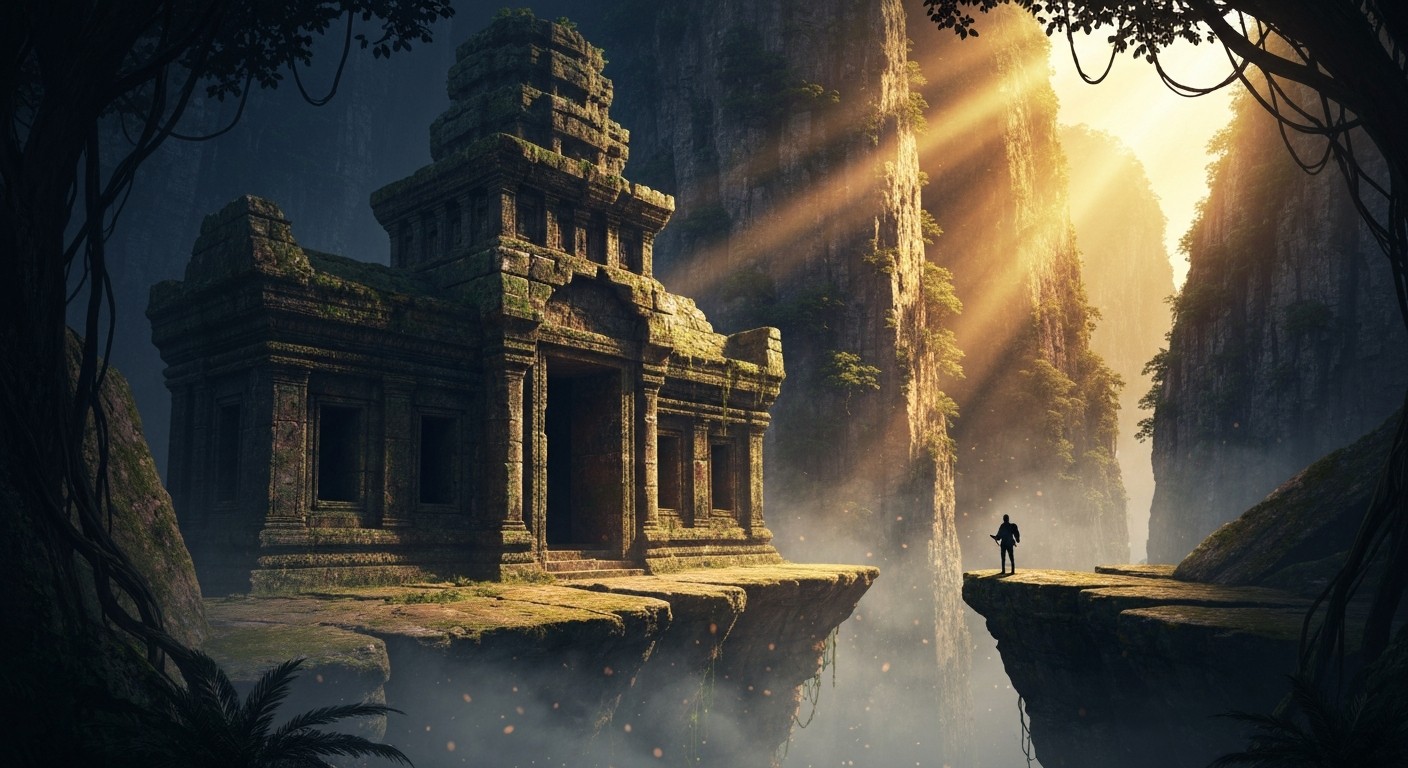
There’s a moment in Tomb Raider: Legend where Lara scales a sheer cliff face in Bolivia, ice picks biting into rock, wind howling through the canyon below. In the original 2006 release, it was a perfectly fine platforming setpiece — press jump, time the grab, watch the animation. In VR, with actual stereoscopic depth to the chasm dropping away beneath her boots, that same sequence takes on a completely different quality. Your stomach lurches. You lean forward in your chair. For about three seconds, you’re actually there — until the camera snaps to a new angle and the illusion shatters.
That’s Tomb Raider: Legend in VR in a nutshell. Glimmers of something genuinely striking, followed by reminders that you’re forcing a nearly 20-year-old third-person action game into a headset it was never designed for.
The interesting part is that there are two distinct ways to do it. The older, and arguably more compelling, is Dolphin VR — a fork of the GameCube emulator with built-in stereoscopic 3D and 6DOF head tracking. The GameCube version of Legend runs cleanly under it, and the result is a console game freed from the flat screen: you can lean in to examine Lara’s surroundings, look around environments independently, and get real spatial depth on every jump, waterfall, and crumbling temple. The newer option is VorpX, a commercial injection driver for the PC version that hooks into the DirectX pipeline and outputs Geometry 3D. Both produce genuine stereoscopy. Both require tinkering. Neither gives you motion controls or a VR-native UI. You are still a disembodied camera operator floating slightly above and behind Lara Croft.
Setting up Dolphin VR means getting the GameCube release running in the emulator, enabling the VR backend, and tuning the stereoscopic separation to something your stomach can tolerate. The 6DOF head tracking is the real draw here — leaning around a corner in the Ghana ruins or peering down a Nepalese ice shaft feels meaningfully more present than the locked-to-avatar camera of the VorpX path. There are caveats, of course. The fixed HUD, the in-engine cutscenes, and the third-person camera all remain products of a non-VR game. Text and UI elements that were readable on a TV become harder to parse inside a headset. Some users report needing to tweak per-camera settings or disable certain effects to keep frame pacing stable. But the core experience — exploring Crystal Dynamics’ colorful, compact setpiece levels with proper head-tracked depth — is there in a way that feels more natural than injection.
The VorpX path, meanwhile, is more finicky on the front end. You need RJK_’s profile for the Original renderer — not the “Next Generation Content” mode that added enhanced shaders and lighting to the PC release. The Next Gen effects flat-out break under VorpX, which means you’re accepting noticeably flatter lighting, simpler water, and generally less impressive visuals in exchange for stereoscopic depth. There’s a shader fix pack to download, and if you’re on the Steam version, you might need to rename the executable to get VorpX to hook at all. Oh, and disable water effects entirely — they glitch in G3D mode.
This is not a plug-and-play experience. It’s a “spend twenty minutes in forums” experience.
Once either path is running, what you get is real Geometry 3D — actual stereo separation, not depth-buffer fakery. Environments have actual volume. The Nepal ice caves feel cavernous. The Ghana waterfalls stretch out in convincing depth. Platforming benefits more than you’d expect; judging distances for jumps is noticeably easier when your brain can actually process the spatial relationship between Lara and the next ledge. Headtracking works as camera control, letting you look around the environment independently of where Lara is facing. In slower, exploration-heavy sections, it’s genuinely pleasant — a kind of virtual tourism through Crystal Dynamics’ 2006 vision of exotic locales.
The problems show up whenever the game remembers it’s an action game.
Combat is the big one. You’re aiming a reticle with a gamepad stick while wearing a VR headset, and the disconnect between your physical head position and the flatscreen targeting system never resolves. The game auto-aims aggressively to compensate for its controller roots, which only makes the disconnect feel stranger — your head says you’re in the space, but your hands are playing a 2006 TPS from the couch. Third-person camera swings during ledge grabs and vaults can be disorienting. The fixed HUD, while functional, floats in your peripheral vision like a reminder that none of this was meant to be here.
And then there’s the fundamental awkwardness of third-person VR through either an emulator or an injection driver. You’re not Lara. You’re floating behind her, slightly above and to the right, watching her animate through a world that has depth but no physical presence. There’s no hand tracking, no motion controls, no body embodiment. For some people that’s fine — for others it’s the uncanny valley of VR, close enough to feel like it should be immersive without ever actually getting there.
Performance is where things get merciful. This is a 2006 game. Even with Dolphin VR overhead or VorpX’s stereoscopic doubling, it’ll run at solid frame rates on hardware that would laugh at modern AAA titles. The GameCube version is even lighter. Mid-range systems and up should have no trouble maintaining smooth performance, which matters more than you’d think for comfort in an emulator or injection driver.
Comfort itself is a mixed bag. Third-person perspective keeps the nausea risk lower than first-person injection would, but the camera’s aggressive auto-alignment during platforming — snapping to new angles when Lara grabs a ledge or enters a new area — can still provoke that familiar lurch. Dolphin VR’s 6DOF tracking can actually make this worse if you’re leaning around during one of those camera snaps. I wouldn’t call it comfortable, but it’s manageable for sessions under an hour. Your mileage will vary based on your VR legs.
Here’s the honest question this article needs to answer: who is this actually for?
Not for someone looking for their first great VR experience — there are dozens of native titles that do everything better. Not for someone who wants to “experience Tomb Raider in VR” for the first time — Team Beef’s OpenLara port of the original 1996 game, or the various official VR offerings in newer titles, are far more coherent. This is for a very specific person: someone who already has Dolphin VR or VorpX set up, already loves Legend specifically (not Anniversary, not Underworld — Legend), and wants to revisit that particular game with an extra layer of spatial depth. The nostalgia has to be strong enough to justify the setup friction, the camera compromises, and the eternal gamepad-in-headset compromise.
If that’s you, start with Dolphin VR if you can. The head-tracked depth and 6DOF leaning make it the more interesting version of the same idea. The VorpX profile is a viable fallback for the PC-only crowd, and the geometry 3D is real, but it feels more like a technical proof of concept than a better way to play.
Tomb Raider: Legend is a solid action-adventure platformer from an era when the series was finding its footing again. In VR, via either path, it becomes a curiosity — technically competent, occasionally striking, ultimately compromised. Play it if the specific nostalgia calls to you. Everyone else should keep scrolling.