
Thumper in VR: Rhythm Violence Perfected
Some games tolerate virtual reality. Thumper demands it.
This self-described “rhythm violence” game from two-person studio Drool was there at the beginning — launching October 2016 alongside the original PlayStation VR as one of its flagship titles. But calling Thumper a PSVR launch game undersells what it actually is: a flat game designed from the ground up to work in VR, where the headset turns something excellent into something transcendent.
The result is one of the most intense, immersive, and genuinely transformative VR experiences available — a game that plays identically on a monitor or in a headset, but feels fundamentally different depending on which you choose.
What This VR Option Actually Is
Thumper is an Official Hybrid — a flat game with VR support built in from launch. There’s no separate VR version to buy, no mod to install, no launcher that switches between modes. You just… toggle VR on or off in the options menu.
Same game. Same content. Same controls. The only difference is whether you’re viewing it on a screen or through a headset.
This is the cleanest possible implementation of hybrid VR support:
- No motion controls — Thumper uses a standard gamepad in both flat and VR modes
- No VR-specific features — no hand tracking, no room-scale interactions, no teleport
- No separate VR mode — the entire game is playable start to finish either way
- No setup burden — if the game launches and your headset is on, you’re playing in VR
The VR implementation is essentially “the flat game, but projected around you in 3D space.” And somehow, that’s all it needs.
How It Plays
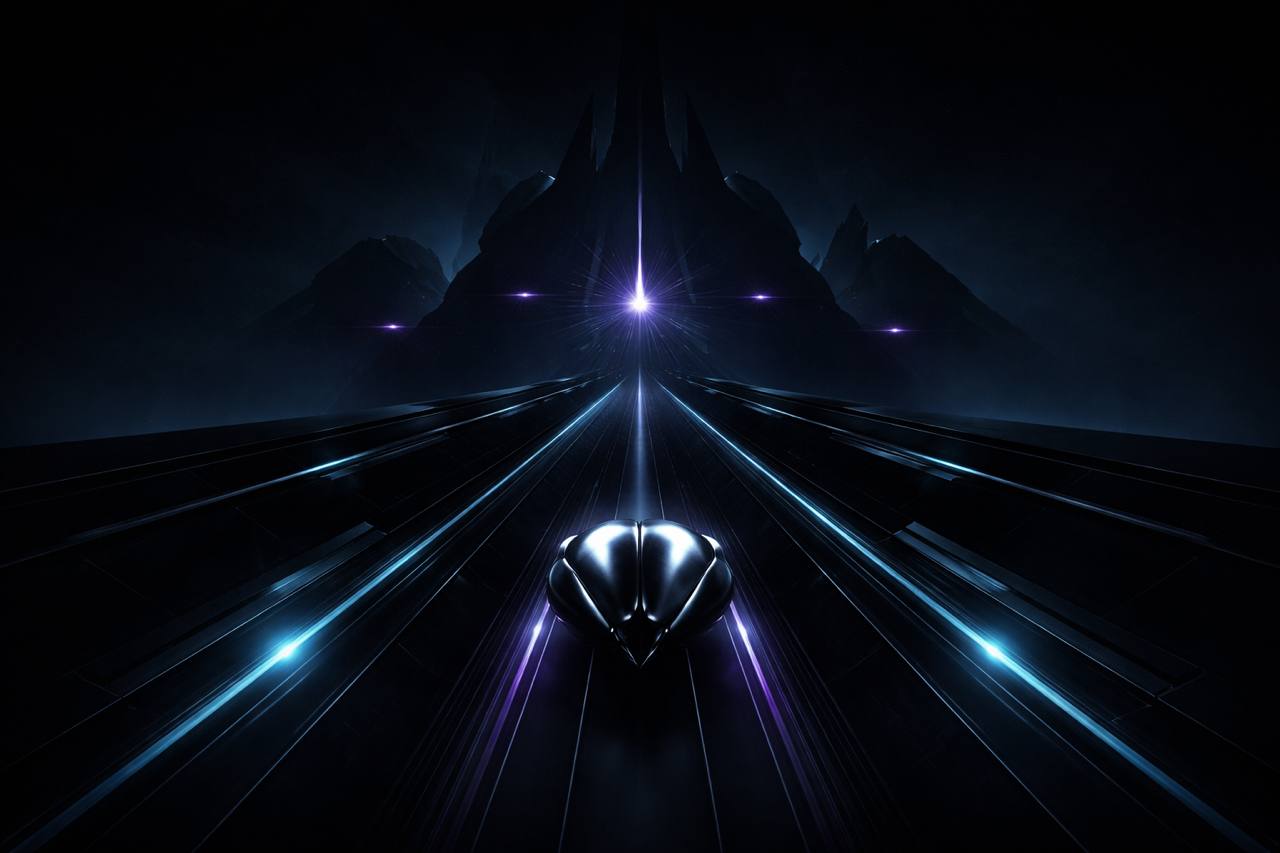
Thumper puts you in control of a chrome beetle hurtling down an abstract track through a hellish void. You press buttons in time with the music to navigate obstacles: banks, turns, jumps, spikes. Miss a beat and you’re one hit closer to death. Two hits and you restart at the last checkpoint.
The controls are simple — one button plus the analog stick — but the execution is brutal. The game doesn’t require you to survive perfectly, it requires you to thrive. You can limp through levels with mediocre timing, but high scores require nailing every beat, every turn, every perfect transition.
In VR, the track surrounds you. The geometric horrors that drift past at the edges of the screen in flat mode become massive, looming presences that fill your peripheral vision. Bosses — already enormous in 2D — become genuinely imposing when they stretch overhead and into the distance.
The checkpoint system is generous. Each level is divided into segments, and you restart at the last checkpoint you passed. This keeps the difficulty from feeling punitive while still demanding precision. You will fail. You will retry. You will eventually hit that sequence perfectly and feel like a god.
Controls
Thumper uses a gamepad in both flat and VR. There’s no motion control option — you’re not conducting with your hands, you’re pressing buttons.
This might sound like a limitation, but it’s not. Thumper’s input model is built around a single button and the analog stick, and that precision matters. You need exact timing, and a physical button provides that consistency.
The gamepad also means no input method complications. Whether you’re on PSVR, Quest, PCVR, or playing flat, the controls are identical.
Comfort
This is the question everyone asks about Thumper in VR: will it make me sick?
The game moves fast. You’re rocketing down a track at high speed, banking around turns, diving through loops. But — crucially — you’re always on rails. There’s no free locomotion, no joystick movement, no player-controlled camera. The game determines where you go and when.
For many players, this makes Thumper more comfortable than expected. You’re not fighting the motion; you’re surrendering to it. The movement is predictable, which helps the brain adapt.
That said, the intensity is real. Thumper is an assault — visual, auditory, and emotional. Some players find the speed overwhelming, especially during boss fights when the screen fills with chaos. It’s not a comfort issue in the traditional sense (no vection-induced nausea), but it is an intensity issue.
Start with short sessions. The game demands focus, and VR amplifies that demand.
Performance
Thumper is efficient across platforms. The minimalist geometric aesthetic — all clean lines, solid colors, and pulsing shapes — means the game runs well even on modest hardware.
Platform hierarchy is predictable:
- PSVR2 — The definitive version. 4K OLED at 120Hz with HDR makes the visuals sing, and headset haptics add physical feedback to the beat. If you have a PSVR2, this is the version to play.
- PCVR (SteamVR) — Highest visual fidelity if you have the hardware. Clean, sharp, customizable.
- PSVR (original) — Still excellent. This was a launch title for a reason.
- Quest — Slightly reduced visual complexity, but the core experience is intact. The standalone port is genuinely impressive.
The game loads fast, runs smoothly, and doesn’t require a supercomputer. That’s the benefit of an art style built around geometry rather than texture density.
What Works Well
The atmosphere is overwhelming in VR.
Flat Thumper is intense. VR Thumper is consuming. The track doesn’t end at the edges of your monitor — it stretches into the distance behind you, above you, around you. Bosses aren’t just large, they’re present. The horror-adjacent aesthetic — all Cthulhian geometry and industrial dread — hits differently when you’re surrounded by it.
The audio design is spatial and devastating.
Thumper’s soundtrack is half the experience: industrial drums, orchestral swells, and the satisfying thump of your actions. In VR, the audio surrounds you. The directionality matters less than the immersion — you’re inside the sound rather than hearing it.
The checkpoint system keeps difficulty fair.
Thumper is hard, but it’s not cruel. The generous checkpoint system means you never lose more than 30 seconds of progress. This keeps the difficulty from becoming a wall while still demanding precision.
The VR toggle is instant and seamless.
There’s no friction. Want to play in VR? Put on the headset. Want to play flat? Take it off. The game doesn’t require a restart, a mode switch, or a separate executable. It just works.
The core gameplay translates perfectly.
Some games feel compromised in VR. Thumper doesn’t. The on-rails design, the fixed camera, the gamepad controls — all of it maps cleanly to virtual reality without requiring any adaptation.
What Doesn’t Work
No motion controls.
If you’re looking for hand presence, physical interaction, or room-scale gameplay, Thumper doesn’t offer it. You’re holding a gamepad in VR, the same as you would on a monitor. For some, this misses the point of VR entirely.
The intensity is not for everyone.
Thumper’s designers call it “rhythm violence.” They mean it. The speed, the sound, the visuals, the bosses — it’s an assault on the senses. Some players find it exhausting rather than exhilarating.
No accessibility options for difficulty.
Thumper expects you to get good. There’s no easy mode, no accessibility settings to reduce the intensity, no way to slow down the track. The checkpoint system helps, but if the base difficulty curve doesn’t work for you, there’s no alternative.
Score-attack focus may not appeal to all.
Beyond the main campaign, Thumper’s longevity comes from replaying levels for better ranks. If you don’t care about leaderboards or perfect runs, the content is finite.
Platform Differences
Thumper is available on almost every platform that supports games: PS4, PS5, PC, Switch, Xbox One, and all major VR platforms (PSVR, PSVR2, Quest, PCVR).
The Switch version has no VR support — it’s flat-only. But if you want Thumper in VR, you have options.
The best version is PSVR2. The combination of 4K OLED, 120Hz, HDR, and headset haptics makes the visuals and audio pop in ways other platforms can’t match. But the game is identical across all VR platforms. You’re not missing content on Quest or PCVR — just some visual fidelity.
If you own multiple VR platforms, play Thumper on whichever has the best display. The experience scales with hardware quality.
Who This Is For
Good for:
- Players who want an intense, music-driven experience
- Rhythm game fans looking for something darker and more aggressive
- Anyone with a VR headset who wants to see what “immersion” really means
- Score-chasers and perfectionists
- Players who don’t mind gamepad-only VR experiences
Not for:
- Players sensitive to fast motion or intense visual stimulation
- Those who want motion controls or physical interaction in VR
- Anyone looking for a relaxed or meditative experience
- Players who struggle with demanding rhythm games
The Verdict
Tier: B
Game Quality: B Thumper is good — a unique “rhythm violence” concept with tight design and incredible atmosphere. But the underlying game is simple: one button, one stick, on-rails progression through abstract tracks. The intensity and aesthetic carry it, but the mechanics are straightforward compared to deeper rhythm games. It’s a great experience, not a transformative one.
VR Implementation Quality: A The VR support is seamless, transformative, and zero-friction. Toggle it on and the game becomes something more. The implementation doesn’t add VR-exclusive features because it doesn’t need to — the core experience is already perfectly suited to virtual reality. This is how hybrids should work: the same game, better in VR.
Overall Tier: B Thumper in VR is better than Thumper flat. The atmosphere that was already impressive becomes consuming when you’re surrounded by it. The on-rails design that might feel limiting in other genres works perfectly here. But the game underneath — while unique and intense — is simple. You’re not getting deep mechanics or extended content. You’re getting a tight, focused rhythm experience that VR amplifies. For VR enthusiasts, it’s essential. For everyone else, it’s a strong recommendation, not a must-play.