
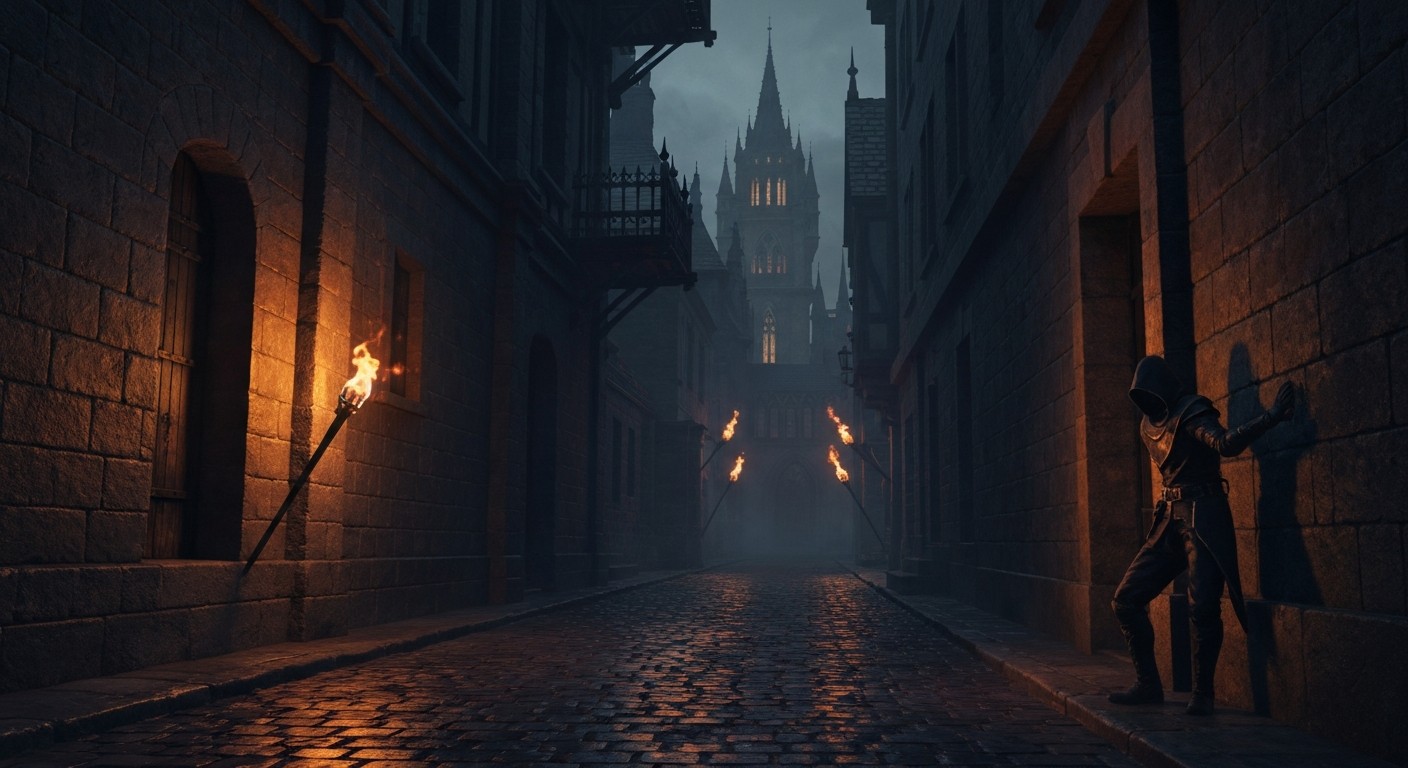
There’s a specific kind of tension that Thief Gold creates, and it has nothing to do with graphics. It’s the moment when you’re crouched in a shadowed corner of Lord Bafford’s manor, listening to a guard’s footsteps echo down a stone corridor, trying to judge whether the torchlight will reach you before he turns the corner. In 1999, this worked because Looking Glass understood that sound and light were game mechanics, not decoration. In a VR headset with stereoscopic depth, that same moment becomes something else entirely. The corridor stretches away from you in tangible depth. The torch flickers at a distance you can actually perceive. The guard isn’t just a sprite approaching a threshold — he’s a figure moving through three-dimensional space, and your hiding spot feels like a hiding spot instead of a darkened pixel cluster.
That specific moment is why Thief Gold in VorpX exists as an idea worth discussing. Whether it’s worth your actual time depends almost entirely on how much you already care about this particular game.
The route is VorpX, a commercial injection driver that hooks into the PC version and outputs stereoscopic 3D with headtracking. But here’s the critical detail that changes everything about expectations: this is a Z-Normal profile, not a Geometry 3D one. VorpX developer Ralf confirmed years ago that the Dark Engine’s pre-DirectX 9 architecture makes true G3D impractical. What you get instead is depth-buffer-based 3D — a convincing approximation of depth, but not the real volumetric stereo separation that makes objects feel physically present. For a fast-paced action game, that would be a dealbreaker. For Thief, where the pace is deliberate and the tension comes from environmental awareness rather than reflexes, Z3D is enough to matter.
Getting it running is not trivial. You’ll need the TFix unofficial patch to make the game function on modern Windows. You’ll need to edit cam_ext.cfg to bump the FOV to 140 so the first-person view doesn’t feel like you’re looking through a mailbox slot. You might need to clone and rename the executable so VorpX hooks properly. You might need to create a custom resolution in VorpX Virtual Desktop to get a crisp image. And you’ll need to accept that every time you draw your blackjack or sword, the Z3D depth effect breaks until you hide the weapon again.
In any other game, that weapon-depth bug would be unacceptable. In Thief, it’s almost a feature — the game actively discourages combat. You’re a thief, not a warrior. The blackjack is for emergencies. The sword is for when you’ve already failed. The fact that the 3D depth disappears when you arm yourself feels weirdly appropriate, like the game is punishing you for breaking character.
Once everything is dialed in, the experience is genuinely atmospheric in ways the flatscreen version can’t replicate. The City — Looking Glass’s fantasy steampunk metropolis — gains spatial presence. Corridors feel longer. Cathedral rafters feel higher. The infamous “Return to the Cathedral” mission, with its undead horrors and oppressive darkness, benefits enormously from depth perception. You can judge distances to hiding spots more intuitively. The sound design, already the game’s greatest achievement, pairs disturbingly well with noise-canceling headphones in a VR headset. You’re not just playing a stealth game — you’re inhabiting a space designed to make you feel vulnerable.
But the compromises are constant and impossible to ignore. The UI is a 1999 flatscreen mess of chunky text and mouse-driven menus that float in your peripheral vision. There’s no motion controls — you’re playing with keyboard and mouse, or a gamepad, while wearing a headset that makes you acutely aware of how unnatural that combination feels. The Dark Engine’s first-person movement has a slight inertia and head-bob that was fine on a CRT monitor in 1999 but can feel subtly wrong in VR. And the Z3D depth, while functional, never achieves the “there” quality of true geometry-based stereo. Objects at mid-range look properly separated, but close-up geometry can feel slightly off, and distant vistas flatten more than you’d want.
The fan mission community adds surprising longevity. Over a thousand user-created missions exist, many of them designed with the same atmospheric principles as the original campaign. AngelLoader makes managing them straightforward, and VorpX handles them without additional configuration. In VR, even a mediocre fan mission gains something from spatial depth — a simple manor heist becomes more engaging when the rooms have actual volume. But the setup burden applies to every mission launch, and the UI friction never goes away.
Performance is a non-issue. This is a game from 1999. Even with VorpX overhead and a high custom resolution, it’ll run at solid frame rates on hardware that struggles with modern VR titles. The bigger concern is display quality. Thief Gold is a dark game — shadows aren’t visual flavor, they’re mechanical necessities. A headset with poor black levels or IPS glow will actively undermine the experience. The community recommends OLED headsets or high-contrast panels for this exact reason. On a budget LCD headset, you might find yourself squinting at grayish shadows that were supposed to be safety.
Comfort is surprisingly good, which is rare for a first-person injection driver. The slow movement speed, the crouched exploration, the lack of rapid camera cuts — Thief’s design philosophy happens to align well with what VR stomachs can tolerate. You won’t be sprinting, jumping, or spinning cameras. You’ll be creeping, listening, and planning. The fixed HUD can cause minor eye strain during long sessions, and the Z3D approximation can feel slightly “swimmy” for sensitive users, but overall this is one of the more comfortable injection experiences you can have.
So who is this actually for?
This is for the person who already owns VorpX, already loves Thief Gold specifically (not just stealth games in general — this game), and wants to experience Looking Glass’s masterpiece with an added spatial dimension. The depth genuinely enhances the atmosphere. The tension genuinely benefits from environmental presence. If you have the patience for TFix installation, FOV editing, and VorpX configuration, the payoff is real.
This is not for someone looking to discover Thief for the first time. The setup friction, the Z3D limitations, and the 1999 UI are too much to ask of a newcomer. It’s not for someone who wants a polished VR stealth experience — there are native VR titles that do this without compromise. And it’s definitely not for someone who doesn’t already own VorpX and would be buying it specifically for this — the value proposition doesn’t hold up against VorpX’s library of better-supported titles.
Thief Gold remains one of the most important stealth games ever made. In VR via VorpX, it becomes a fascinating atmospheric experiment — a 26-year-old design philosophy proving that good spatial audio and deliberate pacing can translate surprisingly well to a medium it was never intended for. But “surprisingly well” is not the same as “well enough to recommend broadly.” This is a love letter to an existing relationship, not an introduction to a new one.