The first time the Minotaur rounds a corner in Theseus, you forget that this is a third-person game.
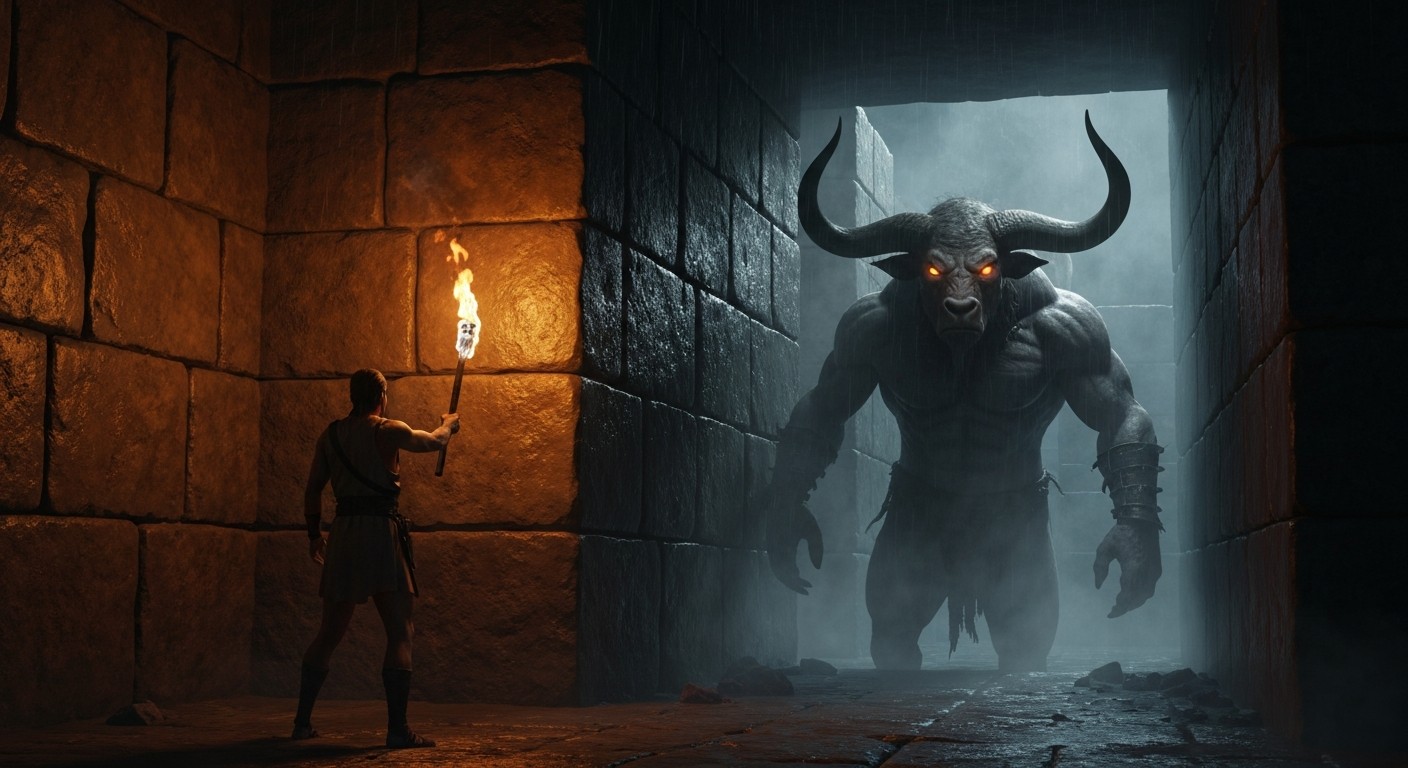
You’re watching Theseus from over his shoulder, torch in hand, creeping through a stone corridor that’s too dark and too quiet. The camera is fixed, locked to a cinematic angle like something out of the original Resident Evil. And then the Minotaur fills the frame — eight feet of horned muscle and wrongness, breathing steam, and suddenly the scale of it hits you in a way that flatscreen horror can’t replicate. You’re not watching a monster on a screen. You’re standing in the same room as it.
That’s the moment Theseus sells its premise. Whether the rest of the game lives up to it depends on what you’re hoping to find in the labyrinth.
Theseus is a native VR title from Forge Reply, released in 2017 for both PSVR and PCVR. It is not a mod, not an injection, not a framework experiment — it’s a third-person action-adventure built for headsets from the ground up. The premise is straight out of Greek myth: you’re Theseus, you’ve entered the labyrinth, and your goal is to survive long enough to face the Minotaur while Ariadne’s voice guides you through the darkness.
Here’s what matters up front: this game takes about ninety minutes to two hours to finish. Maybe two and a half if you’re hunting collectibles for the true ending. That brevity is either the best thing about it or the worst, depending on your expectations. If you’re looking for a meaty, replayable adventure with deep systems and hours of content, close the tab now. If you want a single evening of atmospheric tension with a price tag that usually lands under ten dollars on sale, keep reading.
The third-person perspective is the most interesting design decision here, because it’s the thing that makes Theseus comfortable in a way that most VR horror isn’t. You are not Theseus. You are a camera floating behind him, watching him move through the labyrinth. Your head controls where you look, but your body is safely outside the action. There’s no first-person locomotion to induce motion sickness, no smooth camera spinning to disorient you, no sprinting through corridors while your stomach catches up. The fixed camera angles — some over-the-shoulder, some locked to cinematic positions — create a distance between you and the danger that makes the experience approachable for VR newcomers.
That distance is also where the tension comes from. Because you’re not inside Theseus’s body, you’re watching him navigate spaces that feel increasingly hostile. The labyrinth’s stone corridors are wet and dark, lit by torchlight that flickers just enough to keep you uneasy. The sound design is the real star here — distant groans, the scrape of something heavy moving nearby, Ariadne’s whispered warnings through the dark. In a headset, with headphones on, the atmosphere is genuinely oppressive.
The Minotaur is the reason to play this game. Every encounter with it — and there aren’t many — is structured as a stealth sequence or a chase. You can’t fight it. You can only hide, run, or die. And when it finds you, the sense of scale is staggering. The creature towers over Theseus, fills doorways, and moves with a deliberate weight that makes every encounter feel like a genuine threat rather than a scripted set piece. In flatscreen, this would be a cool monster design. In VR, standing in the same virtual space as it, it’s genuinely intimidating.
The combat, on the other hand, is where the experience thins out. When you’re not running from the Minotaur, you’re fighting smaller spider-like creatures with a sword and torch. The combat system is bare bones: square button combos, a dodge roll, and torch mechanics that let you scare enemies back or set them on fire when they’re low. There’s no weapon variety, no skill progression, no meaningful depth. You acquire the sword early, and the combat loop doesn’t change from that point forward. It works — it’s functional, responsive enough, and serves the pacing — but it never becomes interesting on its own merits.
The stealth sequences against the Minotaur suffer from a different problem: trial-and-error design. Some sections require you to sneak past the creature in tight corridors where a single wrong step means instant death. The checkpointing is generous, but dying repeatedly to scripted sequences that you couldn’t have predicted feels cheap rather than challenging. The game wants you to feel hunted. Sometimes it achieves that. Sometimes it feels like you’re memorizing a pattern after the third or fourth attempt.
Performance is solid on capable hardware. On PS4 Pro, the visual upgrade is noticeable — sharper distant objects, better lighting, improved particle effects. On base PS4, distant geometry gets blurry and jagged, which breaks some of the atmosphere in wide corridors. The PCVR version through Steam is straightforward: standard SteamVR launch, no modding or configuration, just a gamepad and a headset. If you’re streaming to a Quest via Air Link, it works fine — the game isn’t demanding enough to stress most PCVR streaming setups.
Comfort is where Theseus earns its keep for VR newcomers. The third-person camera and fixed angles mean almost zero motion sickness risk. I wouldn’t call it boring — the tension is real — but your inner ear never disagrees with what your eyes are seeing. For someone who’s just bought their first headset and wants to experience something atmospheric without the nausea that comes from smooth locomotion, this is one of the gentler entries in the horror-adventure space.
The replay value is minimal. There’s a true ending gated behind finding collectible braziers and corpses scattered through the labyrinth, but the incentive to hunt them down is weak. The first playthrough delivers the experience. A second run would be for achievement completionists only. At its original launch price of around twenty dollars, that brevity was a harder sell. At the sale prices it routinely hits now — five to ten dollars — the value proposition shifts. You’re paying for a single, polished evening of tension and one truly great monster.
So who should play this?
If you’re new to VR and want a low-stakes introduction to atmospheric horror, Theseus is a solid choice. The comfort, the short runtime, and the low commitment make it approachable in a way that longer, more intense VR horror titles aren’t. If you enjoy cinematic horror pacing — slow build, environmental dread, occasional bursts of terror — the labyrinth delivers that consistently.
If you need motion controls to feel present in VR, or if you’re looking for combat depth, or if you want a game that justifies repeated playthroughs, this isn’t the right labyrinth. The gamepad-only input, the shallow sword combat, and the two-hour runtime make it a single-serving experience.
The honest take: Theseus is a brief, effective atmospheric piece with one genuinely great monster and a lot of thin padding around it. The Minotaur alone justifies the price of admission on sale. The rest of the game — the repetitive spider combat, the trial-and-error stealth, the minimal replay incentive — is functional but forgettable.
But I’ll say this: two hours in a dark labyrinth, with that thing breathing somewhere in the walls, is still two hours well spent. Theseus understands that VR horror works best when the monster feels real, and the Minotaur feels very real indeed. Just go in expecting a short story, not an epic.