
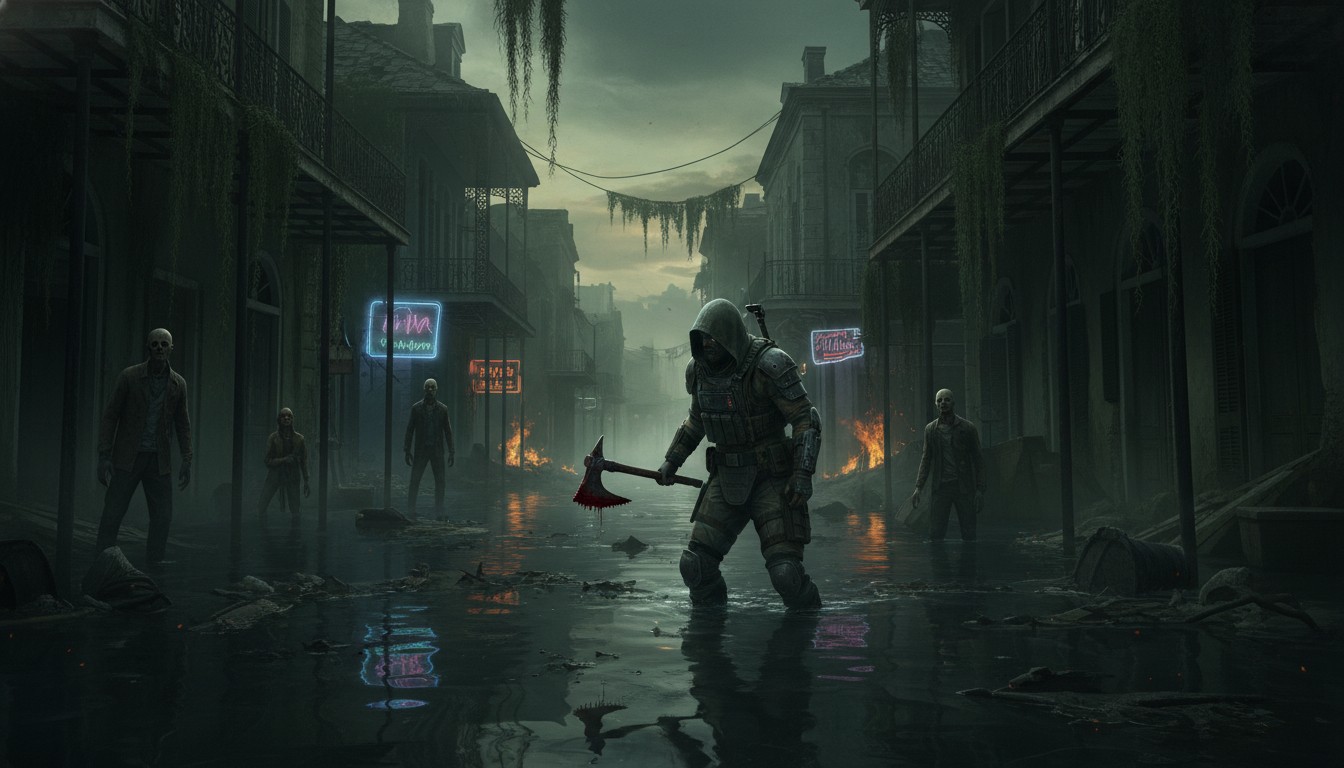
The first time a blade lodges in a walker’s skull and you physically wrench it free, you understand what The Walking Dead: Saints & Sinners is doing differently. Most VR zombie games let you wave a weapon through enemies like a magic wand. Here, your axe has weight. Your knife gets stuck. Your arms get tired. And when the shambling horde closes in while you are still tugging steel from bone, the panic is real.
Skydance Interactive built this from the ground up for VR, and it shows in every system. Released in January 2020, it remains one of the few VR titles that delivers a full-length campaign — roughly 15 hours — wrapped in genuine survival mechanics rather than arcade shooting gallery fare. You play as “The Tourist,” a newcomer to flooded New Orleans searching for a military supply cache called the Reserve while navigating territory torn between the authoritarian Tower faction and the rebel Reclaimed.
What This Actually Is
This is not a mod or a retrofit. Saints & Sinners is a native VR product sold as such across PCVR, PSVR, and Quest platforms. There is no flat version hiding underneath. Every interaction — reloading a revolver by inserting individual rounds, gripping a two-handed rifle, grabbing a walker’s head to shove it back, crafting bandages at a workbench — was designed around motion controls and physical presence.
The day-night cycle drives the tension. Each morning, bells ring and more walkers flood the streets. You must scavenge for food, medicine, scrap, and weapons, then retreat to your bus-base to craft supplies and sleep through to the next day. Resources dwindle. Weapons break. And the game never lets you forget that a single careless noise can pull every corpse within earshot down on your position.
The Combat That Matters
The melee system is the star. Bladed weapons embed in enemies and require a deliberate pull to retrieve. Two-handed weapons demand both hands for stability. Guns need manual reloading — magazines inserted, rounds chambered, hammers cocked. It is deliberately slow and methodical, which means combat is rarely about reflexes and almost always about positioning, resource counting, and deciding whether a fight is even worth starting.
Stealth is usually the smarter play. You can lure walkers into human camps to create diversions. You can crouch through broken buildings, knife-walking past sleeping hordes. The 3D audio sells every creak and distant groan, and the game’s comic-influenced art style keeps the horror grounded rather than gratuitous.
The survival systems have teeth. Stamina governs sprinting, swinging, and even how long you can hold a struggling walker’s jaw shut. Run dry and you are a sitting target. Food restores stamina caps, but scavenged food can lower maximum health, pushing you toward cooking crafted meals. It is unforgiving, and there were early community complaints that stamina drains too fast and weapons degrade too quickly. These are design choices, not bugs — they force you into the game’s intended rhythm of careful scavenging and risk assessment. But they are also genuine friction points that will frustrate players looking for power-fantasy zombie slaughter.
Where the Edges Show
The game is not flawless. Human AI can be uneven — enemies sometimes behave with surprising intelligence, other times they stare at walls while you walk past. The save system is checkpoint-based and can be punishing; lose a long scavenging run to an unexpected swarm and you will feel it. Some players on PSVR reported comfort issues with world warping, and Quest 2 users deal with a noticeably flatter, blurrier visual presentation compared to PCVR.
Platform differences are real but not dealbreakers. PCVR is the definitive experience, with the sharpest visuals and an active modding community. PSVR holds up remarkably well for its generation, with solid tracking and smooth performance. The Quest version — especially on Quest 3 after a substantial visual update — delivers a full-featured portable version that sacrifices some fidelity but keeps the core combat physics intact. It is one of the deepest games on the Quest store by a wide margin.
Long-term support has been respectable for the original game, with post-launch patches addressing controller issues and a free “Meatgrinder” horde mode added later. The sequel, Chapter 2: Retribution, had a rougher launch and has seen more mixed community sentiment, but the original Saints & Sinners remains stable and playable across all platforms.
The Bottom Line
If you own a VR headset and have not played this, you are missing one of the medium’s defining titles. It is not a tech demo. It is not a wave shooter with a famous license slapped on top. It is a proper survival horror game with meaningful choices, physical combat that actually leverages VR, and enough content to justify full-game pricing.
The caveats are real: the stamina system will annoy some players, the save structure is old-school unforgiving, and the human NPC behavior occasionally breaks the spell. But none of that undermines what this game accomplishes. In a VR landscape still too crowded with brief experiences and shallow arcade conversions, Saints & Sinners stands as proof that VR can sustain a full, weighty, terrifying campaign. Play it on whatever headset you own. Just clear your schedule and accept that you are going to get very good at pulling knives out of skulls.