
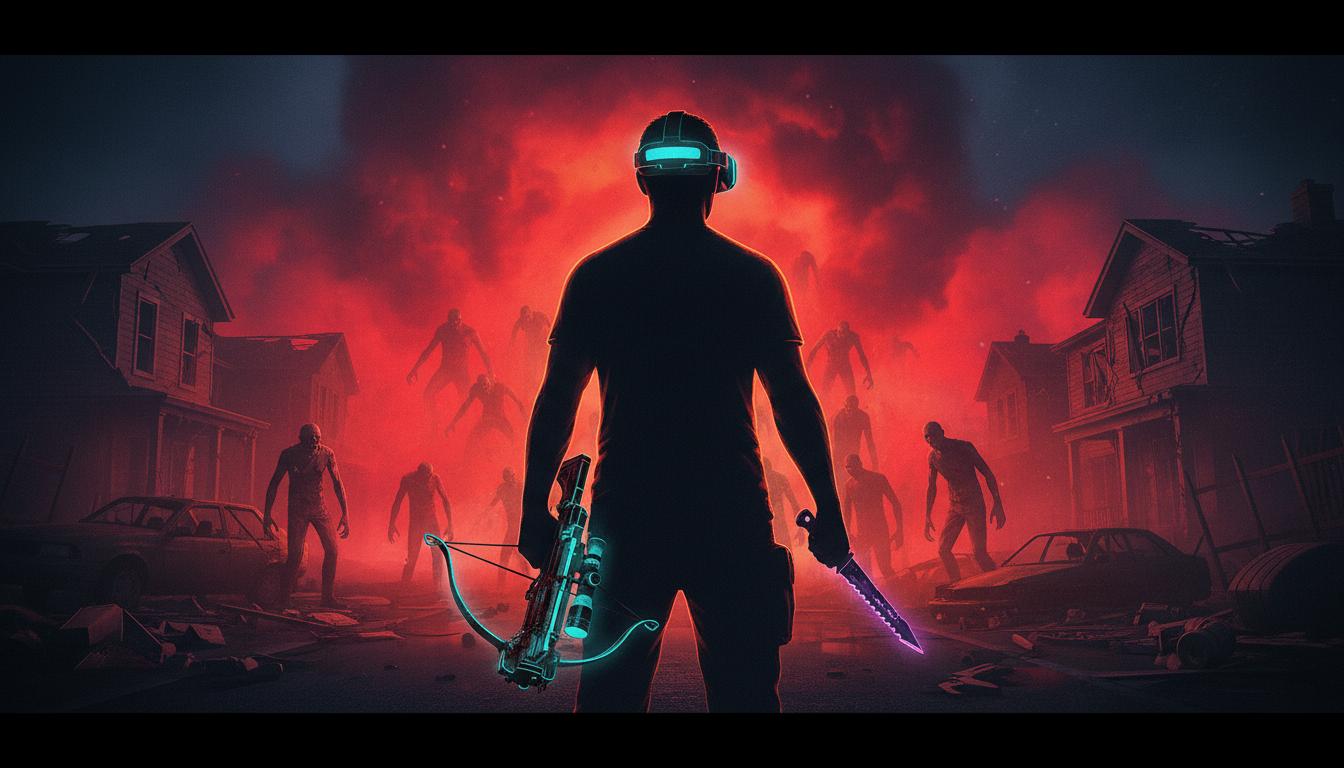
There’s a red cloud that kills you if you stand in it too long. Not because it’s full of zombies — there are no zombies in the red cloud. It’s just red, and foggy, and it drains your health because the game says so. The Walking Dead: Onslaught is full of design choices like this: systems that technically function but make no sense, undermine the fiction, and leave you wondering what anyone on the development team was thinking.
Survios, the studio behind Creed: Rise to Glory and Raw Data, built Onslaught as a native VR action game using the AMC television license. You play as Daryl Dixon (voiced by Norman Reedus), Rick Grimes, Michonne Hawthorne, and Carol Peletier across a short campaign and replayable scavenging missions. The voice acting is a mixed bag — Reedus and the actors for Carol and Eugene sound authentic, while Rick and Michonne are clearly stand-ins whose performances waver between flat and awkward. But voice work is the least of this game’s problems.
The core loop splits into two modes: a linear, roughly five-hour story campaign of flashback missions narrated by Daryl, and a Scavenge mode where you run through maps grabbing supplies while outrunning that inexplicable red haze. Campaign progression is gated by how many survivors you’ve recruited through Scavenge runs, so the mode is mandatory padding dressed up as a replayable loop. The problem is that the red “Horde” cloud exists to create artificial urgency but succeeds only at creating artificial frustration. There’s no narrative justification for why the undead apocalypse manifests as a slowly advancing wall of colored fog. The game never even explains the mechanic — you simply learn through death that lingering costs health.
Combat is where Onslaught most clearly betrays its own premise. Melee weapons are so dominant that firearms become pointless. A quick knife stab to a walker’s face kills instantly, costs nothing, never breaks, and never requires ammunition. Meanwhile, a pistol needs three headshots to drop the same enemy, and reloading means ejecting magazines and fishing for clips on your belt. There’s no stamina system to limit melee spam, no weapon durability to force variety, and no incentive to engage with the shooting mechanics Survios actually built. Shotguns and rifles work fine when you use them, but the game never gives you a reason to bother.
This imbalance is particularly galling because Survios clearly knows how to make physical combat feel good. Grab a walker by the throat, stab its face, rip the blade free, and shove the body aside — that sequence has weight and presence in VR. Lopping off limbs with a katana or fire axe delivers arcade gore that can be genuinely satisfying during heavy swarms. But these moments are undercut by systems that feel like they were designed for a different game, or perhaps no game at all.
The Alexandria settlement feature illustrates the same pattern. As you gather supplies, you rebuild the community with new structures and survivors. Watching a rundown farm transform into a functioning outpost is legitimately rewarding — it’s one of the few places where your effort produces visible, tangible results. But the loop that feeds it is so shallow and the gameplay around it so thin that the feature becomes a shiny wrapper on a hollow core. There’s no meaningful decision-making about what to build or how to configure your camp, and the survivors you unlock deliver nothing more than additional fetch quests.
Environmental interactivity is essentially nonexistent. Every bottle, can, and piece of debris you see on shelves and tables is bolted down. You can’t pick up, throw, or manipulate objects beyond the specific items the game flags as lootable. In a VR landscape where Half-Life: Alyx, The Walking Dead: Saints & Sinners, and Boneworks had already raised the bar for physical presence, Onslaught plays like a step backward into an earlier, more limited era of headset gaming.
Comfort options are competent but unremarkable. You get snap and smooth turning, teleport and smooth locomotion, plus an arm-swinging movement style similar to Survios’ earlier work. FOV limiting features are available for players who need them. The game expects you to play standing, though seated play is technically possible. Performance sits in a middle range — not demanding enough to require a high-end PC, but not optimized enough to feel particularly smooth on modest hardware either.
The real tragedy is what this game could have been. Early previews from 2019 suggested a co-op-focused arcade experience with replayable missions and distinct identity. By the time it shipped, co-op had been cut, the design had pivoted toward a story mode no one asked for, and the final product landed in the shadow of Saints & Sinners — a VR zombie game released earlier the same year that outclassed Onslaught in virtually every dimension. Onslaught is not broken; it installs easily, runs without major technical disasters, and reaches its credits. But it is thin, incoherent, and consistently underwhelming.
If you are deeply attached to the AMC show and desperately need to swing Daryl Dixon’s knife in first person, you might extract a few hours of mild entertainment here. Everyone else — including zombie fans, VR action enthusiasts, and especially anyone who has played Saints & Sinners — should save their money and their time. There are better ways to kill the undead, and there are certainly better ways to spend an evening in a headset.