
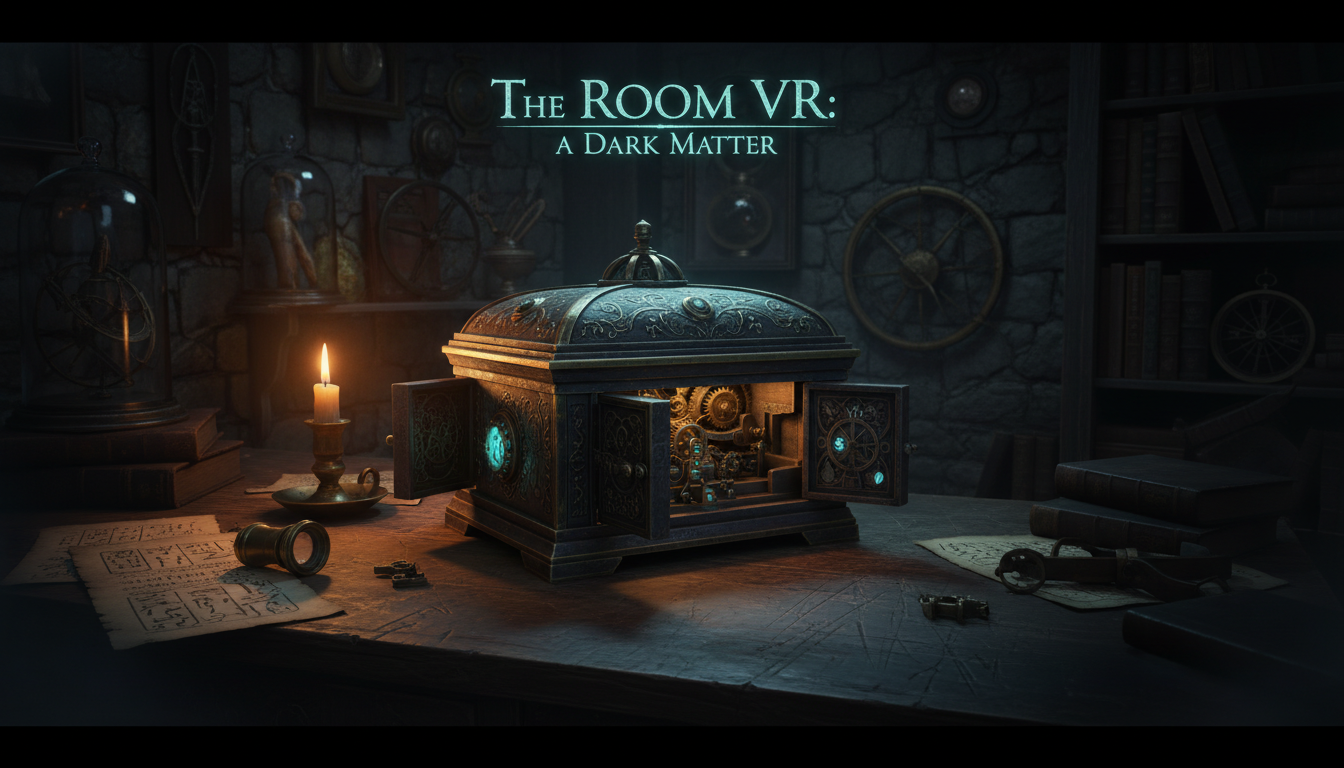
There is a specific pleasure to opening a well-made box. The resistance of a latch, the slide of a drawer, the soft click when a hidden mechanism catches. The Room VR: A Dark Matter understands this completely, and in virtual reality it moves beyond understanding into something closer to obsession. You are not just solving puzzles about boxes here. You are physically inside them, pulling levers with your own hands, holding strange keys up to the light, and at one remarkable moment shrinking down to wander through the interior of a clockwork device no larger than a jewelry case.
This is not a flat game retrofitted with VR support. Fireproof Games built The Room VR as a native virtual reality experience from the ground up, and that distinction matters in every interaction. It arrived as proof that VR could deliver complete, polished experiences rather than tech demos, and it answered that demand with a tightly designed puzzle adventure that lasts roughly four to six hours, depending on how readily you surrender to its logic.
You play as a detective in Victorian London investigating the disappearance of an Egyptologist, though the narrative is largely an excuse to move you between elaborately designed spaces: a police station, a crypt, a church, a study that seems to exist slightly outside normal geometry. Each location functions as a node in a network. You teleport between fixed positions and use snap-turning to adjust your facing. There is no smooth locomotion, no free walking, no smooth turning. For some players this will feel immediately restrictive, like being tethered to invisible pillars in a room you cannot fully explore. For others, especially those prone to motion discomfort, it removes every barrier to entry. The game is playable seated or standing, and the comfort level is among the highest in the medium.
The node system serves the design, though, rather than merely coddling the player. Puzzles in The Room VR demand precision. You need to examine objects from multiple angles, align symbols, slot keys into locks, and trigger sequences of mechanical events. Locking the player to specific vantage points prevents the mild chaos of free locomotion and ensures the environment’s sightlines work as intended. It is a trade-off: freedom for clarity, and in a game this focused on tactile problem-solving, the clarity usually wins.
What elevates the experience is the physicality. Fireproof Games translated their mobile series’ renowned object interaction into motion controls with genuine care. Picking up an ornate box feels weighty. Rotating it in your hands to find a hidden seam is natural. Pulling a drawer open requires an actual pulling motion, and the haptics and audio design combine to sell the sensation of metal sliding against wood. The series’ signature eyepiece returns, a lens you hold to your face to reveal hidden layers of reality: markings invisible to the naked eye, ghostly traces of previous investigators. In VR, raising that eyepiece to your eye is an act of theater that flat screens cannot replicate.
The puzzles themselves are the reason to play, and they remain consistently inventive across the campaign’s runtime. You might reconstruct a lunar clock to alter the shape of a key, manipulate a miniature cathedral to trigger a real-world counterpart, or decode a mechanism using sound cues that require you to physically position yourself near their source. The difficulty curve is gentle but not insulting, introducing new mechanical concepts and then combining them in ways that feel fair but not obvious. That said, getting stuck in The Room VR carries a particular frustration. Trapped inside a headset with no external reference, staring at an object you cannot decipher, the urge to lift the headset and consult a guide becomes almost irresistible. The game offers a hint system, but its pacing is deliberately slow, and some players will find themselves pacing their play space in mild agony.
Visually, the game punches above what you might expect from a puzzle title. The environments are richly textured, filled with occult artifacts, weathered stone, and machinery that looks like it was salvaged from a fever dream. Even the Quest version maintains impressive detail, while PCVR and PSVR iterations deliver sharper textures and more atmospheric lighting. The audio design deserves equal praise: creaking wood, distant chanting, the precise mechanical clicks of a solved puzzle all contribute to an atmosphere that is spooky without ever becoming horror. You are unsettled, not terrified.
The restrictions do accumulate, though. The node-based movement prevents any sense of exploration beyond what the designers explicitly permit. There are no branching paths, no optional corners to investigate, no reward for curiosity outside the prescribed puzzle sequence. The story, delivered through notes and environmental implication, is thin enough that it functions more as mood than narrative. And the length, while appropriate for the density of puzzles, may disappoint players looking for a substantial VR investment. This is an evening or two of entertainment, not a weeks-long campaign.
For newcomers to VR, however, that brevity is arguably a strength. The Room VR asks almost nothing of its player in terms of setup, tolerance for motion intensity, or mechanical complexity. It is one of the most accessible full VR experiences available, a game you can hand to someone who has never worn a headset and trust that they will understand what to do within minutes. The controls are intuitive, the objectives are clear, and the satisfaction of solving its contraptions is immediate.
For veteran VR users, the appeal depends on your patience for deliberate pacing and your appetite for puzzle-box logic. If you enter expecting the freedom of a walking simulator or the kinetic energy of an action game, the fixed nodes and methodical tempo will chafe. But if you want to feel the specific, almost childlike satisfaction of opening a secret compartment and finding something impossible inside, there are few VR games that deliver it better.
Fireproof Games built something that understands exactly what VR is good for: presence, physical interaction, and the manipulation of objects at human scale. It does not try to be everything. It is a puzzle game that knows it is a puzzle game, executed with precision and restraint. That focus is rare enough to be noteworthy, and the result is one of the most reliably rewarding experiences in the medium.