
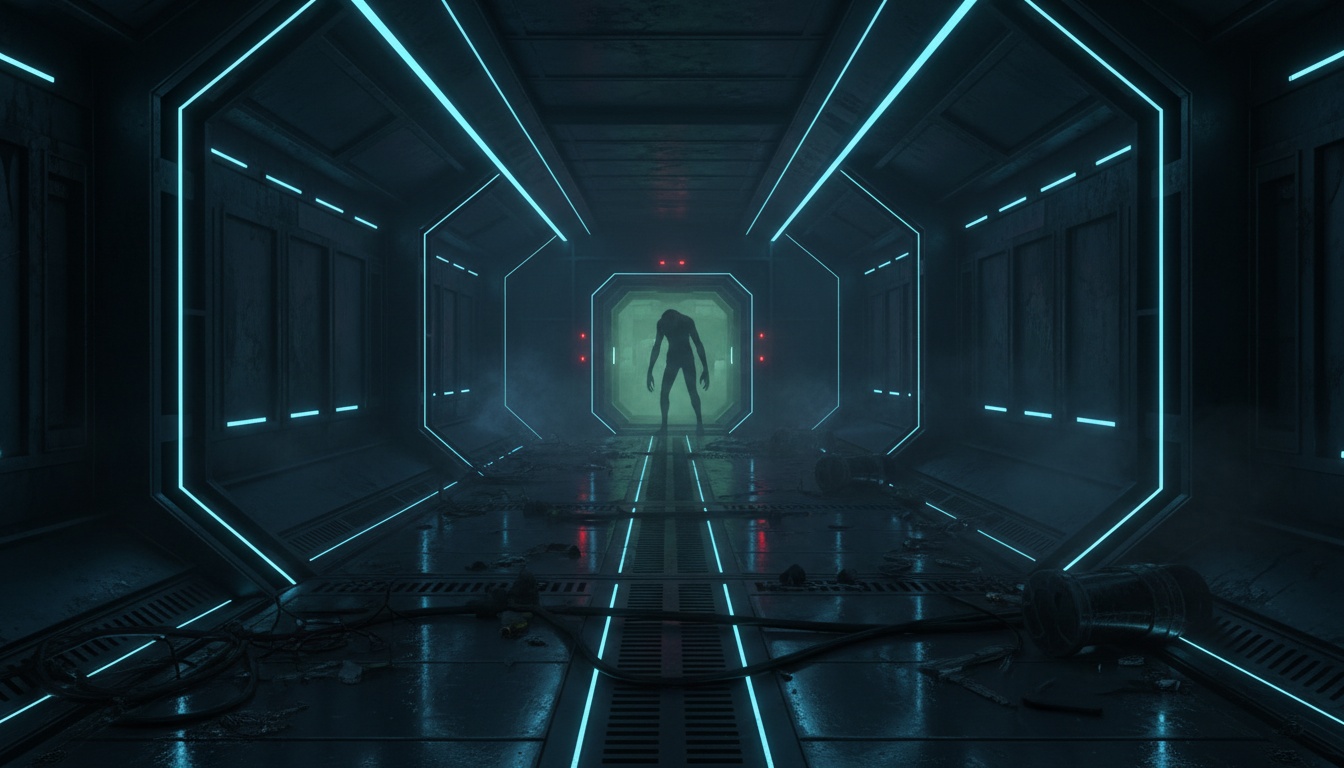
You wake up in a cloning bay. Again. The ship around you has rearranged itself while you were dead, and somewhere in the dark corridors outside, something that used to be your crewmate is listening for footsteps. This is the loop of The Persistence — die, respawn as a new clone, and step back into a spaceship that never stays the same twice.
Firesprite built this as a VR-native experience first. It launched on PSVR in 2018 as an exclusive, then came to flat platforms and PCVR in a later Enhanced Edition. That lineage matters. The corridors are sized for a headset’s sense of scale. The sound design — creaking metal, distant screams, the wet breathing of mutated enemies — was mixed to wrap around you in three dimensions. When you lean around a corner and spot an enemy facing the other way, the temptation to hold your breath is real. VR doesn’t just decorate the horror here; it is the container for it.
The game is a first-person roguelike survival horror shooter set aboard a colony ship called The Persistence. You play as successive clones of security officer Zimri Eder, attempting to repair the ship and escape. Every death triggers a full procedural reshuffle of the level layout, enemy placement, and item spawns. You lose your current gear but keep permanent upgrades purchased with stem cells and credits — better health, longer shield duration, improved “super sense” that highlights threats through walls. That progression system gives each run forward momentum even when the ship itself has turned into a new maze of terror.
On PSVR, the controls use a DualShock 4 controller with head-based aiming. You move with the left stick, turn with the right, and look at what you want to shoot. It sounds limiting on paper, but in practice it feels surprisingly natural inside a headset — your gaze becomes your crosshair, which actually speeds up target acquisition in close-quarters horror moments. The game was built around this input method, and it shows. Firesprite included extensive comfort options to support it: smooth turning with adjustable speed, snap turning, optional blinders, and even a setting that unlocks head movement from arm movement for added immersion.
The problem arrives when you boot the PCVR Enhanced Edition. All of that PSVR-native design is still present — the head aiming, the comfort toggles, the seated scale — but the port brings nothing else to the table. There is no motion controller support. No hand presence. No room-scale interaction. On a PCVR headset in 2020 and beyond, sitting with a gamepad while wearing a headset that supports precise tracked controllers feels archaic. It is technically the same game, but it arrives on PC without adapting to the platform’s strengths. The Enhanced Edition does add ray tracing and DLSS support, which sharpens the shadows and reflections in those dark corridors, but the control scheme still treats the headset like a stereoscopic monitor strapped to your face.
That input limitation is the single biggest caveat for anyone considering the PCVR version. The game itself remains strong — the roguelike loop is addictive, the upgrade tree gives you meaningful choices, and the horror pacing is disciplined. Enemies are dangerous enough that early runs feel genuinely frightening, and once you start unlocking better fabrication blueprints, you get the satisfying arc of returning stronger to a ship that has no respect for your previous accomplishments. The companion app, Solex, is a nice touch: a friend on a phone or tablet can view the ship map, open doors for you, mark items, or actively mess with you by luring enemies or killing the lights. It is a gimmick, but a fun one that adds texture to co-op play without requiring a second headset.
Where the game softens is in environmental variety. The procedural generation changes layouts and enemy positions, but the rooms, corridors, and visual motifs repeat. After several hours, you recognize the modular pieces. The horror shifts from “what is this place” to “which tileset am I in now,” which dulls some of the early tension. The sound design and jump scares keep it from going stale too quickly, but The Persistence is not infinite — it is a very good ten-to-fifteen-hour experience that starts to show its seams if you marathon it.
Comfort is a mixed bag by design. The game offers full smooth locomotion with no forced teleportation, which will immediately exclude players who need snap movement to avoid motion sickness. That said, the comfort settings on PSVR were praised at launch for being genuinely effective, with fast rotation speeds and optional blinders that do help mitigate nausea for players on the borderline. It is seated play only, and minimal room space is required. On PCVR, those same options exist, but the lack of motion controller support removes one common crutch — many players find that holding virtual weapons with tracked hands reduces disorientation more than gamepad thumbsticks do.
Performance is reasonable on both platforms. The PSVR version ran well on a base PS4 and looked noticeably sharper on PS4 Pro. The PCVR Enhanced Edition adds modern rendering features that scale with hardware, so mid-range and higher PCs should have no trouble maintaining a stable frame rate. This is not a demanding title by contemporary standards.
So who is this for? On PSVR, The Persistence is an easy recommendation for anyone who wants a seated horror experience with genuine mechanical depth. The roguelike structure, the upgrade persistence, and the audio design make it one of the stronger exclusive-era PSVR titles. On PCVR, the recommendation narrows significantly. You need to specifically want this game’s loop, because the port does not earn its place against native PCVR horror titles that offer hand tracking, physical interaction, and room-scale presence. It is still fully playable and still atmospheric, but it feels like a transplant rather than a native PCVR citizen.
If you have a PlayStation VR headset and a tolerance for gamepad horror, The Persistence is worth your time. If you are browsing Steam for your Index, Quest Link, or Reverb G2, go in knowing that you are getting a very good PSVR game running on PC, not a PCVR game that happened to start on console. The horror is real, the loop is smart, and the ship is cruel — but the controls stay stubbornly rooted to the platform where this game was born.