
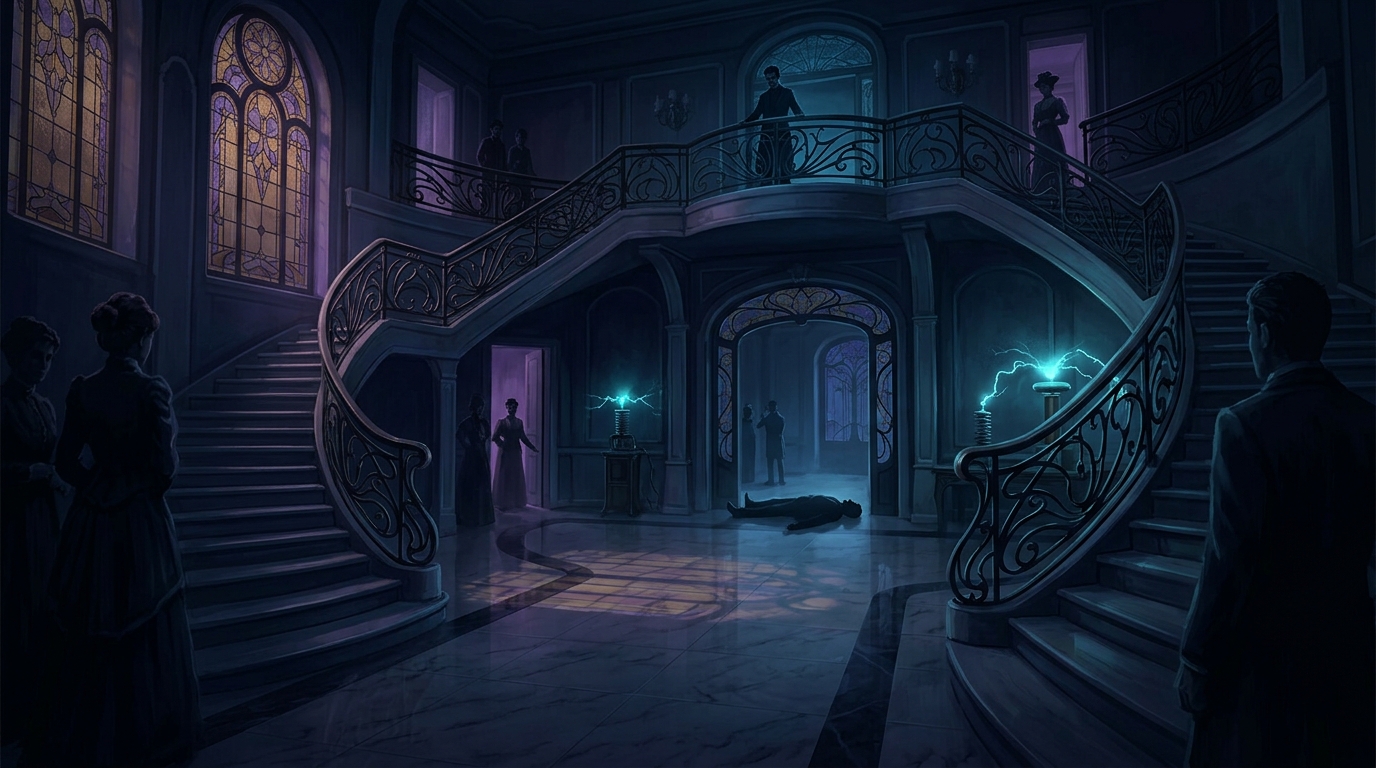
The first thing that strikes you is the silence of your own presence. In The Invisible Hours, you do not arrive as a detective, a hero, or even a named character. You are a ghost — a spectator with no body, no voice, and no ability to change what is about to happen. Nikola Tesla is already dead when you get there, slumped in his mansion’s foyer, and the seven people in the house are already moving through their private griefs, schemes, and secrets. Your only power is the one that makes this worth experiencing: you can walk through walls, eavesdrop on whispers, and, most importantly, rewind time.
Tequila Works calls this immersive theatre, not a game, and that honesty matters. There are no puzzles to solve, no inventory to manage, no dialogue trees. The “gameplay” is observation itself — choosing which suspect to follow, noticing what they pick up, where they glance, who they avoid. Every character acts on their own timeline simultaneously, whether you’re watching or not. Thomas Edison might be arguing with Flora White in the library while, upstairs, the blind butler Oliver Swan is cleaning blood from a cufflink. You cannot be everywhere at once, and that impossibility is the entire point.
The VR implementation is what makes this conceit actually work. In flatscreen, the experience would be a well-made but passive curiosity. In a headset, standing inside Tesla’s art nouveau mansion, the scale becomes the story. Ceilings soar. Doorways frame conversations like stage sets. The teleportation-based movement keeps you comfortable — there’s no free locomotion to induce dizziness, and the game is entirely playable seated, which matters more than most developers seem to realize. Head tracking functions perfectly for leaning into conversations or peering around corners, and the overall presentation is polished enough that you forget the technical boundaries and focus on the human ones.
Controls split between tracked motion controllers and gamepad, and the choice reveals the design’s small compromises. Motion controllers let you pick up and examine objects — letters, weapons, personal effects — which adds a welcome layer of physicality. But teleportation is mapped to pointing, and some players found the DualShock controller quicker and more precise for simply looking and jumping to a new vantage point. Neither option breaks the experience; both get you where you need to go. The performance is lightweight by modern standards — this is a narrative experience, not a technical showcase — and stability has been solid since launch with no reports of crashes or major bugs.
The time manipulation system is the real mechanical triumph. A radial menu lets you pause, rewind, or fast-forward the action at any moment. Following a single character through one loop of the evening takes roughly an hour, but the full story requires multiple passes — Edison’s alibi only makes sense once you’ve watched where Gustav the detective actually was, and Flora’s nervousness reads differently once you know what she’s hiding in her room. The total runtime lands around four to five hours to see every thread, and the structure invites that repetition rather than punishing it. Each rewind reveals new details: a glance held too long, a door closed too quietly, a lie that doesn’t match the timeline you just witnessed.
The writing and performances deserve the praise they’ve received. The cast — a deliberately anachronistic mix including Edison, the actress Sarah Bernhardt, and a disgraced Swedish detective — is voiced with restraint, never tipping into melodrama. The mansion itself is a character, designed with theatrical precision so that key moments naturally occur in spaces visible from multiple angles. You feel less like you’re playing a mystery and more like you’re attending a private performance where the actors don’t know you’re there.
That framing is also the experience’s limitation. If you come wanting agency — choices that matter, puzzles to crack, a score to chase — The Invisible Hours will frustrate you. You cannot warn Tesla. You cannot confront the killer. You cannot even make a character look your direction. The interactivity is limited to locomotion and object inspection, and some players will find that too thin for the price of admission. It is also a one-and-done experience for most; the replay value is in seeing what you missed, not in mechanical mastery.
But for the right player, this is one of VR’s most essential experiences. If you enjoy immersive theatre, if you like the idea of being a fly on the wall in a finely constructed mystery, if you want something comfortable enough to play in an evening without worrying about motion sickness or complex controls — this is an easy recommendation. It is one of the few VR titles that understands presence not as a technical achievement but as a narrative tool. The headset doesn’t make you powerful; it makes you invisible. And in this mansion, on this night, that is exactly enough.