
There is a moment early in The Gallery Episode 2: Heart of the Emberstone when you pull a cassette tape from a crevice in alien stone, thumb it into a player clipped to your backpack, and hear a voice from another world crackle into your ears. It is a deliberate gesture — physically picking up the tape, turning it over, slotting it home — and it tells you exactly what Cloudhead Games is aiming for. This is not a game that happens around you. It is a game that asks you to reach into it.
Released in October 2017 as a native VR adventure for HTC Vive and Oculus Rift, Heart of the Emberstone is the second chapter in a planned episodic series that never found its third. You play as a sibling searching for Elsie across the ruins of Ember, a shattered civilization built from the bones of 1980s fantasy cinema — Labyrinth, The Dark Crystal, Indiana Jones — where holographic memories hang in the air and cassette tapes hold the history of a dead world. There is no flat version. This was built for headsets, sold for headsets, and it only exists inside them.
The leap from Episode 1 is immediate and substantial. Where Call of the Starseed was a narrow, linear path roughly two hours long — Cloudhead described it as “an interactive movie in length and pacing” — Heart of the Emberstone opens into a hub-based structure with three major areas to explore in whatever order you choose. A thorough playthrough runs between three and a half and six hours depending on how much lore you chase, and the content is denser rather than merely longer. The collectible books, notes, and tapes scattered through the environment actually expand the story rather than padding the runtime. That alone feels like a lesson learned.
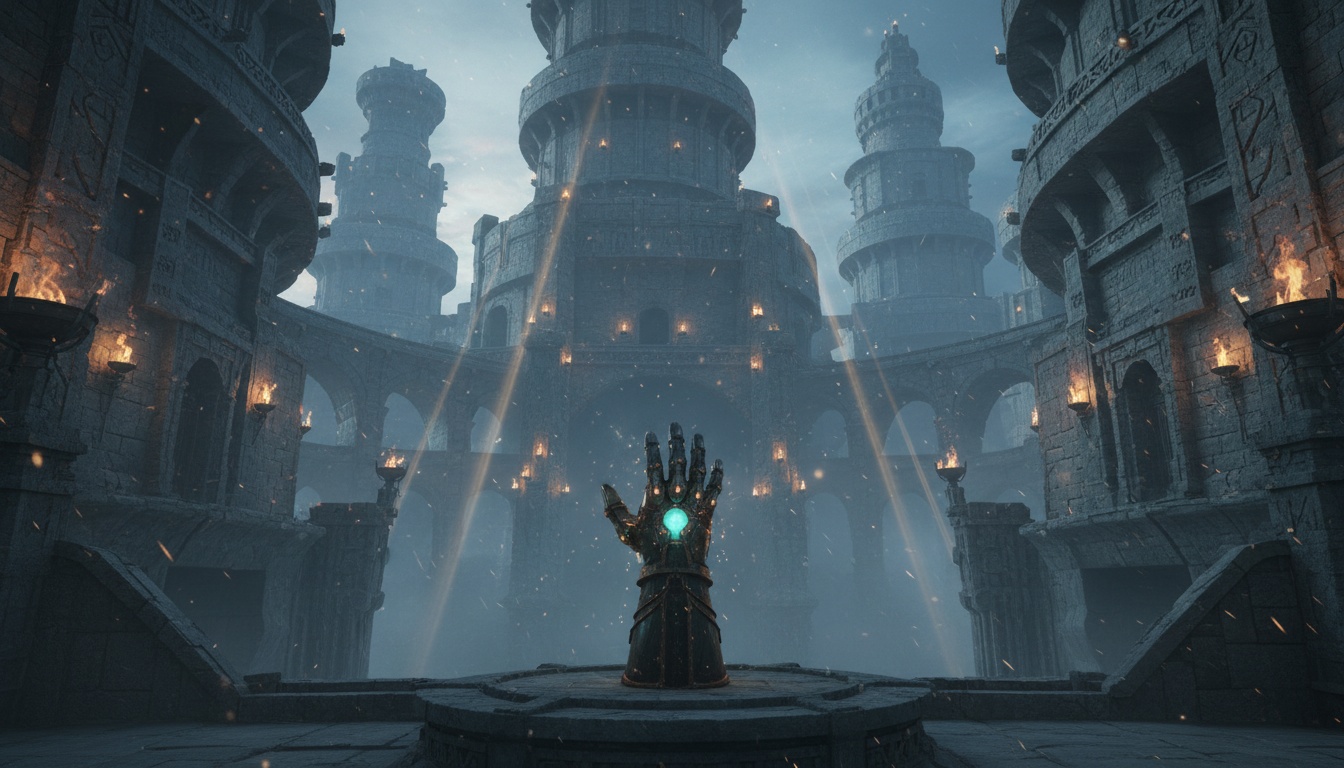
The puzzles are the heart of it. Early in the game you acquire a gauntlet that grants telekinetic abilities, and the designers build the entire experience around the physical act of reaching, grabbing, and placing objects in three-dimensional space. Simple telekinesis clears debris from paths. Later, dual-hand powers let you wrestle heavier objects into position. There are sphere-and-socket mechanisms, cube receptacles that activate portals, gear-based timing challenges, and holographic gauntlet puzzles where you guide a hexagonal ball through a floating field without touching the edges. None of it is brutally difficult — this is an adventure game, not a brain-teaser compilation — but the spatial nature of the solutions means they could not work outside of VR. Sliding a cube into a slot with your actual hands, fumbling slightly, adjusting your stance: that friction is the point.
Locomotion is handled with the pragmatism of a studio that understands 2017 VR audiences. Blink teleportation is the default, comfortable and immediate. Cloudhead later added free stick locomotion in beta for players who wanted it, with adjustable speed and head-anchored or controller-anchored movement options. It is a sensible spread of choices that acknowledges different comfort thresholds without defaulting to the most nauseating option available.
The world itself is the game’s strongest suit. Ember is genuinely atmospheric — towering alien architecture, warm torchlight against cold stone, a sense that something terrible happened here long before you arrived. The story is told asynchronously through the environment: holographic memories of the civilization’s final days, scribbled notes from previous travelers, and those cassette tapes with titles like “Magic Space Books” that reward curious hands. The 1980s fantasy aesthetic is not a coat of paint; it is structural. The chunky technology, the practical-mystery tone, the emphasis on wonder over exposition — it all coheres into a specific mood that few VR games have attempted since.
But time has not been entirely kind. The loading screens between areas, once a necessary evil of 2017 hardware, now feel more intrusive than they should. Some puzzle mechanics repeat across the three main hubs, and a few sequences edge toward fetch-quest territory — go here, activate that, return — that briefly stall the momentum. More importantly, the series sits in limbo. A PSVR port was announced after the PC release but never materialized, and Episode 3 has not surfaced in the years since. Heart of the Emberstone tells a satisfying enough chapter on its own, but it is hard not to feel the absence of closure.
Performance is reasonable on mid-range hardware by modern standards — this is not a visual showcase that demands top-tier GPUs, but it is also not lightweight. The art direction carries more weight than raw fidelity. Stability is solid; this is a polished, finished product, not a live-service experiment.
So who should bother? If you are looking for a native VR adventure that respects your time, builds a world worth standing inside, and constructs puzzles around hand presence rather than button presses, this is still among the better options from the first wave of room-scale PCVR. It is not essential in the way modern standout VR titles are, and the incomplete series is a genuine mark against it. But for players who value atmosphere over action and are willing to accept a 2017 design sensibility, the ruins of Ember remain worth visiting.
It is, in the end, a good VR adventure that arrived too early to benefit from everything VR would later learn, and too late to avoid the growing pains of the medium’s first generation. That middle ground is exactly where it lives: not a must-play, but a worthwhile one — especially for anyone who has already made peace with the particular loneliness of exploring dead worlds alone in a headset.