
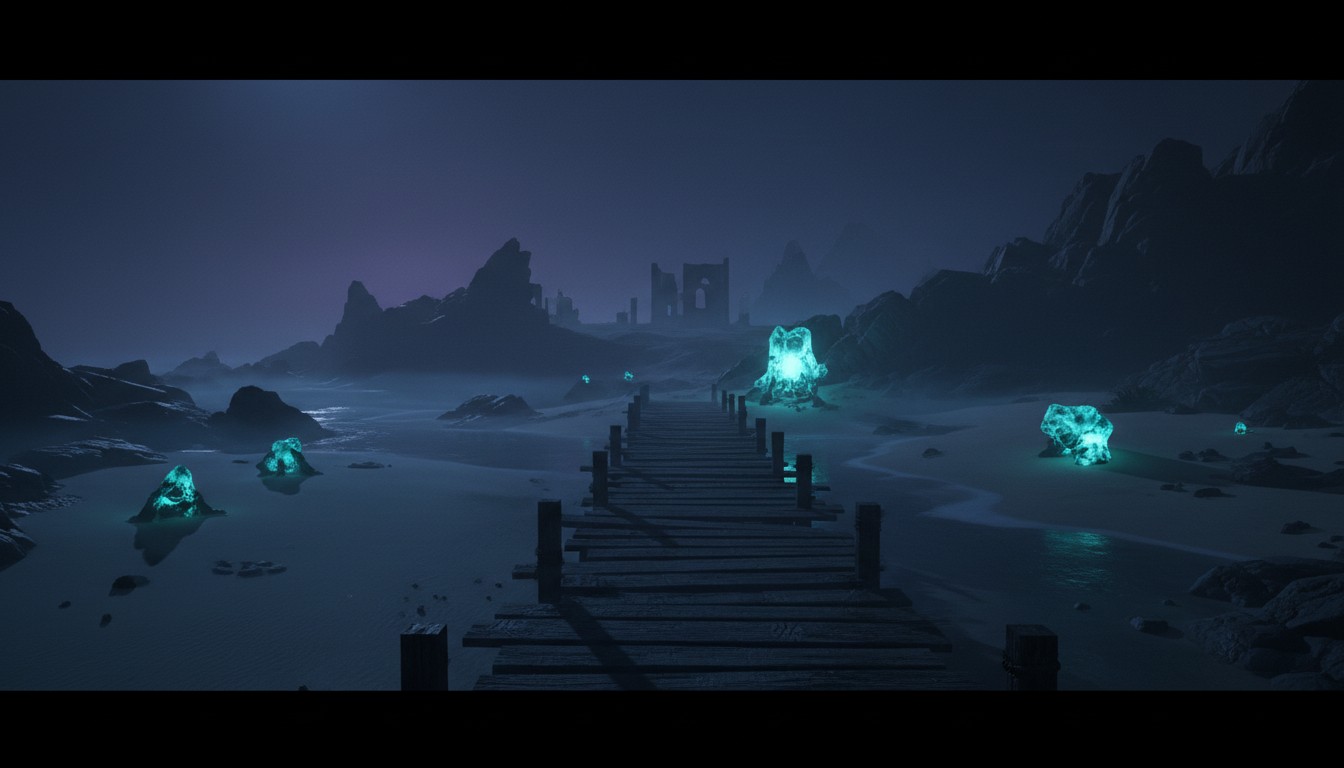
I remember the first time I blinked across a virtual beach and didn’t feel like I was going to vomit. That sounds like a low bar, but in April 2016 it was revolutionary.
The Gallery — Episode 1: Call of the Starseed launched the same day as the HTC Vive, and it was one of the few launch titles that wasn’t a tech demo, a wave shooter, or a proof-of-concept. It was a real adventure game — puzzles, story, voice acting, an actual ending — built from the ground up for room-scale VR. No flat version exists. No pancake fallback. You either played it in a headset or you didn’t play it at all.
Here’s the thing: Cloudhead Games basically invented comfortable VR locomotion. Their “Blink” teleport system — point, press, fade to black, reappear — became the industry standard because it solved the one problem that was making everyone miserable. Before Blink, developers were either bolting traditional first-person movement onto VR and making people sick, or locking players in tiny play spaces and pretending that was fine. Cloudhead looked at that mess, said “no,” and built a movement system that let you traverse actual environments without reaching for the sick bag. The fade-to-black transition mimics a natural eye blink, and the result is so smooth that even VR newcomers can handle it. By 2016 standards, it felt like wizardry. By 2026 standards, it’s still how half the VR industry handles locomotion.
The game itself is a first-person puzzle adventure heavily inspired by Myst and 90s adventure games. You play as someone searching for their missing sister, Elsie, across a mysterious coastal landscape that includes derelict beaches, abandoned sewers, weird underground labs, and stranger places I won’t spoil. The puzzles are light — nothing that’ll stall you for an hour — but they’re woven into the world well enough that they push the story forward rather than feeling like arbitrary roadblocks.
The presentation was Hollywood-grade by 2016 VR standards. Jeremy Soule, the composer behind The Elder Scrolls and Guild Wars 2, did the soundtrack, and it shows — the audio design is genuinely excellent. Voice acting is solid, the environments have real texture detail and polished lighting, and the whole thing feels like an actual production rather than a garage project. TIME named it one of the five best Vive launch games. It won over 30 awards, including VR Game of the Year from several outlets. This wasn’t a novelty — it was a statement that VR could do real games.
But here’s where I have to be honest with you. The runtime is roughly two hours. Maybe three if you explore thoroughly. And the asking price, even now, can feel steep for that length. There’s limited replay value — once you’ve solved the puzzles and seen the story, you’ve seen it. If you’re the type who measures value in hours-per-dollar, this is going to sting.
The bigger problem is that the series never finished. Episode 2 — Heart of the Emberstone — came out in October 2017 and was substantially longer at around five hours, with improved production values across the board. But Episode 3 was planned and never made. The VR market didn’t grow fast enough to justify the investment, Cloudhead pivoted to Pistol Whip in 2019, and that was that. Then in January 2026, Cloudhead laid off 70% of their staff. The studio is barely hanging on. Whatever hope remained for a conclusion to this story is effectively gone.
So you’re buying into an incomplete narrative. The first episode ends on a cliffhanger that will never be resolved by the original creators. That’s a real caveat, and I won’t pretend otherwise.
That said, the game is still playable. It still runs on modern PCVR headsets. The Blink locomotion still works beautifully. The atmosphere still lands. If you go in knowing you’re getting a short, self-contained experience rather than the start of a completed saga, there’s genuine value here — especially if you care about VR history.
The controls are straightforward: full motion controls, room-scale movement, and the Blink system handles traversal. Comfort is excellent — the teleport system and the generally slow pace make this one of the more comfortable VR experiences you can play. Performance is light by modern standards; this was built to run on 2016 hardware, so even modest current setups handle it without trouble.
Who this is for: VR enthusiasts who want to understand where the medium came from. Adventure game fans who can accept a short runtime. Players who prioritize atmosphere and narrative over mechanical depth. Anyone curious about the game that proved VR could handle genuine storytelling.
Who should skip it: Players looking for a lengthy campaign. Anyone who needs narrative closure. People who already find teleport locomotion outdated and prefer smooth artificial movement. If you want a modern, full-length VR adventure, this isn’t it — and it never will be.
I still think Call of the Starseed is worth experiencing, but with your eyes open. It’s a fascinating artifact from the moment VR grew from tech demos into actual games, and it’s one of the few early titles that doesn’t feel embarrassing to revisit. Just know what you’re getting: two hours of genuinely atmospheric puzzle adventure, a movement system that changed the industry, and a story that ends with a promise nobody could keep.