
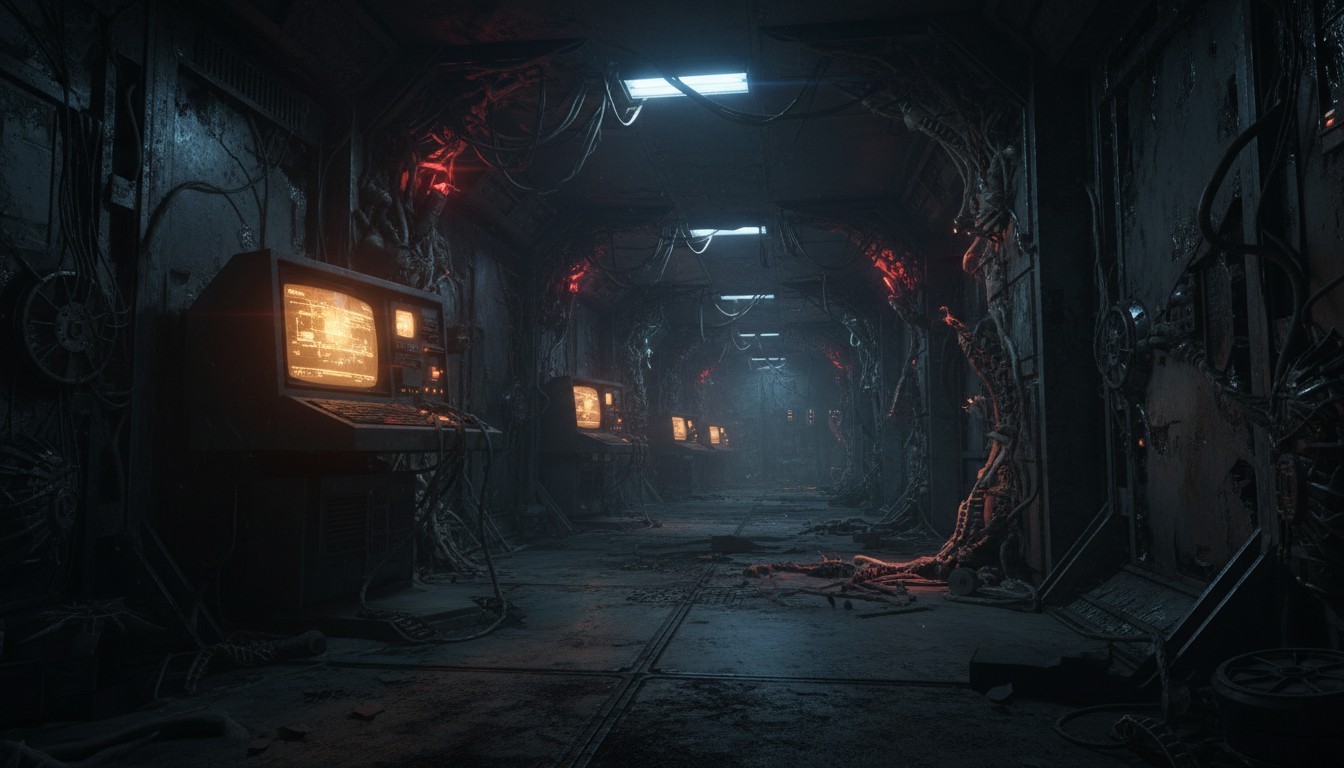
System Shock 2 is one of those games that rewired what people thought a first-person game could be. The RPG-inventory-survival-horror hybrid that Irrational Games and Looking Glass shipped in 1999 still casts a shadow over everything from BioShock to Prey. If you’re here, you already know that. The question is whether putting it in a headset does anything meaningful for the experience.
The short answer: not really. Not yet, anyway.
What You’re Actually Getting
The only way to play System Shock 2 in VR right now is through vorpX, a paid injection driver that wraps a stereoscopic 3D shell around a flatscreen game. You get depth perception and head tracking — the rotational, look-around kind, not positional lean-and-crouch tracking. You don’t get motion controls. You don’t get hand presence. You don’t get a VR interface. You play the same keyboard-and-mouse game you’d play on a monitor, except it’s floating in front of your face with some depth to it.
vorpX uses Z-Buffer 3D mode for System Shock 2, which generates depth separation rather than rendering true geometric stereo. It looks decent — the corridors of the Von Braun gain some real spatial presence — but it’s not native VR rendering. Geometry 3D support for the game’s DX9 renderers has been reportedly in development for vorpX, which would improve the effect, but it hasn’t landed yet.
The game plays exactly as it does on a flatscreen. Same controls, same UI, same inventory management. You’re holding a mouse and keyboard. Your head turns the camera, and that’s the extent of VR integration.
The Configuration Hurdle
Getting System Shock 2 running acceptably in vorpX is not a plug-and-play situation. You need the modern DX9 fan renderer, specific resolution settings (the game wants a 4:3 aspect ratio, so you’re pushing something like 3840x2880 for clarity on a modern headset), V-sync enabled, maximum in-game FOV, and the headset in extended mode as your primary display. vorpX’s DirectVR feature can handle FOV and resolution auto-adjustments, but it doesn’t provide positional head tracking for this title.
Screen tearing, inconsistent frame timing, and judder on head turns have all been reported even on capable hardware. The original game’s head-bobbing option causes nausea in VR and needs to be disabled. Menu navigation requires switching to vorpX’s edgepeek mode, which temporarily flattens the image so you can read text and click buttons without straining.
None of this is impossible. It’s just work — the kind of work where you spend 30 minutes in configuration menus before you see a single hybrid, and then you’re still holding a mouse.
The Atmosphere Tax
Here’s the thing: when it clicks, it does add something. The Von Braun’s corridors have genuine spatial presence through the headset. The audio design — already one of the strongest aspects of the original game — takes on a different quality when you’re physically enclosed in the environment. Hearing a hybrid’s groaning footsteps approach from behind you while you’re actually looking down a hallway in VR does hit differently than hearing it through speakers while staring at a monitor.
But the atmosphere tax is steep. You’re paying in configuration time, comfort risk, and the fundamental disconnect of playing a mouse-driven game inside a headset. Every time you need to manage your inventory, read a log, or navigate a menu, the illusion cracks. And System Shock 2 is a game that demands constant inventory management and log reading.
The Ghost of What Could Have Been
The hardest part about writing this is knowing what Nightdive Studios was building. The official VR mode for the Enhanced Edition (later renamed 25th Anniversary Remaster) was the real deal — full motion controls, one-to-one arm-swinging melee, manual weapon reloading, the works. Inspired by Half-Life: Alyx. Prototyped on Valve Index hardware. Nightdive CEO Stephen Kick showed it off and it looked legitimate.
Then Meta canceled it. The funding was pulled as part of a broader project cull, and the VR mode died. Nightdive has said restarting development isn’t off the table — it could come back as a patch or standalone release depending on how the 25th Anniversary Remaster performs — but as of now, it’s dead. Flat2VR Studios has expressed interest in taking over, but nothing has materialized.
There’s also shock2quest, an independent project on GitHub attempting to recreate the Dark Engine for standalone Quest VR. It’s pre-alpha. Not meaningfully playable. No timeline. Worth watching, not worth waiting for.
What You Should Actually Do
If you want to play System Shock 2, play it flat. It’s still brilliant. The game loses nothing on a monitor that the vorpX wrapper gains in atmosphere — and the wrapper costs you configuration time, comfort, and the constant friction of flatscreen interaction inside a headset.
If you want System Shock in VR with actual motion controls and hand presence, play the 2023 System Shock Remake with Ashok0’s UEVR mod. That’s a different game — a remake of the first System Shock, not the sequel — but it’s the only way to get a proper VR System Shock experience right now. And it’s genuinely good.
If you’re a vorpX owner who wants to see the Von Braun’s corridors with depth perception and you’re comfortable with advanced configuration, sure — it works once you dial it in. The atmosphere gain is real. But you need to be honest with yourself about what you’re signing up for: a flatscreen game displayed in stereo, not a VR game.
This isn’t a D-tier game. System Shock 2 is an all-timer. But the VR experience is a D-tier VR experience — a stereo wrapper on a mouse-driven game with no motion controls, no VR UI, and enough configuration friction to weed out anyone who isn’t already committed. The tier system rates the VR experience, not the game, and on that axis this lands squarely in “only bother if you already own vorpX and love the game enough to tolerate the wrapper.”