
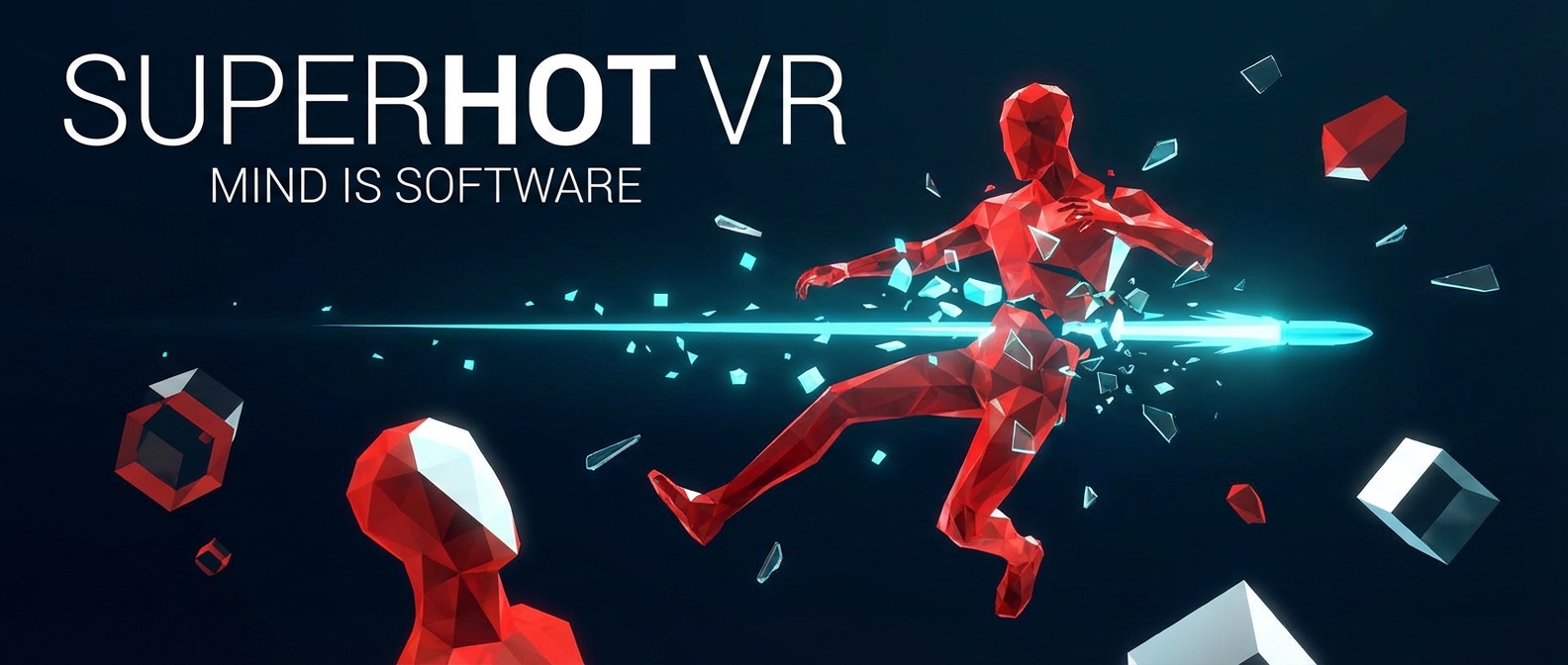
SUPERHOT VR: The Bullet-Time You Inhabit
SUPERHOT VR is not a VR mode tacked onto a flat game — it is a separate, purpose-built VR experience that stands as one of the most convincing arguments for VR as a gaming medium. The time-moves-when-you-move mechanic translates flawlessly to hand-tracked motion controllers, turning each level into a choreographed action puzzle that feels like starring in your own bullet-time sequence.
Critical distinction: This is NOT the same game as flat SUPERHOT. Different levels, different campaign, different mechanics. It is a separate purchase.
What Makes It Work
The Core Mechanic
SUPERHOT’s central concept — time only advances when you move — sounds like a novelty. In VR, it becomes transformative. You are not playing a slow-motion shooter; you are playing a puzzle game where your body position and movement timing are the variables. A single level might involve:
- Dodging a bullet by physically ducking
- Throwing a coffee cup to disarm an enemy
- Catching their dropped pistol mid-air
- Pivoting to shoot another attacker approaching from behind
- All while frozen in a crystalline moment of action
This works because the game gives you full hand presence. Every object is grabbable. Every bullet is a physical projectile you can see, track, and evade. The red-on-white visual language is stark but perfectly readable — you always know what is a threat, what is cover, and what is a weapon.
VR Implementation Quality
This is where SUPERHOT VR earns its reputation. The developers rebuilt the game from scratch for VR rather than porting the flat version.
- Hand tracking: Precise. Weapons align to your grip. Throwing physics are learnable.
- Head tracking: Critical to gameplay. You physically dodge bullets by moving your head and body.
- Room-scale support: Technically “Standing Only” per Steam, but the game works best with room-scale space. You will physically step, duck, and lean.
- 360° gameplay: Enemies attack from all angles. Wired headsets introduce cable-management tension; Quest’s wireless freedom is genuinely advantageous here.
Platform Comparison
PCVR (Steam / Meta Rift)
- Pros: Best visual fidelity, most reliable tracking
- Cons: Cable management is real; spinning 360° while dodging creates tangle risk
Meta Quest (Standalone)
- Pros: Wireless freedom is transformative; no PC required; optimized port
- Cons: Slightly reduced visual fidelity
- Verdict: Many reviewers consider this the definitive version due to untethered movement
PSVR (PlayStation VR)
- Pros: Accessible entry point
- Cons: Move controller tracking limitations affect throwing mechanics
- Verdict: Still playable, but the weakest of the three options
Controls & Comfort
No Artificial Locomotion
SUPERHOT VR has no teleport, no smooth locomotion, no snap-turn. You physically step within your play space, and time advances only when you move.
This means:
- Small play spaces: Playable but limiting. Some levels require enemies to approach you because you cannot close distance yourself.
- No seated play: This is a standing/room-scale experience. Seated play would break the core mechanics.
Comfort
- Motion sickness risk: Minimal. No smooth locomotion, no camera shake, no forced movement.
- Physical demands: High. You will be ducking, dodging, and twisting. Not suitable for users with limited mobility.
- Cable hazard: On wired headsets, the 360° nature of combat creates genuine cable-tripping risk.
Content & Longevity
Campaign
- Length: ~1.5-2 hours for first playthrough
- Structure: Linear progression through increasingly complex scenarios
- Story: Minimalist narrative delivered through environmental storytelling
Post-Game Modes (unlock after completion)
- Endless Mode: Survival against waves
- Headshot Only: Precision challenge
- No Guns: Melee and thrown objects only
- Hardcore Mode: Faster enemy movement, one-bullet weapons
- Speedrun Modes: Against the clock
Each level is a puzzle with multiple solutions, and self-imposed challenges extend lifespan significantly.
How It Differs From Flat SUPERHOT
| Aspect | Flat SUPERHOT | SUPERHOT VR |
|---|---|---|
| Levels | Different campaign | Different campaign |
| Mechanics | Keyboard/mouse or gamepad | Full hand tracking |
| Combat | Aiming with mouse/cursor | Physically aiming, throwing, catching |
| Movement | WASD locomotion | Physical movement only |
| Price | Separate purchase | Separate purchase |
The VR version is not an “enhanced edition.” It is a parallel title built for a different input paradigm. Owners of flat SUPERHOT do not get a discount or free upgrade.
Known Limitations
- Short campaign: 2 hours is brief for the price point. Challenge modes extend value, but this is not a long narrative experience.
- Play space requirements: Minimum standing room. Room-scale (2m x 2m) recommended. Users with small spaces report frustration.
- PSVR throwing: Move controller tracking limitations make throwing objects inconsistent for some users.
- No locomotion options: Intentional design. Locomotion would break level choreography.
The Bottom Line
SUPERHOT VR is S-tier material. Not because it is perfect — it is short, it demands physical space, and PSVR users face compromises — but because it demonstrates what VR can do that flat games cannot. The time mechanic, the physical dodging, the hand-to-hand combat flow: none of this translates to a monitor.
Quest owners: Essential purchase. This is a showcase title for the platform. PCVR owners: Highly recommended. Use cable management or wireless adapter if possible. PSVR owners: Recommended with caveats. Be aware of Move controller limitations.
Who should skip: Users with very small play spaces, those seeking a long narrative campaign, or users with mobility limitations that prevent ducking/dodging.
Setup: Native VR title. No configuration required. Buy and play.
Play Space: Standing minimum. Room-scale strongly recommended.
Platform Note: Quest version is often considered definitive due to wireless freedom.
Last Verified: March 2026