
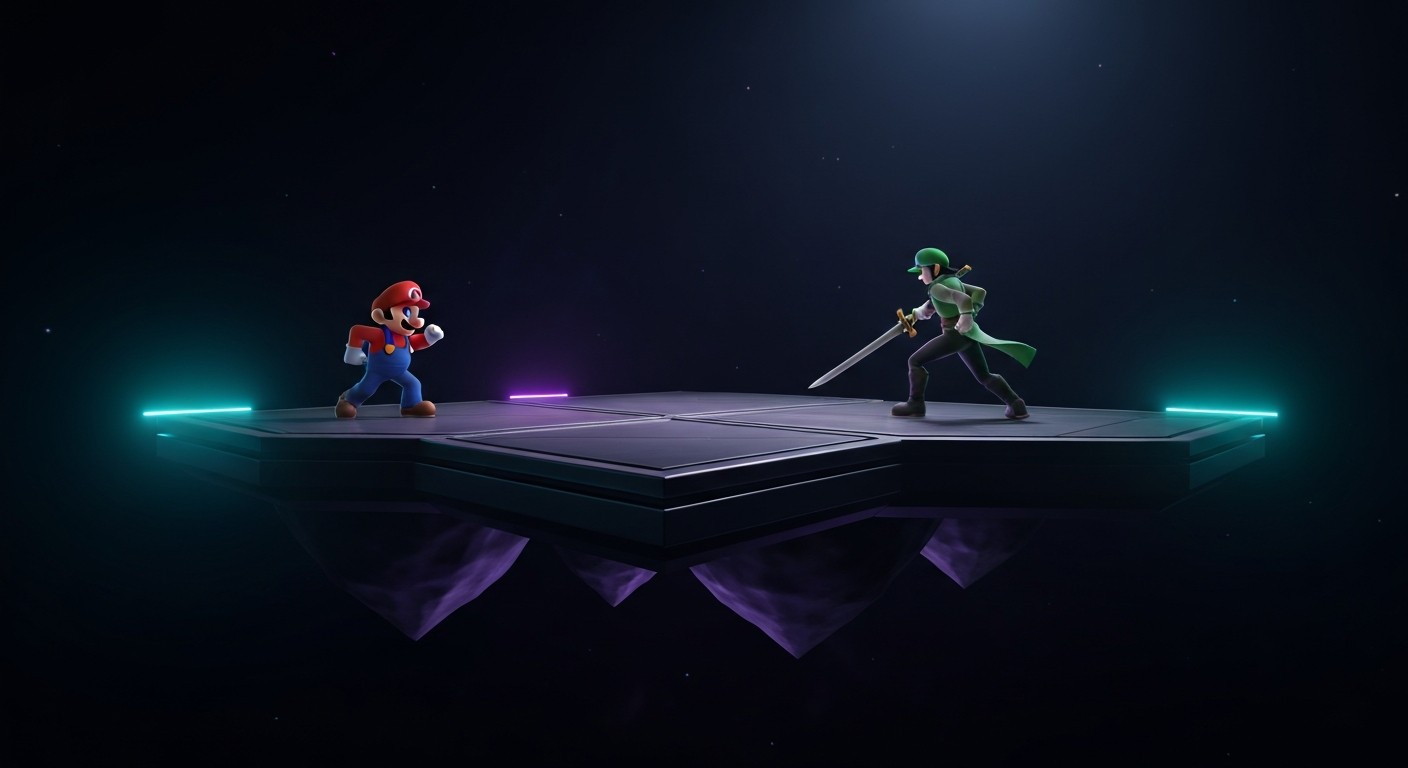
I love Super Smash Bros. Melee more than most things in this world. I still have a GameCube controller with a frayed cord and worn-out Z button that I’ve been meaning to replace for three years. So when I heard there was a way to play it in VR, I had two simultaneous thoughts: “Holy shit, that sounds incredible” and “This is going to be a nightmare.”
Both were right.
The way you get Melee into a headset is through Dolphin VR, a fork of the Dolphin emulator built by Carl Kenner to render GameCube and Wii games in stereoscopic 3D with head tracking. It takes the flat image you remember from your childhood and turns it into a life-sized diorama you can lean into, look around, and observe from angles the GameCube’s fixed camera never intended. The characters have depth. The stages stretch out in front of you. Final Destination looks like an actual platform floating in space, not a flat plane on a CRT.
It’s genuinely striking the first time you see it. Then you try to play a serious match and remember why this is a curiosity, not a competitive setup.
Here’s the thing: Dolphin VR doesn’t change how Melee plays. You’re still looking at a side-view fighting game, still inputting the same frame-perfect commands on a GameCube controller (or whatever adapter you’ve got plugged in), still relying on the same muscle memory that took you years to develop. What changes is the presentation layer. Instead of watching Melee on a screen, you’re inside a virtual space looking at a 3D diorama of Melee playing out in front of you.
That distinction matters, because it defines what this experience actually is. It’s not “Melee in VR” in the way Half-Life: Alyx is Half-Life in VR. It’s “Melee, but stereoscopic and head-tracked,” which is a much more accurate and much less exciting description.
The setup is not for the faint of heart. You need the Dolphin VR fork specifically — not the standard Dolphin emulator, not the newer Dolphin XR fork that’s targeting standalone headsets with OpenXR. The original Dolphin VR is a 2016-era project built for the Oculus Rift CV1 and HTC Vive, and getting it running on modern hardware means navigating compatibility quirks, graphics backend experimentation, and per-game configuration tweaks. For Melee specifically, you need to disable “Stabilize: Roll” or the entire menu spins like a broken carousel. The HUD defaults to appearing way too close to your face, so you spend the first twenty minutes adjusting HUD distance and world scale until the stage looks right.
And then there’s performance. Dolphin VR is CPU-hungry in ways that standard Dolphin isn’t. The stereoscopic rendering and head tracking add overhead on top of already demanding emulation, and stuttering is a common complaint. The community’s workaround — setting Dolphin’s game speed to Unlimited while GPU-locking to 60 FPS — is the kind of esoteric fix that makes sense once you understand it and sounds like sorcery until you do. Even then, you may find yourself toggling between OpenGL and Direct3D backends, tweaking internal resolution, and generally treating the emulator like a science experiment rather than a game launcher.
All of that tinkering might be worth it if the payoff were transformative. For me, the novelty wore off around the third match. Melee is a game of millimeters and milliseconds — spacing, reaction, muscle memory, and visual clarity. The 3D diorama is undeniably cool, but it adds nothing to those actual gameplay priorities. If anything, it slightly subtracts from them. The head-tracked camera can drift during fast action, and the added latency of emulation plus VR rendering means your inputs feel just a hair slower than they should. That hair matters in Melee. A lot.
I found myself playing better with the headset off and the emulator in standard flat mode. The 3D was neat. Winning was more fun.
That said, there are contexts where this works. Local multiplayer with friends who don’t care about frame-perfect play is genuinely fun in VR — the diorama effect makes the stage feel like a toy you’re all gathered around, and the spectacle of watching a Falco shine combo from a low angle is the kind of thing that makes people laugh out loud. It’s a party trick, not a practice tool, but it’s a good party trick.
Comfort is a non-issue, which is rare for VR coverage. Melee has no first-person movement, no artificial locomotion, no snap turning — just a fixed camera and characters bouncing around a stage. The diorama view is genuinely comfortable even for VR newcomers. If you’re introducing someone to VR and want to show them something familiar in a new format, Melee in Dolphin VR is an unexpectedly gentle option.
The newer Dolphin XR fork deserves a mention here, because it’s trying to modernize what Dolphin VR started. Built on OpenXR with targets for Quest and Pico standalone headsets, it’s attempting to bring GameCube and Wii emulation to headsets without a gaming PC tether. But as of its first preview release, it’s early, unstable, and not yet a practical way to play Melee. The original Dolphin VR fork, despite its age, remains the functional option for PCVR users.
So who is this for? If you’re a Melee obsessive with a headset gathering dust and a high tolerance for emulator configuration, the diorama effect is worth experiencing once. If you’re looking for a new way to play Melee seriously — netplay, local tournaments, anything where performance matters — this is not it. The added latency, the fiddly setup, and the fact that the 3D presentation adds nothing to the actual game make this a hard pass for competitive players. And if you don’t already own a headset, there is zero reason to buy one for this.
Look, I’m not gonna lie — I wanted to love this more than I did. Melee in my headset felt like the fulfillment of a childhood dream for about ten minutes. Then I tried to short-hop nair and the timing felt wrong, and I remembered that nostalgia and good gameplay aren’t the same thing. The diorama view is a genuinely impressive technical achievement, and the fact that a community emulator fork can render a 2001 GameCube game in stereoscopic 3D with head tracking is remarkable. But remarkable technology doesn’t automatically make for a better way to play a game that was already perfect at what it did.
Melee deserves your GameCube controller, your CRT or low-lag monitor, and your full attention. It doesn’t need a headset. It especially doesn’t need a headset with menus that spin like a broken roulette wheel until you find the right config setting to disable.