Super Mario Bros. 3 in VR: The Greatest 2D Platformer Finds a Third Dimension
Super Mario Bros. 3 is not just a great NES game. It is not just a great platformer. It is one of the most perfectly designed video games ever created—an eight-world masterclass in introducing mechanics, escalating challenge, and rewarding mastery that every designer still studies today.
Released in 1988 in Japan and 1990 in North America, it took everything from Super Mario Bros. and Super Mario Bros. 2 and refined it into something almost architectural. The world map with its branching paths and secret routes. Eight distinct kingdoms, each with unique environmental mechanics. The Super Leaf’s raccoon tail that fundamentally changed how you navigated levels. The Frog Suit, the Tanooki Suit, the Kuribo’s Shoe. The airship fortresses with their scrolling cannons. The final confrontation in Bowser’s castle that required understanding the mechanics rather than just reaching the end.
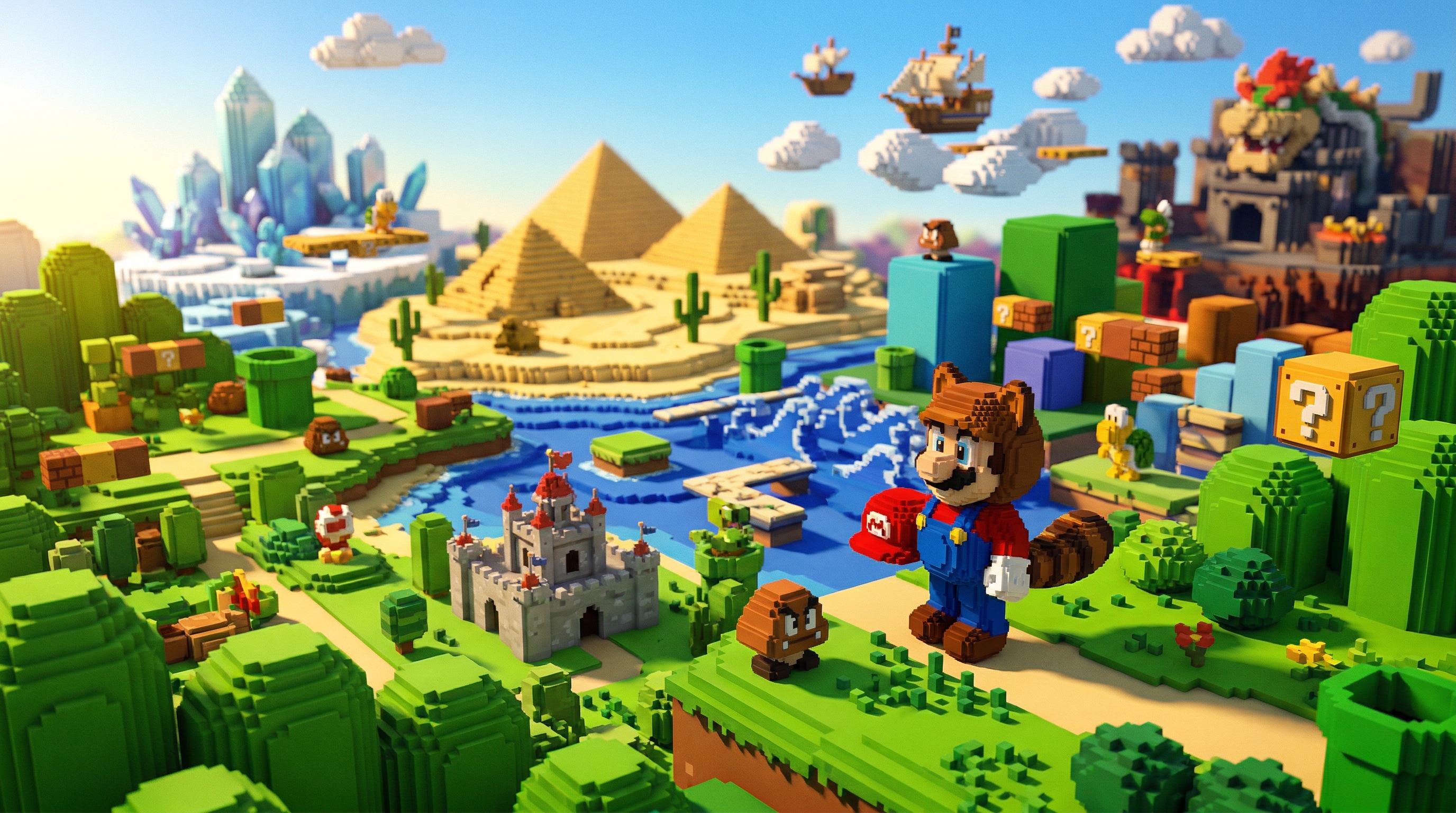
Playing it in VR through 3dSen VR doesn’t just add novelty to nostalgia. It transforms the experience into something genuinely spatial—turning the most celebrated 2D platformer into a 3D diorama you can step inside, examine from any angle, and appreciate with new eyes. The result is the definitive way to experience a game that, incredibly, still hasn’t been bettered in its specific craft.
What This VR Option Actually Is
3dSen VR — The Voxel Transformation Engine
3dSen VR is a commercial NES emulator that performs something no other tool attempts: real-time conversion of 2D pixel graphics into fully dimensional 3D voxel environments. This isn’t stereoscopic 3D applied to a flat image. The engine analyzes each game’s visual elements and constructs plausible 3D geometry—blocks that pop out, backgrounds that recede, enemies that have actual volume.
Each supported game requires a hand-crafted 3D profile. The developer, geod (Tran Vu Truc), has spent over a decade refining this technology, and Super Mario Bros. 3 has received substantial attention. The result is one of the most visually striking implementations in the entire 3dSen library.
What it provides:
- Full 3D voxel transformation of all eight worlds
- World map rendered as a spatial board you can examine
- Each kingdom’s unique aesthetics translated to dimensional geometry
- Power-ups, enemies, and blocks given actual volume
- Room-scale VR with free camera positioning
- Mixed Reality mode on Quest for placing the game in your real environment
What it doesn’t provide:
- Motion controls (you play with a gamepad)
- Altered physics or gameplay (it’s the exact NES game)
- ROMs (you must provide your own legally obtained copy)
The Alternative Routes
EmuVR offers a different approach: a virtual 80s bedroom where you insert a physical Super Mario Bros. 3 cartridge into a NES and play on a CRT television. The game remains 2D, but the ritual and nostalgia are authentic. This is for purists who value the experience of retro gaming over visual transformation.
Mixed Reality Mode (Quest) uses the same 3dSen engine but displays the game world as a diorama floating in your actual room through passthrough cameras. You can place the Mushroom Kingdom on your coffee table, walk around it, and play with your real environment visible.
How It Plays
The World Map in 3D
Super Mario Bros. 3’s world map was revolutionary in 1988—a meta-layer that transformed the game from a linear sequence into a strategic journey. In 3dSen VR, this map becomes a physical board you can examine.
The Grass Land’s gentle hills have actual topography. The Desert Land’s pyramids cast shadows. Giant Land’s oversized elements gain genuine scale when they have dimensional presence. The cloud platforms in Sky Land float at different depths. Ice Land’s crystalline aesthetic refracts light. Pipe Land’s maze-like structure becomes navigable in 3D space. Dark Land’s threatening atmosphere intensifies with volumetric presentation. And Bowser’s Castle looms with architectural weight.
You don’t just select levels—you hover over a tangible world.
The Eight Kingdoms Transformed
Each of the eight worlds benefits from the 3D conversion in distinct ways:
World 1: Grass Land The foundational world that teaches the game’s vocabulary. The simple hills and blocks gain charming dimensionality. Goombas and Koopa Troopas have actual volume as they patrol. The first fortress’s architecture becomes a genuine structure rather than flat tiling.
World 2: Desert Land Where the transformation becomes dramatic. The sun that chases you in certain stages has radiant presence. The pyramids and sphinxes gain monumental scale. The quicksand sections have actual depth—you see into the pits. The Angry Sun itself becomes a threatening 3D object.
World 3: Water/Ice Land The aquatic stages gain genuine underwater atmosphere. Bubbles rise through dimensional space. The Jelectros (floating jellyfish) hover at different depths. Ice physics remain unchanged, but the crystalline environments refract light beautifully.
World 4: Giant Land Perhaps the most impressive transformation. The oversized enemies—Gargantua Koopas, Grand Goombas—have genuine imposing scale when rendered as 3D voxels. The giant blocks become architectural elements. Everything that was “big” in 2D becomes “massive” in 3D.
World 5: Sky Land The cloud platforms naturally benefit from depth separation. The two-part structure—ground kingdom and sky kingdom—becomes visually distinct. Lakitu’s cloud patrols at a different plane. The airship fortress feels genuinely airborne.
World 6: Ice Land The slipperiest world gains crystalline beauty. Ice blocks have translucency. The frozen aesthetic becomes palpable. The difficult platforming sections remain mechanically identical but visually striking.
World 7: Pipe Land The maze-like structure becomes genuinely navigable in 3D space. You can see how the pipes connect across layers. The Piranha Plants emerge from dimensional depth. The complexity of the world design becomes more appreciable.
World 8: Dark Land/Dark Kingdom Bowser’s territory gains ominous weight. The tank and ship stages become military processions through space. The final castle looms with genuine architectural presence. The ultimate confrontation with Bowser has gravitas.
The Power-Ups in Three Dimensions
Super Mario Bros. 3’s power-up system remains the most creative in the series, and the voxel conversion gives each suit tangible presence:
Super Leaf (Raccoon Mario): The tail that enabled flight becomes a dimensional appendage you can see from any angle. Flying through stages gains spatial satisfaction when you can perceive depth while gliding.
Frog Suit: The amphibious mobility becomes more visually distinctive when the suit has actual volume. Swimming sections gain underwater atmosphere.
Tanooki Suit: The transformation that added flight and the statue ability becomes one of the most visually striking power-ups. The stone statue form is genuinely solid in 3D.
Hammer Suit: The rarest and most powerful suit—allowing Mario to throw hammers like the Hammer Bros—becomes a tangible reward you can examine.
Kuribo’s Shoe: The iconic green boot you steal from a Goomba becomes a physical object Mario inhabits. Jumping on spiky enemies while invulnerable has dimensional satisfaction.
The Airship Fortresses
Each world’s airship fortress—where you battle one of Bowser’s children—gains genuine spectacle in 3D:
- The scrolling cannons fire through dimensional space
- The wooden ship architecture has plank depth
- The boss chambers gain enclosed atmosphere
- The scrolling backgrounds create parallax depth
Fighting Larry, Morton, Wendy, Iggy, Roy, Lemmy, and Ludwig on their respective flagships becomes a series of set-piece encounters with spatial presence.
Controls and Input
Critical clarification: 3dSen VR does not transform Super Mario Bros. 3 into a native VR platformer with motion controls. You are not physically reaching to grab blocks, swinging your arms to throw shells, or leaning to control flight.
You play with a gamepad exactly as you would with any NES emulator:
| Action | NES Original | Recommended Mapping |
|---|---|---|
| Movement | D-Pad | Left Stick or D-Pad |
| Run | B Button | Right Trigger or B |
| Jump | A Button | A Button or Right Bumper |
| Power-Up | Select/Start | Menu buttons |
Recommended controllers:
- Xbox/PlayStation controllers work perfectly
- Nintendo Switch Pro Controller for nostalgic layout
- 8BitDo N30 Pro for authentic feel
- Keyboard (not recommended for precision platforming)
The VR value comes from:
- The spatial presentation of the game world
- Ability to position yourself at optimal viewing angles
- The sense of “being near” rather than “looking at” the Mushroom Kingdom
- Mixed reality placement that makes the game a tangible object in your space
Comfort and Motion Sickness
Super Mario Bros. 3 in 3dSen VR is among the most comfortable VR experiences available:
No artificial locomotion: The game is side-scrolling with screen-edge advancement. You don’t control camera movement with analog sticks.
Stable horizon: The game world maintains a consistent orientation. No tilting, spinning, or disorienting camera behavior.
Player-controlled viewing: You can position yourself at the distance and angle that feels comfortable. The game doesn’t force perspective changes.
Predictable physics: Mario’s jumps arc exactly as they did in 1988. No VR-specific movement surprises.
Minimal intensity: Even the autoscrolling airship stages move at manageable speeds.
Verdict: Suitable for VR beginners and users sensitive to motion sickness. The experience is essentially a 3D diorama viewed from a comfortable position.
Performance and Stability
Super Mario Bros. 3 is a 1988 NES game. It ran on a 1.79 MHz processor with 2KB of RAM. The 3dSen VR conversion adds overhead, but the result remains trivial for modern hardware:
Minimum requirements (per 3dSen VR):
- CPU: Intel Core i3
- RAM: 8 GB
- GPU: Nvidia GTX 960
Real-world performance:
- Runs flawlessly on any VR-capable system
- Stable 90fps on minimum hardware
- No frame drops during intense action
- Quick save/load operations are instant
- No crashes or instability reported
Platform-specific notes:
PCVR (SteamVR):
- Native support for all major headsets (Index, Vive, Rift, Windows MR)
- Best visual quality with full PC rendering power
- Most flexible control options
Meta Quest (Standalone):
- Available on Quest Store or via SideQuest
- Identical performance to PC version
- Reduced visual fidelity compared to PC but still excellent
- Battery drain is minimal due to light computational load
Mixed Reality (Quest):
- Passthrough adds minimal overhead
- Requires well-lit room for best camera performance
- Quest 3’s color passthrough significantly superior to Quest 2’s grayscale
What Works Well
The visual transformation is genuinely magical: Seeing the Grass Land’s opening stage with blocks that have actual thickness, platforms that cast shadows, and Mario as a dimensional figure is striking. The effect doesn’t wear off—it enhances the entire campaign.
The world map gains navigational clarity: The branching paths, secret routes, and world structure become more comprehensible when rendered spatially. You understand the geography better.
Each kingdom’s aesthetic is amplified: The eight worlds were already visually distinct. The 3D conversion makes those distinctions tangible—Desert Land’s monuments, Giant Land’s scale, Sky Land’s elevation, Dark Land’s menace.
Power-ups feel more rewarding: The rare suits (Tanooki, Hammer) become physical objects you want to possess. The transformation from small Mario to powered-up forms has dimensional satisfaction.
The airship battles become set pieces: Each Koopaling confrontation gains presence. The scrolling ships feel like genuine environments rather than flat backdrops.
Performance is bulletproof: No stuttering, no lag, no compatibility issues. The emulation is rock-solid.
Co-op works perfectly: Two-player simultaneous play (Mario and Luigi) functions exactly as intended. The shared diorama experience actually enhances local co-op.
What Doesn’t Work
No motion controls: This is the primary limitation. You cannot physically reach into the world, grab shells, or swing the raccoon tail. You’re viewing and controlling, not embodying.
The 3D is visual-only: Hitboxes remain 2D. A fireball that appears to miss in Z-space might still hit because collision detection is planar. This takes brief adjustment.
ROM requirement: You must provide your own legally obtained NES ROM. 3dSen VR is an emulator, not a game distribution platform.
Some visual artifacts: The voxel conversion occasionally produces edge cases—blocks that don’t quite align, sprites that flicker between states, backgrounds that separate oddly. These are rare but present.
Not the SNES All-Stars version: This is the original NES version with its specific visuals and audio. The Super Mario All-Stars remake with updated graphics is not supported.
The Comparison: Super Mario Bros. vs. Super Mario Bros. 3
Both games are available in 3dSen VR, and both are worth playing. But they offer different experiences:
| Aspect | Super Mario Bros. | Super Mario Bros. 3 |
|---|---|---|
| Scope | 32 levels, linear progression | 90+ levels, 8 worlds, branching paths |
| Mechanics | Basic run and jump | Flight, swimming, power-up inventory |
| World Design | Repetitive themes | Eight distinct visual kingdoms |
| Power-ups | Mushroom, Fire Flower, Star | Leaf, Frog, Tanooki, Hammer, Shoe |
| Bosses | Bowser at the end | Seven Koopalings + Bowser |
| Secrets | Hidden blocks, warp zones | Extensive, world map navigation |
| Length | 30-60 minutes | 4-8 hours first playthrough |
| Difficulty | Challenging but short | Substantial, escalating complexity |
| 3dSen Profile | Excellent, well-established | Excellent, more complex transformation |
Recommendation: If you only play one, choose Super Mario Bros. 3. It’s the more substantial game, and the 3D transformation has more material to work with across its eight worlds.
Who This Is For
Play this if:
- You consider Super Mario Bros. 3 one of gaming’s masterpieces (it is)
- You want to experience it in what may be its definitive form
- You own a VR headset and need justification for the purchase
- You appreciate precision platforming that still hasn’t been surpassed
- You want to share the experience with others (co-op, spectators)
- You’re teaching someone about game design history and want the most engaging presentation
Don’t play this if:
- You expect motion-controlled platforming (this is not that)
- You want modernized graphics (these are still 8-bit aesthetics, just dimensional)
- You’re unwilling to source your own ROM
- You prefer the Super Mario All-Stars visual updates
- You get frustrated by NES-era difficulty (no save states between levels)
Platform-Specific Recommendations
PCVR (Index, Vive, Rift, etc.): Best overall experience. Highest visual fidelity, most flexible setup, best controller options. If you have a capable PC and PCVR headset, this is the definitive version.
Quest 3 (Mixed Reality): The most “magical” experience. Placing the Mushroom Kingdom as a diorama in your actual living room creates something genuinely novel. The color passthrough makes this feel like a real object in your space.
Quest 2 (VR mode): Excellent experience in full VR. The grayscale passthrough in MR mode is less impressive than Quest 3’s color version, but the game itself runs flawlessly.
The Verdict
Tier: A
Game Quality: A+ Super Mario Bros. 3 is not just a great retro game—it is one of the most perfectly designed platformers ever created. The eight worlds offer escalating complexity that teaches through level design. The power-up system remains unmatched in creativity. The world map transformed how platformers structure progression. The precision of Mario’s movement—run speed, jump arcs, momentum—set standards that modern games still chase. This is foundational, essential gaming.
VR Implementation Quality: A- The 3dSen VR conversion is technically impressive and visually striking. The voxel transformation adds genuine spatial depth that enhances every kingdom, power-up, and set-piece. The hand-crafted profile demonstrates deep understanding of the source material. The limitation is purely in interaction—you’re viewing and controlling, not physically inhabiting. But as an enhanced emulation experience, it’s exceptional.
Overall Tier: A
Super Mario Bros. 3 in 3dSen VR represents flat-to-VR conversion at its absolute best. The developer took one of gaming’s most important works and created a dimensional translation that respects the original while adding genuine visual wonder. Playing through the eight worlds with blocks that pop out, backgrounds that recede, and power-ups that have tangible presence recaptures the magic that players felt in 1988 and 1990.
For the price of a few coffees ($24.99 for 3dSen VR, which includes 100+ supported games), you can experience what may be the definitive version of the greatest 2D platformer ever made. That’s an essential recommendation for anyone with even passing interest in gaming history, platformer design, or VR experiences that justify the hardware investment.
The Mushroom Kingdom has never looked more dimensional. The raccoon tail has never felt more satisfying. And Bowser’s castle has never loomed with more menace.
This is how you revisit a masterpiece.