
Streets of Rage in VR: Three Classics on a Virtual Screen
Streets of Rage is one of the greatest franchises in beat ‘em up history. The 1991 original defined the genre on Sega Genesis. The 1992 sequel remains arguably the finest side-scrolling brawler ever made. The 1994 finale tried to go deeper — new mechanics, branching paths, multiple endings — even if the Western release fumbled the execution. Together they represent some of the most influential action game design of the 16-bit era, with Yuzo Koshiro’s techno soundtracks still sounding urgent three decades later.
But this isn’t a review of Streets of Rage. This is a review of what it means to play these games in VR. And the answer is: not much.
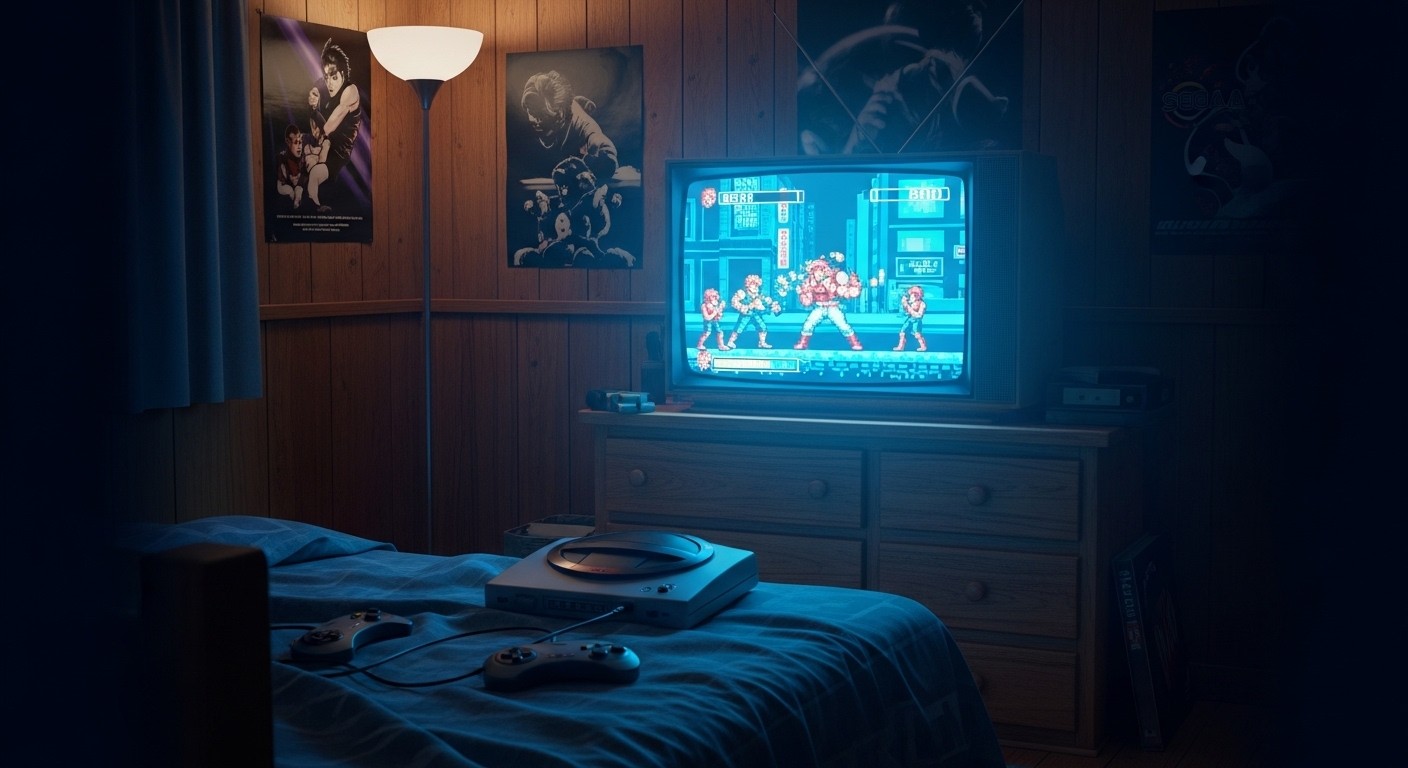
The Sega Genesis Classics collection on Steam included a VR Hub mode that placed players inside a virtual 90s bedroom, complete with period posters, furniture, and a glowing CRT television. Any of the 50+ included Genesis games could be played on that screen. Streets of Rage, Streets of Rage 2, and Streets of Rage 3 were all in the collection. The VR Hub was identical for all three. It was also delisted from Steam in December 2024. Only players who already owned the collection can still access it.
If you are looking for a VR beat ‘em up — motion punches, spatial crowd control, anything that actually uses the medium — this is not it. This is a 2D game on a virtual screen inside a nostalgic room. Three different games, one identical wrapper, and none of them meaningfully transformed by VR.
What This VR Option Actually Is
The Sega Genesis Classics VR Hub was an official mode included with Sega’s Genesis Classics collection on Steam. It ran through SteamVR and placed the player inside a themed bedroom environment where a CRT television displayed whichever Genesis title was selected.
This was not a native VR conversion of any of the three Streets of Rage games. The games remained exactly as they were on original Genesis hardware — 2D side-scrolling beat ‘em ups played on a flat virtual screen. The VR element was purely environmental. You could look around the bedroom, lean toward the television, and soak in the nostalgic atmosphere. The combat, movement, and gameplay were entirely unchanged.
The same bedroom, the same CRT, the same non-interactive wrapper applied identically to all three titles. There was no adaptation for the differences between the games. Streets of Rage 3’s faster pace, dodge rolls, and rechargeable special meter got the exact same treatment as the slower, more deliberate original.
The collection was delisted from Steam in December 2024. No new purchases are possible. The VR Hub is now a legacy curiosity for existing owners only.
The Games
Since the VR implementation was identical across all three titles, the differences that matter here are the games themselves.
Streets of Rage (1991) established the template. Three ex-cops — Adam, Axel, and Blaze — fight through eight stages of side-scrolling combat to dismantle Mr. X’s syndicate. The move set is limited by later standards, the roster is small, and the enemy variety is thin. But the pacing is tight, the co-op is immediate, and Yuzo Koshiro’s soundtrack is one of the most recognizable in Genesis history. It is historically foundational and still playable, but it shows its age next to its sequel.
Streets of Rage 2 (1992) is the peak. Larger roster, deeper combat, more expressive combos, unforgettable music, and level design that the genre still references. It is one of the finest beat ‘em ups ever made and the strongest reason to revisit the trilogy. If you are going to play one Streets of Rage game, this is the one.
Streets of Rage 3 (1994) is the most mechanically ambitious and the most compromised. Running, dodge rolls, upgradeable blitz attacks, weapon specials, and a rechargeable meter add genuine depth. Multiple endings and unlockable characters give it replay value. But the Western release is a damaged version of the Japanese Bare Knuckle III — inflated difficulty, visual censorship, removed characters, and altered story elements that make an already divisive game harder to recommend. Modern emulation can access the superior Japanese version. The Genesis Classics collection cannot.
All three played the same way in the VR Hub. None of them were changed by it.
How It Plays
Controls
Standard gamepad only. No motion controls, no hand presence, no VR-specific interactions. You played these games with a controller exactly as you would on any emulator or flat-screen setup. The VR headset functioned as a virtual monitor inside a themed room.
Two-player co-op was supported in the flat version of the collection but not in the VR Hub mode. For a series where co-op is central to the experience, this was a meaningful loss.
The Experience
The virtual bedroom had atmospheric charm. The CRT’s glow, the ambient lighting, and the period-accurate details created a nostalgic frame that flat-screen emulation does not replicate. For players who grew up with a Genesis in their bedroom, the recognition was immediate.
But the wrapper added nothing to gameplay. The fixed screen size and headset resolution limitations meant the games did not look better than they would on a modern monitor. Streets of Rage 2’s precise combo timing and Streets of Rage 3’s faster dodge-roll mechanics gained nothing from being viewed inside a headset. If anything, the abstraction of a virtual screen inside a virtual room added distance between the player and the action.
Comfort
Among the most comfortable VR experiences possible. A static virtual room with no locomotion, no camera movement, and no motion triggers. Motion sickness risk was essentially zero.
Performance
The Genesis Classics Hub ran on modest hardware without issue. The bedroom environment was lightweight, and Genesis emulation overhead was negligible. Performance was stable and predictable.
What Works Well
- Three legendary games in one collection: Whether you prefer the foundational original, the masterful sequel, or the ambitious finale, the trilogy is here — and Streets of Rage 2 alone justifies attention
- Atmospheric nostalgia: The 90s bedroom recreation was genuinely effective for players with Genesis-era memories
- Zero setup friction: The VR Hub worked immediately if you owned the collection — no configuration, no mods, no tinkering
- Official stability: Sega’s implementation meant no crashes or compatibility headaches
- Perfect comfort: No motion sickness risk whatsoever
What Doesn’t Work
- No actual VR gameplay: This is a 2D game on a virtual screen, not a VR beat ‘em up — no motion punches, no spatial awareness, no VR interaction of any kind
- Co-op removed in VR mode: Two-player co-op, a defining feature of the series, was unavailable in the VR Hub
- Delisted and unavailable: The collection was removed from Steam in December 2024 — no new purchases possible
- Fixed virtual screen: The CRT could not be resized or repositioned
- Western version of SoR3: The collection included the compromised Western release with inflated difficulty and censorship, not the superior Japanese Bare Knuckle III
- Better alternatives exist: Modern emulators offer more features, better display options, and access to regional versions. The flat version of the collection offered more features than the VR Hub
- No differentiation between games: The identical wrapper treated all three titles the same, regardless of their mechanical differences
Platform Differences
The Genesis Classics Hub was exclusive to PCVR via SteamVR. No PlayStation VR, Quest, or console VR version existed. The experience required a VR-ready PC and a compatible headset.
Who This Is For
Good for:
- Existing collection owners with strong Genesis nostalgia who want a themed way to revisit the trilogy
- VR users seeking comfortable, zero-risk experiences
- Completionists who want to experience the trilogy through the same nostalgic lens
Not for:
- Anyone seeking actual VR beat ‘em up gameplay — this is still a 2D game on a screen
- New buyers — the collection is delisted and unavailable
- Co-op players — VR mode is single-player only
- Players wanting the best version of Streets of Rage 3 — the Japanese Bare Knuckle III release is superior and accessible through emulation
- Anyone who does not already own the collection
The Verdict
Tier: D
Game Quality: A (for SoR2) / B (for SoR1) / B- (for SoR3) Streets of Rage 2 is one of the finest beat ‘em ups ever made. Streets of Rage is foundational and still enjoyable. Streets of Rage 3 is mechanically deep but compromised in its Western form. The underlying games range from good to genuinely great. But this is not a review of the underlying games.
VR Implementation Quality: D The Genesis Classics VR Hub was a virtual room with a television, not a VR transformation of any kind. It added atmospheric nostalgia but nothing to gameplay. It removed co-op. It treated all three mechanically distinct games identically. It was never VR in any meaningful sense — it was a themed wrapper around a flat-screen emulator.
Overall Tier: D Three of the best beat ‘em ups in history, wrapped in a VR implementation that never justified the headset. The bedroom was charming for about five minutes. The games played exactly as they would on any monitor. Co-op was gone. The collection is now delisted. For existing owners who already own it and want the nostalgia hit, it is harmless — but it was never the best way to play these games, and it certainly was never a real VR experience. If you do not already own the Sega Genesis Classics collection, you cannot access this at all. Even if you could, there would be little reason to.