
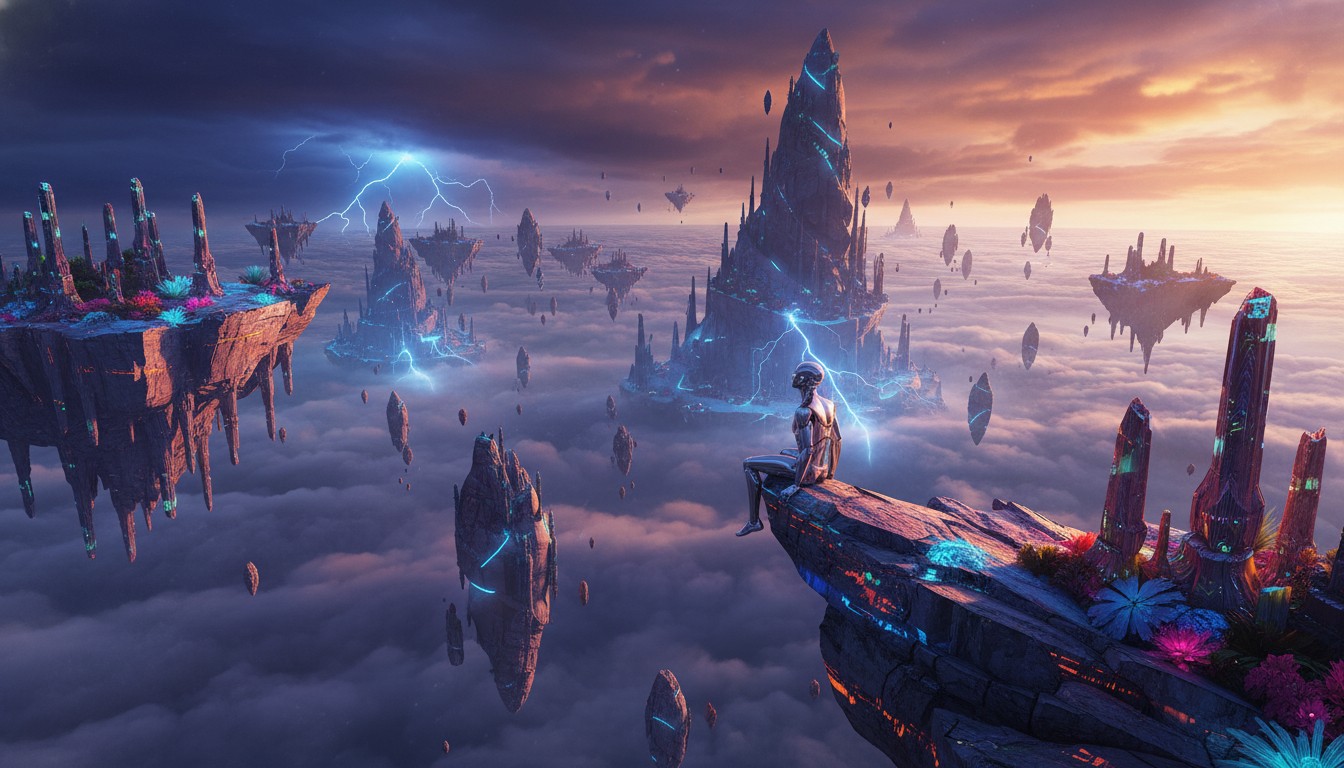
The first time you boost off a cliff face, catch an updraft, and surf across a bank of storm clouds in Stormland, you understand exactly what Insomniac was chasing. This is not a game about careful teleportation between static nodes, and it is not a seated experience with a gamepad. It is a game about momentum, verticality, and the specific fantasy of moving through an alien landscape like you actually belong there. That feeling — of genuine, unscripted freedom in three dimensions — is the best thing Stormland offers. It is also, unfortunately, about the only thing that fully works.
Released as an Oculus Rift exclusive with no flatscreen version, Stormland is Insomniac Games’ first dedicated VR project: an open-world action-adventure built from the ground up for headsets. You play as an android gardener exploring a shattered alien archipelago that reconfigures itself through a procedural system called the Terravolta. The fiction frames this as a regenerative weather cycle repairing the damage of an occupying robotic force; in practice, it means the map reshuffles between sessions, resetting outposts and respawning enemies to keep the world from going static.
The hook is movement, and Insomniac commits to it completely. Stormland gives you climbing, gliding, wall-running, and the signature cloud-surfing — a boost-powered slide across the sky that feels closer to Tony Hawk than to any traditional VR locomotion scheme. The comfort options are robust, with adjustable vignetting, snap-turn increments, and multiple locomotion preferences, but the design clearly expects you to embrace speed and altitude. For players who acclimate, bounding up a cliff face, sprinting along its wall, and leaping into a glide becomes second nature. It is the most confident traversal system in VR to date, full stop, and it makes simply getting from one island to the next more engaging than the combat waiting at the destination.
The problem is what happens once you land.
Combat is functional but conspicuously thin. You carry replaceable guns — pistols, rifles, shotguns — with elemental modifiers that slot in like interchangeable ammo types. The shooting is adequate, the reload mechanics are tactile enough, and dual-wielding two mismatched weapons feels natural in a way that would be clumsy on a monitor. But enemy variety is limited to a small roster of robotic types, the AI is predictable, and encounters rarely evolve beyond shooting robots until they stop moving, then moving to the next marker. There is no melee system to speak of, no grenades, no meaningful environmental destruction during fights, and no creative tools that leverage the traversal. For a studio known for the inventive arsenals of Ratchet & Clank and Resistance, the gunplay here feels like a contractual obligation rather than a design priority.
The Terravolta loop compounds the shallowness instead of solving it. When the world regenerates, your localized map progress resets. You keep permanent upgrades to your android body — enhanced jump jets, better shields, weapon modifications — but outposts, enemy placements, and mission objectives shuffle back to default states. The design intention was clearly to create an endlessly explorable frontier that stays fresh. The reality is a treadmill: clear an island of its robotic occupiers, log out, return to find the same island repopulated with the same encounters in slightly different arrangements. The procedural generation changes layouts but not the texture of the experience. After three or four cycles, exploration stops feeling like discovery and starts feeling like housekeeping.
Co-op for two players helps, somewhat. Having a partner to coordinate assaults on outposts or race across cloud banks injects social energy that the solo loop badly needs. The implementation is stable and genuinely easy to drop into, which is rarer than it should be in VR multiplayer. But co-op cannot fix the underlying repetition. It just means you have someone to share the grind with, and the limited enemy variety becomes even more obvious when two players are tearing through encounters faster than the spawn logic expects.
Technically, Stormland holds up well on typical hardware and maintains its sense of scale without obvious pop-in or visual compromises. The art direction is vivid and readable, with bright alien flora, crystalline architecture, and dramatic weather that gives each floating island a distinct visual identity. Performance is steady, loading is quick, and the comfort options mean most experienced VR users can handle the intensity once they find their settings. It is a polished, professional product by the standards of native VR — just a structurally shallow one.
So who is this actually for? If you want to feel what freeform VR locomotion can be at its best, Stormland is worth your time. The movement alone justifies several sessions, and the opening hours are genuinely thrilling as you learn the full vocabulary of traversal. But if you are looking for a deep action-adventure with meaningful progression, varied combat, and a world that rewards long-term investment, this is not it. Stormland is a brilliant traversal demo stretched across an open-world framework that needed another year of systems design to match the ambition of its movement.
Insomniac proved they could build a VR world worth moving through. They just did not quite build one worth fighting for.