
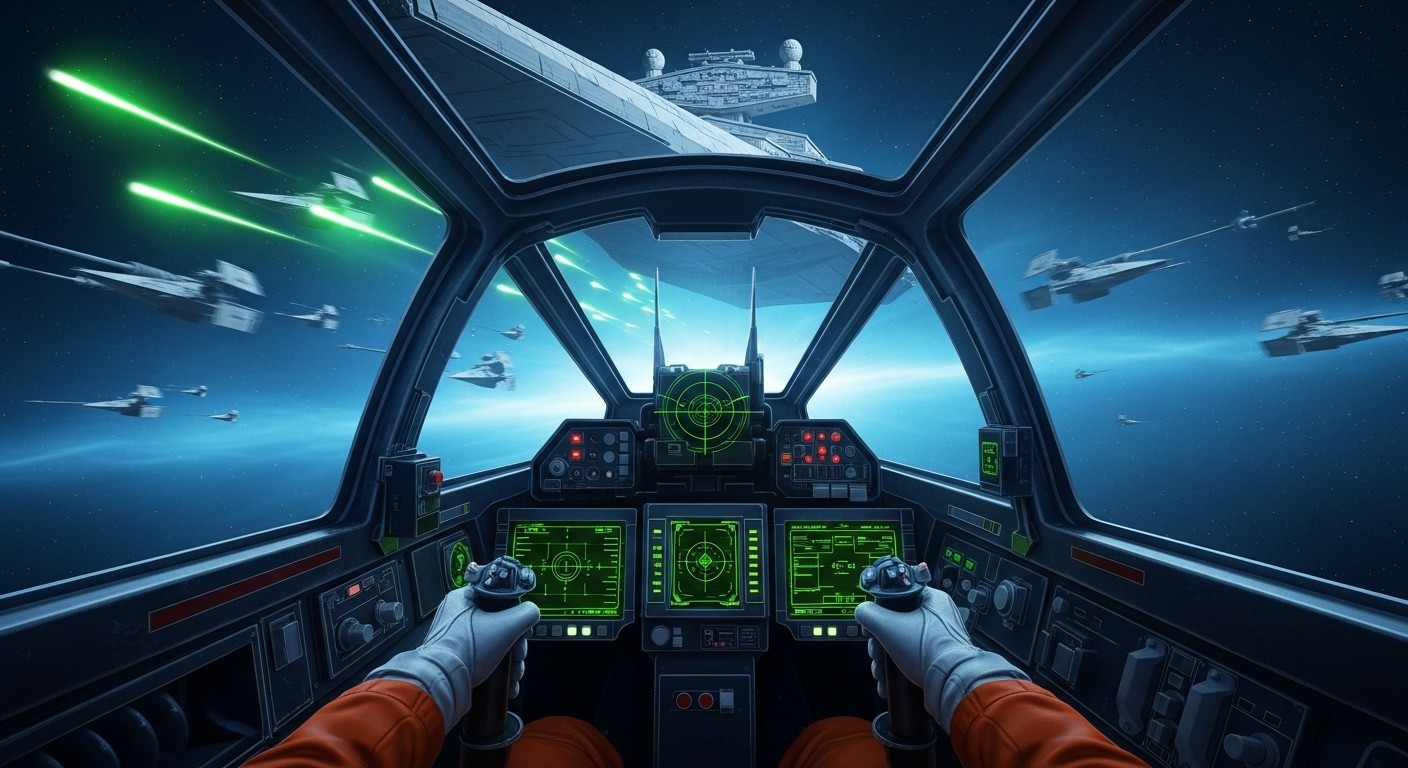
Star Wars: X-Wing Alliance in VR: The Rebellion’s Story, Finally Told in Cockpit Reality
X-Wing Alliance never quite escaped the shadow of its legendary predecessors. Released in 1999 after TIE Fighter had already cemented itself as the pinnacle of space combat simulation, it arrived as the overlooked middle child—technically superior in engine and scope, but lacking the cultural footprint of the games that came before.
Two decades later, the X-Wing Alliance Upgrade project has done something remarkable. Through SteamVR integration and a complete visual overhaul, this forgotten chapter of Star Wars flight simulation has become something its predecessors never were: a fully realized VR experience that puts you inside the Rebellion’s most iconic craft.
What This VR Option Actually Is
The X-Wing Alliance Upgrade (XWAU) is a community-driven modernization project that does far more than patch a twenty-five-year-old game. It fundamentally rebuilds the visual experience while adding native VR support:
- Base game required: You must own X-Wing Alliance (GOG, Steam, or Origin versions work)
- Complete asset replacement: Virtually every ship, station, planet, and effect has been rebuilt with modern resolution textures and models
- SteamVR integration: Native head tracking and stereoscopic rendering, not a wrapper or injection
- Ongoing development: Regular updates adding new ships, improved visuals, and VR refinements
This is not an injection driver or stereoscopic hack. This is a purpose-built VR implementation with head tracking as a core feature.
The Campaign: Family, Commerce, and War
Where TIE Fighter focused on military hierarchy and Imperial ambition, X-Wing Alliance tells a different story—one about a merchant family drawn into galactic conflict.
The narrative arc: You play as Ace Azzameen, a young pilot whose family runs a shipping business caught between Imperial demands and Rebel sympathies. When the Empire nationalizes your family’s assets, the Azzameens scatter—and you join the Rebel Alliance both to fight the Empire and to reunite your family.
Mission structure: The campaign unfolds across approximately fifty missions spanning the timeline from The Empire Strikes Back through Return of the Jedi. Unlike the purely military focus of TIE Fighter, missions include cargo runs, prisoner rescues, smuggling operations, and family extraction alongside standard combat sorties.
Craft progression: The game gives you meaningful access to the Rebel starfighter roster:
- X-Wing: The workhorse—versatile, reliable, iconic
- Y-Wing: The bomber—slow but devastating against capital ships
- A-Wing: The interceptor—fragile but unmatched in speed
- B-Wing: The heavy assault craft—experimental, powerful, strange
Each craft handles distinctly. The B-Wing in particular benefits enormously from VR—you finally understand why pilots complained about its unusual cockpit orientation when you can look around and see the asymmetrical design in three dimensions.
Capital Ship Encounters in VR
This is where X-Wing Alliance distinguishes itself. The game engine handles larger battles and bigger ships than its predecessors, and in VR, the scale becomes genuinely impressive.
Star Destroyers: Flying alongside these giants in VR reveals their true immensity. The original game always struggled to convey how massive an Imperial-class Star Destroyer really is. In VR, you can look up from your cockpit and watch kilometers of hull pass overhead, turbolaser batteries tracking distant targets, the sheer presence of Imperial engineering.
Calamari Cruisers: The Rebel flagship Liberty and her sisters feel properly substantial—graceful curves of Mon Calamari design, bristling with defensive armaments, hangar bays that actually look like they could service fighter squadrons.
Space combat dynamics: The campaign builds toward the Battle of Endor, and the final missions deliver fleet-scale engagements that remain impressive decades later. Watching squadrons of fighters weave between capital ships while trading fire—your head naturally tracking threats, checking six, reading the tactical situation through spatial awareness rather than radar blips—is what VR space combat promised and rarely delivered.
VR Implementation Quality
The XWAU VR implementation prioritizes presence over gimmicks.
Head tracking: Full six degrees of freedom inside the cockpit. Lean forward to examine targeting computers, look over your shoulder during dogfights, glance down at status displays. Combat becomes spatial—you’re not wrestling with a hat switch to check your rear, you’re using natural head movement.
Cockpit detail: Each flyable craft has distinct interior geometry. The X-Wing’s familiar cockpit translates beautifully to VR—you recognize instrument panels from film stills. The B-Wing’s unusual gyroscopic cockpit makes more sense when you can look around and see how the craft reorients around you. Even the family transports and freighters you pilot in early missions have appropriate interior detail.
HUD preservation: The original game’s green vector-style HUD has been updated for VR readability while maintaining its retro-futuristic aesthetic. Targeting displays, shield readouts, and weapon status remain legible without breaking immersion.
What’s missing: No motion controller support for cockpit interaction. This is HOTAS or gamepad territory—your hands stay on controls, not reaching for virtual switches.
Setup Burden: Enthusiast Territory
Getting X-Wing Alliance running in VR requires patience and technical comfort.
Installation layers:
- Clean X-Wing Alliance installation
- XWAU Upgrade package (substantial download with modern assets)
- VR configuration through the project’s tools
- SteamVR setup and tuning
Disk space: Expect 20GB+ for the upgraded assets, with additional temporary space required during installation.
Configuration complexity: The VR integration works through the XWAU Launcher and configuration tools. You’ll need to specify VR mode, tune resolution and rendering settings, and potentially adjust SteamVR supersampling for performance.
Steam considerations: As with many legacy game VR implementations, Steam overlay can cause instability. Launching outside Steam with SteamVR already running is often more reliable.
Controls: HOTAS Required
The consensus across all sources is clear: gamepad works, but HOTAS transforms the experience.
Why HOTAS matters:
- Button identification by touch (cannot see keyboard in VR headset)
- Analog throttle for precise speed management during combat
- Stick precision for deflection shooting and evasive maneuvers
- Muscle memory mapping that reinforces cockpit presence
Configuration: Mapping HOTAS requires time in the XWAU configuration tools. Sensitivity curves, dead zones, and button assignments all need attention. Expect to spend time tuning before the controls feel natural.
Gamepad fallback: Functional but compromised. Analog sticks lack the precision for advanced combat maneuvers, and button memorization becomes challenging when you cannot see the controller.
Keyboard limitations: Possible for setup and casual play, but impractical for serious combat—you cannot see keys while wearing a headset.
Performance Demands
VR mode significantly increases hardware requirements compared to flat gameplay.
Realistic minimums: Mid-range enthusiast hardware (RTX 3060 Ti / RX 6700 XT class) with 16GB system RAM and a modern 6-core processor.
Recommended: Upper mid-range to high-end hardware (RTX 3070+ / RX 6800+) with 32GB RAM for consistent performance.
Tuning requirements:
- Resolution scaling likely needed via SteamVR settings
- Visual quality adjustments (shadows, effects density)
- Frame rate targeting (72Hz often more stable than 90Hz)
- The visual overhaul is demanding—beautiful, but not free
Comfort Considerations
Space combat in VR involves rapid rotation, acceleration changes, and perspective shifts that can challenge comfort-sensitive users.
The experience: You’ll roll, pitch, yaw, and boost through combat. Capital ship encounters involve flying close to massive rotating structures. The game includes comfort options, but this remains an intense VR experience by nature of the genre.
Not recommended for: Users highly sensitive to motion sickness, or those new to VR who haven’t established their comfort baseline.
What Works Well
Campaign depth: The full narrative campaign—family drama, smuggling operations, escalating Rebel operations, and the Battle of Endor—is present and complete. This is dozens of hours of structured content.
Visual overhaul: The XWAU assets transform the game. Ships look current-generation, space environments feel appropriately vast and detailed, and the whole experience has visual credibility that matches modern VR titles.
Cockpit presence: The combination of recognizable Star Wars craft interiors, functional HUDs, and free head tracking creates genuine presence. You feel like you’re sitting in an X-Wing.
Scale realization: Capital ships finally feel capital. The size and detail of Star Destroyers, Calamari cruisers, and stations benefits enormously from VR’s spatial awareness.
What Doesn’t Work
Setup friction: Multi-layer installation, configuration tools, and potential compatibility troubleshooting put this well beyond “install and play” territory.
No motion controls: Cockpit interaction remains traditional input. You cannot reach out and flip switches—the VR is visual and positional, not interactive in the hand-presence sense.
Performance demands: The visual overhaul is beautiful but heavy. Users with lower-end hardware will face compromises.
Control complexity: HOTAS configuration requires patience. This is not a plug-and-play experience even after installation is complete.
Who This Is For
Good for:
- Star Wars enthusiasts who want to experience the Rebellion’s side in proper VR
- Space combat sim fans seeking substantial campaign content
- Players with HOTAS hardware and technical comfort
- Those who remember X-Wing Alliance fondly and want to revisit it properly
Not for:
- Users seeking quick, frictionless VR experiences
- Those without HOTAS or unwilling to invest in one
- Comfort-sensitive VR users who struggle with rotation and acceleration
- Players who want modern motion-controlled cockpit interaction
The Verdict
Tier: B
Game Quality: B X-Wing Alliance offers a substantial, well-structured campaign with craft variety and memorable set pieces. The family narrative adds human stakes that complement the military focus of TIE Fighter. It was always a strong space sim; the XWAU project simply makes it look and play like it belongs in the modern era.
VR Implementation Quality: B The SteamVR integration provides genuine cockpit presence with full head tracking and proper stereoscopy. The lack of motion controller support keeps it from excellence, but what is implemented works well. The visual overhaul combined with VR scale realization makes this feel like a native VR experience despite its origins.
Overall Tier: B This is a substantial VR space combat experience with decades of content depth. The setup burden and performance demands prevent easy recommendation for casual users, but for the right audience—Star Wars enthusiasts with HOTAS hardware and technical patience—this is one of the most complete campaign experiences available in VR. The combination of full narrative arc, craft variety, and capital ship encounters delivers something that remains rare in the VR space combat genre.
Recommendation: Recommended with Caveats. Complex setup and demanding performance make this enthusiasts-only territory. But for patient players with appropriate hardware, this is a definitive way to experience a classic Star Wars campaign.
Base Game Required: Star Wars: X-Wing Alliance (1999)
Install: Via XWAU Launcher. Requires base game ownership. Multi-step installation with configuration tuning.
Controls: HOTAS strongly recommended. Gamepad functional. Keyboard impractical for VR.
Performance: Heavy demands. Mid-range to high-end hardware recommended.
Comfort: Space combat involves rapid rotation. Not for VR-sensitive users.
Links: XWAU Website | XWAU on ModDB