
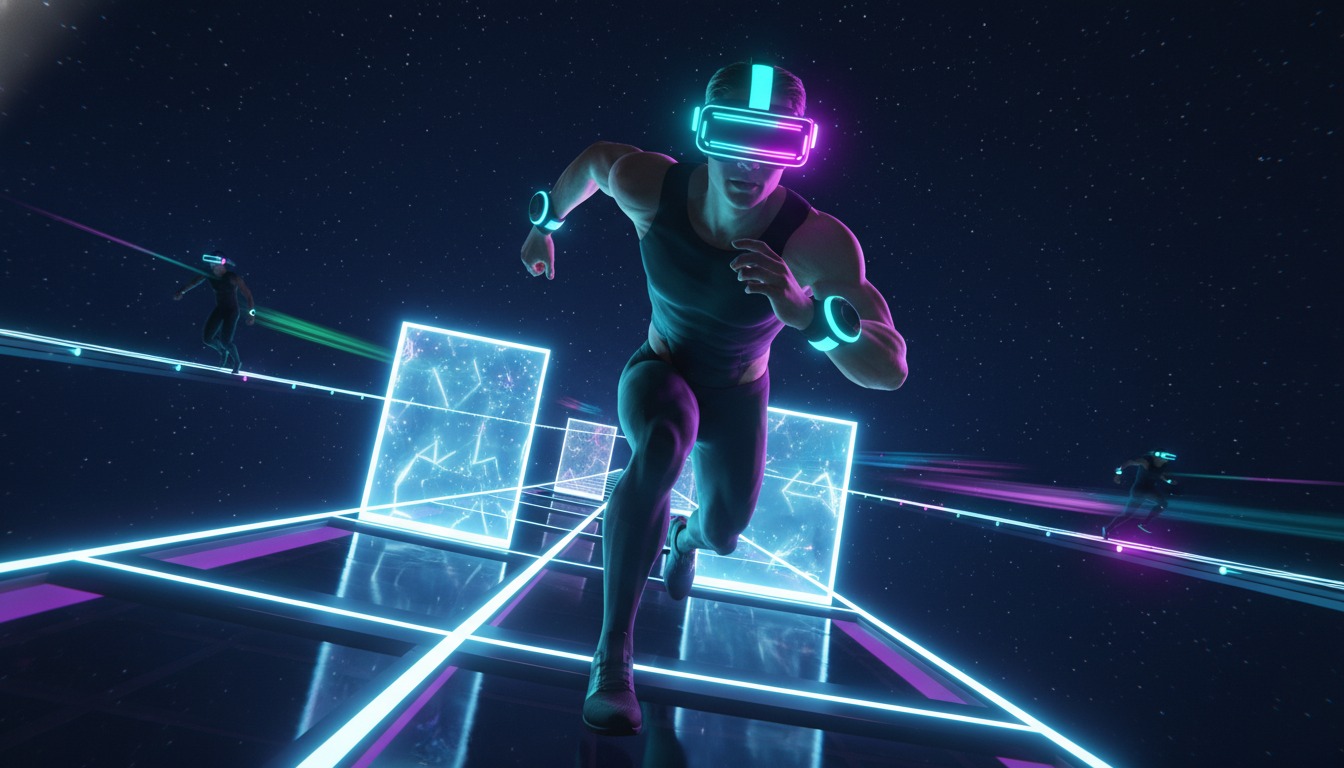
The first thing that hits you about Sprint Vector is not the speed. It is the realization that you are generating the speed yourself — physically pumping your arms like a speed skater, feeling your heart rate climb, watching your virtual avatar tear across a neon track at velocities that would make most VR games unreadable. Survios, the studio behind Raw Data and the recent Creed: Rise to Glory, has built something that should not work on paper: a high-speed competitive racer in virtual reality where your body is the engine.
Released in February 2018 for PSVR, Oculus Rift, and HTC Vive, Sprint Vector is a native VR product with no flat-screen equivalent. There is no gamepad mode, no seated option that makes any sense, no way to experience this without motion controllers strapped to your wrists and enough floor space to swing your arms freely. It is a multiplayer obstacle-course racing game — think Mario Kart by way of American Ninja Warrior — built entirely around a locomotion system Survios calls Fluid Locomotion.
The Mechanics of Momentum
Here is how you move: you hold the triggers, pump your arms in a running motion, and release the triggers at the forward extension of each swing. The rhythm and amplitude of your arm movement directly controls your acceleration. To turn, you tilt your head for gentle curves or hit face buttons for hard drifts. To jump, you pump and hold a jump input. To fly, you extend your arms and glide. To climb walls, you grab handholds and fling yourself upward. To brake, you squeeze triggers while hitting a brake input.
It sounds complicated because it is. The first twenty minutes feel like learning to drive a manual transmission while jogging. But once the muscle memory clicks — once your arms find the rhythm and your brain stops consciously tracking each input — the result is extraordinary. You are moving fast in VR, genuinely fast, without the stomach-churning disconnect that smooth artificial locomotion usually causes. The physical motion of your arms anchors your vestibular system to what your eyes see. The speed is real because the effort is real.
That effort is no joke. Sprint Vector is one of the most physically demanding games available in VR, full stop. Thirty minutes of racing will leave you sweaty, breathless, and aware of muscles in your shoulders you had forgotten existed. Survios has essentially built a cardio machine that disguises itself as a game show. The aesthetic leans into a garish, intergalactic competition broadcast, complete with an announcer shouting encouragement and obstacles that look like they were designed by a sadist with a foam budget.
The Track Design
The twelve tracks span multiple planets and biomes, each layered with boost pads, wall-running sections, glide chutes, and environmental traps. The courses are not simple loops; they are vertical, multi-path obstacle courses with shortcuts that reward mastery of the movement system. A well-timed jump can skip a winding canyon section. A perfect drift through a corner maintains momentum that casual braking would kill. The tracks reward repetition and memorization in the way the best arcade racers always have.
Weapons and power-ups add a layer of chaos. Nitro boosts, impulse shots to knock rivals off course, proximity mines, and lag-inducing traps mean that first place is never safe. The items are balanced enough to create drama without feeling cheap, and the physical intensity of the racing means you are rarely calm enough to strategize — you are reacting, surviving, hoping your arms do not give out before the finish line.
Multiplayer and Content
Online multiplayer supports up to eight players, and that is where Sprint Vector sings. Racing against AI is functional and serves as adequate practice, but the real draw is human competition. The unpredictability of eight players all flailing their way through a wall-run section, the panic of getting hit by an impulse shot mid-jump, the satisfaction of nailing a shortcut and watching your rival overshoot the turn — these moments need human opponents to land. The matchmaking is straightforward, and the netcode holds up under the speed.
Single-player content exists — challenge maps that test specific skills, a Skate Park lobby for practice — but the game is built around the multiplayer circuit. If you are buying this strictly for solo content, you will exhaust it faster than your biceps exhaust you.
The Learning Curve and Comfort
The physical demand is the clearest caveat. This is not a game you play after dinner while half-watching a podcast. It requires energy, space, and a tolerance for genuine exertion. Players with limited mobility or small play spaces will struggle; the arm-swinging requires clearance on both sides, and the intensity makes seated play impossible.
Comfort-wise, the Fluid Locomotion system genuinely minimizes motion sickness for most players because your body is actively engaged in generating movement. But the speed, the jumps, the drops, and the occasional collision with track hazards can still be disorienting. The game offers comfort options, but there is no getting around the fact that this is an intense experience by design.
On PSVR with Move controllers, the tracking volume can occasionally lose a swing at the edge of the camera’s view, which is frustrating in a game where every pump matters. PC VR setups with wider tracking coverage fare better, but the game is playable and enjoyable across all three platforms.
The Bottom Line
Sprint Vector is one of the most inventive VR games to release this year, and one of the most physically honest. It does not simulate racing; it makes your body do the racing. The learning curve is real, the exhaustion is real, and the multiplayer population will determine its long-term health. But for players willing to treat their headset like gym equipment and their living room like a track, there is nothing else in VR that delivers this particular combination of speed, competition, and physical catharsis.
It is not for everyone. If you want to relax, look elsewhere. If you want to race without breaking a sweat, there are flat-screen games for that. But if you have ever wanted to know what it feels like to run at sixty miles per hour without leaving your house, Sprint Vector is the closest virtual reality has come.