
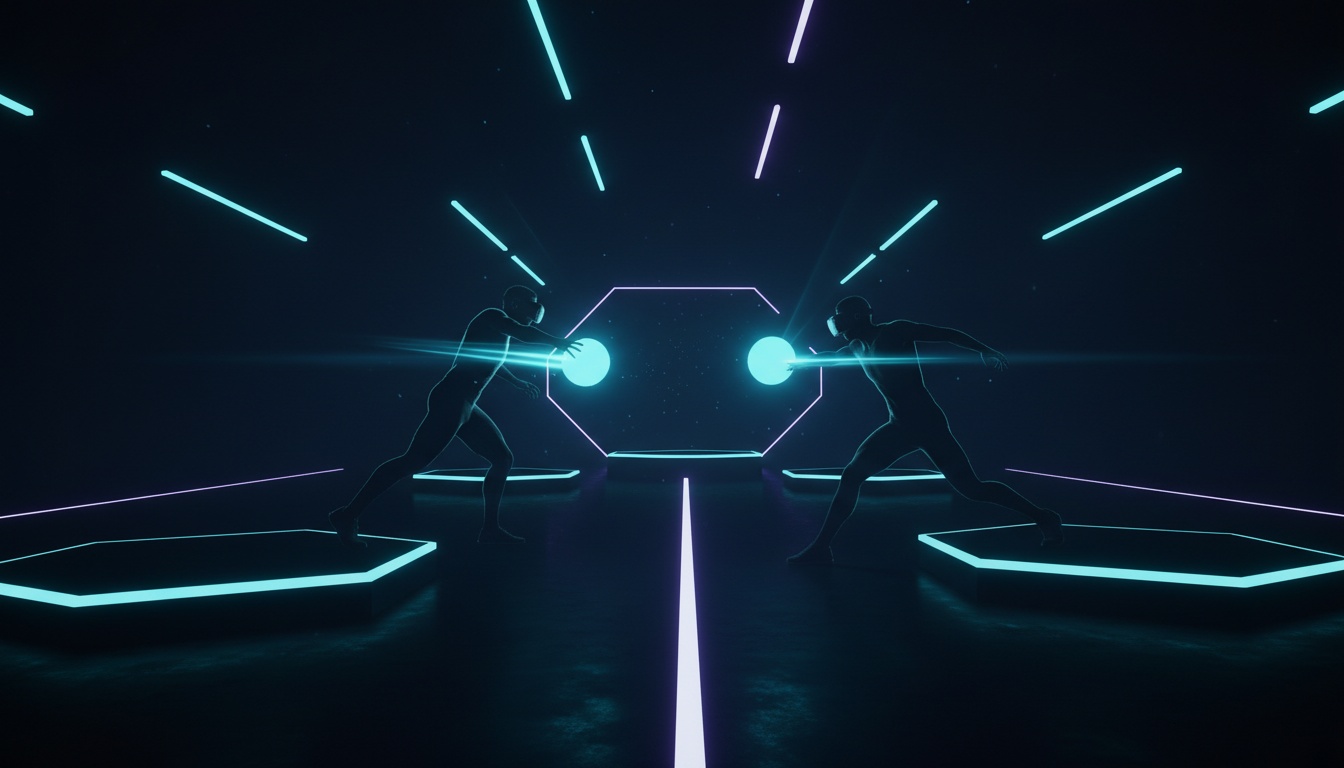
Sparc does not want to be a video game that supports VR. It wants to be a sport that happens to exist inside a headset.
CCP Games — the Icelandic studio best known for the thousand-player space spreadsheets of EVE Online — built Sparc as a native VR competitive experience from the ground up. There is no flat version. There is no gamepad mode. You stand in an arena, you throw a glowing ball at your opponent, and you physically duck, weave, and block to keep theirs from hitting you back. It is dodgeball by way of Tron, and it only works because VR lets your whole body become the controller.
The Arena
The core loop is ruthlessly simple. Two players face each other across a narrow corridor. Each holds a single projectile — a lightball — that regenerates after a throw. Hit your opponent, you score. Get hit, you don’t. The ball bounces off walls and ceilings, can be curved with spin, and accelerates after each successful dodge, turning exchanges into escalating volleys that reward reflexes and reading your opponent’s body language.
What makes Sparc compelling is how honestly it translates physical skill into virtual competition. Throwing uses the same motion controllers you’d expect — PS Move on PlayStation VR, Vive wands or Touch on PC — but the game’s tracking and physics tuning make the release point, arc, and velocity feel intentional rather than approximated. Deflecting an incoming ball with your knuckle guards or a well-timed punch is similarly immediate. There is no button-mashing abstraction here; your actual speed and accuracy determine the outcome.
Defensive play is where the physicality gets intense. Dodging is not a trigger input — it is you literally stepping sideways, crouching, or leaning back in your playspace. The arenas are small enough that a cornered player can be pressured, but large enough that a skilled defender can make throws miss by millimeters. Reviewers at launch consistently noted that sessions left them genuinely winded, a rarity in 2017 VR titles that mostly asked players to stand still and wave controllers.
The shield mechanic adds a layer of decision-making. Holding your ball grants a single-use shield that can block one incoming projectile. Throw it, and you lose that protection until you bounce a new ball off the far wall behind your opponent. This creates a risk-reward tension: throw aggressively and leave yourself exposed, or hold defensively and give your opponent time to set up a harder shot. A strike zone behind each player further rewards accuracy — hit it, and your next throw comes back faster and larger, escalating the pressure.
The World Around the Court
The presentation reinforces the sport-first philosophy. The aesthetic is stripped-down and neon-lit: dark spaces, glowing geometry, clean lines. No narrative justification, no elaborate lore — just courts, balls, and competition. Between matches, players gather in Courtside, a freeform spectator space where you can watch live games from floating camera angles, queue for your next match, or customize your avatar. It is a smart bit of social infrastructure that keeps the game from feeling like a sterile matchmaking lobby.
Solo content exists but is thin. A handful of challenge modes let you practice throwing accuracy and deflection timing against stationary targets, and leaderboards give completists something to chase. But Sparc is unapologetically built around online 1v1 multiplayer. That single-minded focus is both its greatest strength and its largest vulnerability.
The Population Question
At launch, cross-platform play between PSVR and PCVR (Rift and Vive, starting November 2017) helped unify the player base, but a game this dependent on live opponents lives or dies by its queue times. During active hours, matchmaking worked. During off-peak times, you might spend more time in Courtside waiting than in the arena playing. There is no AI opponent mode for offline practice — a conspicuous omission that makes low-population periods feel empty rather than relaxing.
Comfort is a non-issue for most players. The game uses a static standing position with no artificial locomotion, no smooth turning, and no camera shake. The only discomfort comes from the actual physical exertion, which is a feature, not a bug. Performance on PSVR and PCVR was efficient and stable at launch, running cleanly on standard hardware without demanding headsets push unusual frame rates.
Who Should Step Into the Arena
Sparc is for players who want competitive VR that demands real athletic reflexes — not just quick trigger fingers. The mechanics are clean, the moment-to-moment play is genuinely thrilling, and the physicality is something flat gaming cannot replicate. If the idea of a VR experience that leaves you sweaty and sore sounds appealing, this is one of the most focused attempts at the concept in the headset generation.
If you want single-player content, progression systems, or guaranteed matches at any hour, Sparc is the wrong purchase. It is a sport, not a campaign. It assumes you are showing up to compete against humans, and it offers nothing meaningful if those humans are not online.
Note: Sparc does not have a PSVR2 version. Official multiplayer servers were discontinued in 2022; community-run private servers (AfterSparc) now maintain access for archived copies of the PCVR build.