
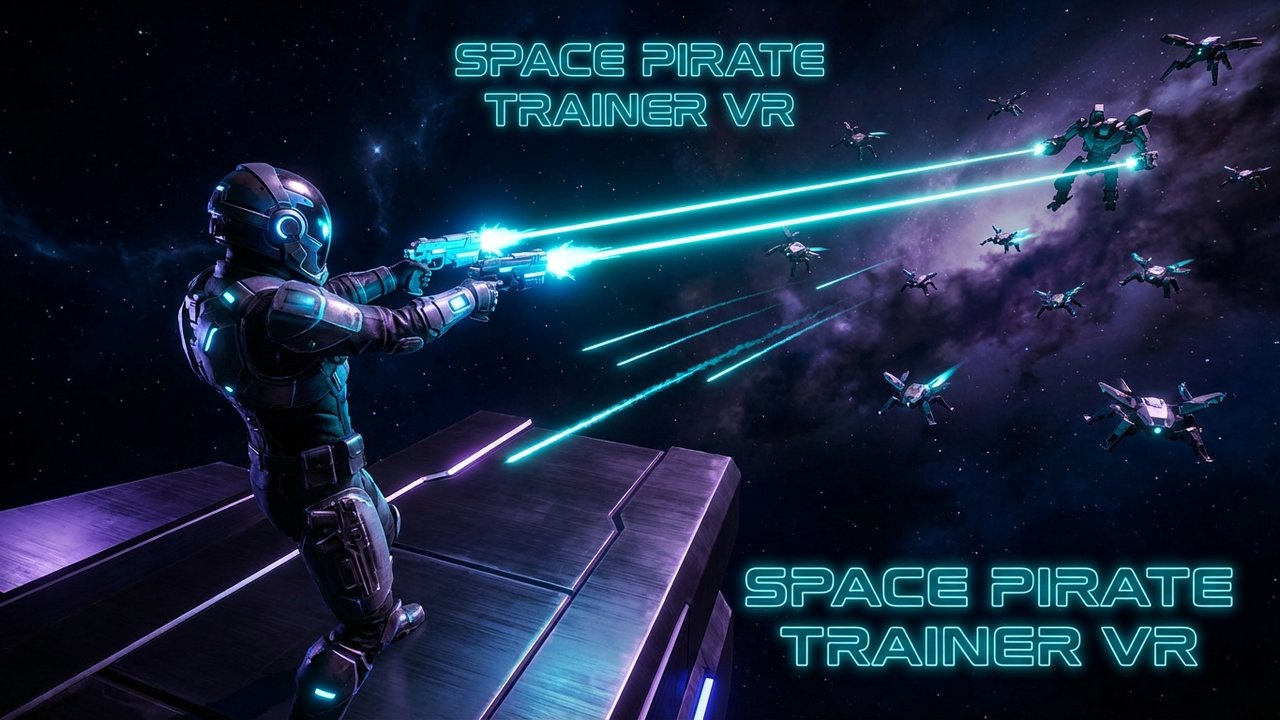
Space Pirate Trainer: The Seminal VR Wave Shooter That Still Delivers
Status: Native VR Title (Not a Flat-to-VR Mod)
Platforms: PCVR (SteamVR), Meta Quest (Standalone), PlayStation VR
Developer: I-Illusions
Original Release: April 2016 (HTC Vive Launch Title)
Current Price: $14.99 USD (Standard) / $24.99 USD (DX Edition, Quest Only)
Playtime: Short sessions (5–20 minutes), arcade-style replayability
TL;DR
Space Pirate Trainer is a native VR wave shooter that helped define room-scale VR gaming in 2016. It remains one of the most polished, accessible, and mechanically satisfying arcade experiences in VR—provided you understand exactly what you’re getting: a pure wave shooter with minimal progression systems. The Quest-exclusive DX Edition adds multiplayer modes and arena-scale play, making it the definitive version if you have the space and hardware.
What VR Route Exists?
This is not a flat-to-VR mod. Space Pirate Trainer was designed from the ground up for room-scale VR, making it one of the medium’s foundational titles.
Available Versions:
| Platform | Version | Notes |
|---|---|---|
| PCVR (Steam) | Standard | Full feature parity with original release, continuous updates |
| Meta Quest | Standard + DX Edition | DX adds multiplayer; exclusive to Quest platform |
| PlayStation VR | Standard (2018 port) | No PSVR2 native version announced as of 2026 |
| PICO | Standard | Via official store |
Key Distinction:
- Standard Edition ($14.99): Single-player wave shooter across all platforms
- DX Edition ($24.99, Quest only): Adds VERSUS mode (1v1 competitive) and ARENA mode (large-space multiplayer)
The DX Edition remains a Quest exclusive since its September 2021 release, with no announced plans for PCVR or PSVR2 ports. This creates a genuine platform advantage for Quest owners.
History and Development Status
A Foundational VR Title
Launched in April 2016 alongside the HTC Vive, Space Pirate Trainer was one of the first wave shooters built specifically for room-scale tracking. Developer I-Illusions positioned it as the answer to a simple question: What if classic 80s arcade cabinets were immersive?
The game became a de facto demo experience for VR—used in retail stores, conventions, and first-time VR setups worldwide. This wasn’t marketing; it was practical. The mechanics require no explanation, the feedback loop is immediate, and the physicality of dodging lasers showcases what makes VR different from traditional gaming.
Post-Launch Evolution
- 2016–2018: Continuous updates added turrets, boss fights, weapon upgrades, and Steam achievements
- 2018: PlayStation VR port released (requires PS Move controllers)
- 2019: Quest launch title (May 2019)
- 2020: Quest 2 graphics update significantly improved visual fidelity
- 2021: DX Edition launched (Quest exclusive), introducing multiplayer
- 2024: Quest 3 graphics update—still receiving polish nine years post-release
Current Status: Maintained, Not Actively Expanded
The game receives periodic technical updates and graphics improvements, but I-Illusions has shifted focus to other projects. The ARENA mode in the DX Edition represents the last major content addition. This isn’t abandonment—it’s a finished product receiving maintenance.
Setup Complexity and Current State
PCVR (Steam)
Setup Complexity: Minimal
- Native SteamVR integration—no modding, no workarounds
- Automatic controller detection for all major PCVR headsets
- Launch and play; no configuration required
- Steam Cloud saves for leaderboards
One caveat: The game predates SteamVR 2.0’s input system. While functional, it uses legacy input bindings that occasionally require manual adjustment for non-standard controllers.
Meta Quest (Standalone)
Setup Complexity: None
- Download and launch—pure standalone VR
- Guardian/Quest boundary system handles room-scale setup automatically
- DX Edition available as a separate purchase or upgrade
PlayStation VR
Setup Complexity: Moderate
- Requires PS Camera and two PS Move controllers
- No PSVR2 native version; must play via backward compatibility if supported
- Sony’s camera-based tracking introduces more friction than inside-out alternatives
Controls and Input Methods
Core Control Scheme
Space Pirate Trainer uses dual-wielded motion controllers with an elegant simplicity:
| Input | Function |
|---|---|
| Trigger | Fire weapon |
| Grip Button | Switch weapon type (blaster, shotgun, grenade, etc.) |
| Shield Toggle | Raise energy shield (blocks lasers, disables shooting) |
| Physical Movement | Duck, dodge, weave to avoid incoming fire |
Weapon Arsenal
- Blaster: Default, reliable, good rate of fire
- Shotgun: Close-range spread, high damage
- Railgun: Charge-up shot, piercing
- Auto-fire: Sustained DPS, overheats
- Grenade Launcher: Explosive crowd control
- Volt Gun: Chain lightning between drones
- Shield: Blocks all incoming fire; strategic necessity at higher waves
ARENA Mode Controls (DX Exclusive)
The DX Edition’s ARENA mode fundamentally changes the control paradigm:
- 10x10 meter (33x33 foot) play area required
- Physical locomotion replaces stationary gameplay
- Hide-and-seek mechanics against drones or other players
- Essentially laser tag in VR
This mode is impractical for most home setups but represents the most technically ambitious implementation of large-space VR to date.
Comfort Considerations
Motion Sickness Risk: Very Low
Space Pirate Trainer is one of the most comfortable VR experiences available for one simple reason: there is no artificial locomotion.
- Stationary gameplay: Your feet never move; you stand on a single platform
- No smooth turning: The world rotates around you, not vice versa
- Physical dodging: All movement is self-directed and physically grounded
- Fixed horizon: No camera shake or unexpected movement
Bottom line: If Space Pirate Trainer makes you sick, VR as a medium may not be compatible with your physiology.
Physical Comfort Considerations
- Active play required: Dodging lasers means constant movement—treat it as light exercise
- Room-scale demands: Minimum 2m x 1.5m recommended; larger is better
- Session length: Arcade structure encourages short bursts (10–15 minutes)
- Standing only: No seated play mode
Performance Demands Across Platforms
PCVR System Requirements
| Tier | Specification |
|---|---|
| Minimum | GTX 970 / i5 / 8GB RAM |
| Recommended | GTX 980+ / i7 / 16GB RAM |
| Storage | 3GB |
Analysis: These requirements are dated by modern standards. A GTX 1060 or RX 580 runs this flawlessly. The game was optimized for 2016-era hardware and maintains excellent performance on even modest modern systems.
Meta Quest Performance
- Quest 1: Runs well at reduced visual settings
- Quest 2: Significant graphics update (2020) brought PC-like visual quality
- Quest 3: Further visual improvements (2024 update); still actively optimized
The Quest versions benefit from being native ports rather than PCVR streamed—zero latency, optimized rendering path, and no compression artifacts.
Cross-Platform Considerations
- No cross-play between PCVR and Quest
- No save transfer between platforms
- Leaderboards are platform-specific
Community Consensus on Playability
The Good
“Still the best intro to VR” — Consistently cited as the ideal first VR experience. The mechanics are intuitive, the feedback is satisfying, and the physicality immediately demonstrates VR’s unique value.
“Mechanically perfect” — The gunplay, dodging, and enemy patterns are finely tuned. There’s no jank, no ambiguity, no learning curve beyond “shoot drones, don’t get shot.”
“Infinite replayability for score chasers” — The arcade structure (waves of increasing difficulty) supports endless attempts to climb leaderboards.
The Caveats
“It’s just a wave shooter” — No campaign, no narrative, no unlock progression beyond weapon variety. If you need structured content, this isn’t it.
“Shallow by modern standards” — Released in 2016, it predates the VR design evolution that brought us complex physics interactions, narrative integration, and systemic gameplay. What’s here is polished, but limited in scope.
“DX content locked to Quest” — PCVR players are stuck with the 2016 single-player experience while Quest owners get the expanded multiplayer suite. This frustrates long-time PCVR supporters.
Who Should Play This?
- VR newcomers: Ideal first-timer experience
- Score chasers: Leaderboard competition is the primary loop
- Quick session gamers: Perfect for 10-minute play bursts
- Quest owners: DX Edition makes this platform-definitive
Who Should Skip?
- Campaign/narrative seekers: No story, no progression beyond high scores
- Those wanting deep systems: No crafting, no upgrades, no meta-progression
- Multi-focused PCVR players: DX content unavailable on PC
Game Modes and Content Depth
Classic Mode (All Platforms)
Wave-based survival with escalating difficulty:
- Drones attack in formations
- Boss waves every 10 rounds
- Weapon upgrades spawn mid-wave
- Global leaderboards
- Endless structure—survive until you don’t
Content depth: High replayability, low variety. The same 10+ waves repeat with increasing speed and aggression. The mechanical depth comes from mastery, not content volume.
VERSUS Mode (DX/Quest Only)
1v1 competitive multiplayer:
- Two players share a modified wave arena
- Shooting drones spawns additional enemies targeting your opponent
- Tug-of-war dynamic—aggressive play punishes the other player
- Online matchmaking or private lobbies
ARENA Mode (DX/Quest Only)
Large-space multiplayer laser tag:
- Requires 10m x 10m (33ft x 33ft) cleared space
- Physical hide-and-seek with tracked drones
- Single-player vs. AI or multiplayer PvP
- Essentially a separate game built on the same mechanics
Critical note: Most residential spaces cannot accommodate ARENA mode. This is a “if you have access to a gym/warehouse” feature, not a living room experience.
Verdict: Is It Still Worth Playing in 2026?
Yes, with context.
Space Pirate Trainer is not a game you play for hours at a time, nor is it a game you finish. It’s a mechanically pure arcade experience that accomplishes exactly what it sets out to do: make you feel like a sci-fi action hero dodging laser fire.
The wave shooter genre has evolved since 2016—Pistol Whip adds rhythm, Superhot VR adds time mechanics, Arizona Sunshine adds narrative and progression. But none of them match SPT’s immediate accessibility and physical satisfaction.
Platform Recommendations:
- Quest 2/3 owners: The DX Edition justifies the purchase. ARENA mode (if you have space) and VERSUS add genuine multiplayer value.
- PCVR owners: Worth owning at sale prices ($7.49 is common) as a palette cleanser between longer experiences. Don’t expect depth, expect polish.
- PSVR owners: The 2018 port is functional but shows its age; PS Move tracking is inferior to modern alternatives.
Final Assessment:
Space Pirate Trainer is a museum piece that still plays beautifully. It defined room-scale VR’s potential in 2016 and remains a reference point for mechanical polish. It’s not the future of VR gaming—it’s the foundation. And foundations, properly built, remain worth standing on.
Score: 8.5/10 — “Essential for VR newcomers; rewarding but shallow for veterans. DX Edition elevates it to must-have for Quest owners.”