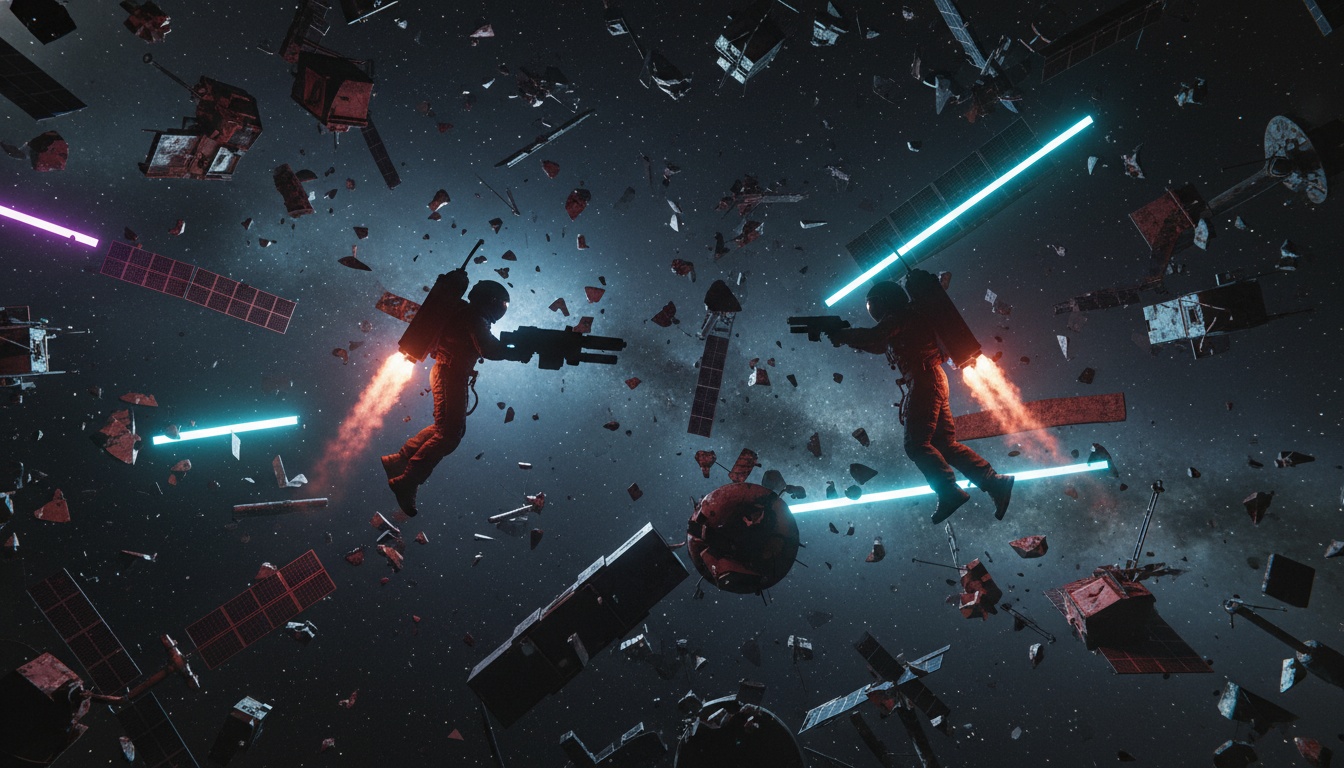
The first time you boost off a chunk of space debris and arc over an opponent’s head, dual pistols tracking their evasive burn, you understand exactly what Space Junkies is chasing. Ubisoft Montpellier — the same studio behind Eagle Flight and Grow Home — built this thing as a love letter to the arena shooters of the late ’90s, then dropped the whole formula into full three-dimensional zero gravity. No up, no down, just thrust, momentum, and whoever lands the shot while spinning through a shattered orbital wreckage field.
It launched in March 2019 as an official hybrid: you could play it flat or in VR, though the VR version was clearly the intended experience. On PC VR headsets, the motion controls give you full freedom — one hand on a jetpack thruster, the other on a weapon, or both hands armed if you’re feeling reckless. The PSVR version was locked to the DualShock 4, which meant no Move controllers and no true hand tracking. You could still play, but the physicality that made the PC version click was flattened into thumbstick aiming. Cross-platform multiplayer meant PSVR and PC players shared lobbies, which was generous in theory but occasionally lopsided in practice.
The locomotion system is the star here. Space Junkies calls it “Jetpack Arena” movement, and it’s exactly what it sounds like: you thrust in any direction, drift with inertia, and use quick boosts to dodge or close distance. There’s no artificial “up” — the game doesn’t reorient you to a floor plane unless you manually stabilize. That freedom is exhilarating and, surprisingly, not as nauseating as you’d expect. The developers clearly spent time tuning comfort; the zero-G drift feels controlled rather than chaotic, and the combat arenas are compact enough that you’re rarely accelerating into disorienting open space. It’s moderate intensity, but manageable for anyone with a few VR hours under their belt.
Combat channels Unreal Tournament by way of low-orbit demolition. Weapons spawn as pickups scattered through the map — pistols, shotguns, a rocket launcher, a solar sword for close-quarters panic moments. The flat beta that preceded the VR launch proved the shooting worked on a monitor, but in VR the aiming becomes physical. On PC, you can dual-wield independently, track targets with your head, and even positionally block with a shield. It feels good in a way that flat competitive shooters rarely replicate: your body is involved in the aiming, not just your reflexes.
But here’s the tension. Space Junkies arrived with esports ambitions — it was featured in ESL’s VR League Season 3 with a prize pool north of $25,000 — yet the content at launch was undeniably thin. Four maps. Two main modes: 1v1 and 2v2 deathmatch, plus a King of the Crown variant. No single-player campaign, no bot matches, no meaningful progression system. The arena shooter purity was intentional, a deliberate throwback to the days when a map and a weapon spawn list was all you needed. In 2019, though, that purity felt like a gamble. The combat was tight, the movement was distinctive, but the package was slight. You had to genuinely love the core loop, because there wasn’t much else to do.
And the core loop was good — for the right audience. This is a skill-based competitive shooter with a high skill ceiling and a low floor for entry. The zero-G movement has a learning curve, but the weapons are straightforward and the time-to-kill is forgiving enough that new players weren’t instantly steamrolled. If you wanted a VR multiplayer shooter that wasn’t military realism or wave-based co-op, this was one of the few options that took competitive structure seriously.
Performance was never a major concern. The art style is clean and stylized rather than photorealistic, which kept framerates solid across both PC and PSVR. The arenas are dense with debris and neon signage, but the scale is intimate enough that rendering load stays reasonable. Stability at launch was generally solid, which you’d expect from a first-party Ubisoft release — this wasn’t a mod or a framework experiment, it was a polished commercial product with matchmaking and dedicated infrastructure.
So who was this for? Competitive VR players who wanted something faster and stranger than Onward or Pavlov. Players who missed the arena shooter era and wanted to see what that design philosophy felt like with full spatial freedom. And, aspirationally, an esports audience that VR was still struggling to cultivate. Who should have skipped it? Anyone looking for single-player content, anyone without a stomach for competitive multiplayer, and anyone on PSVR who couldn’t tolerate DualShock-only controls.
The servers went dark in September 2022. Ubisoft decommissioned the online services, and because Space Junkies was multiplayer-only, that was the end. No offline mode, no bot matches, no community workarounds — just a delisted, unplayable executable. What remains is a snapshot of what competitive VR looked like when a major publisher still believed in it: briefly thrilling, mechanically honest, and ultimately too slight to survive.