
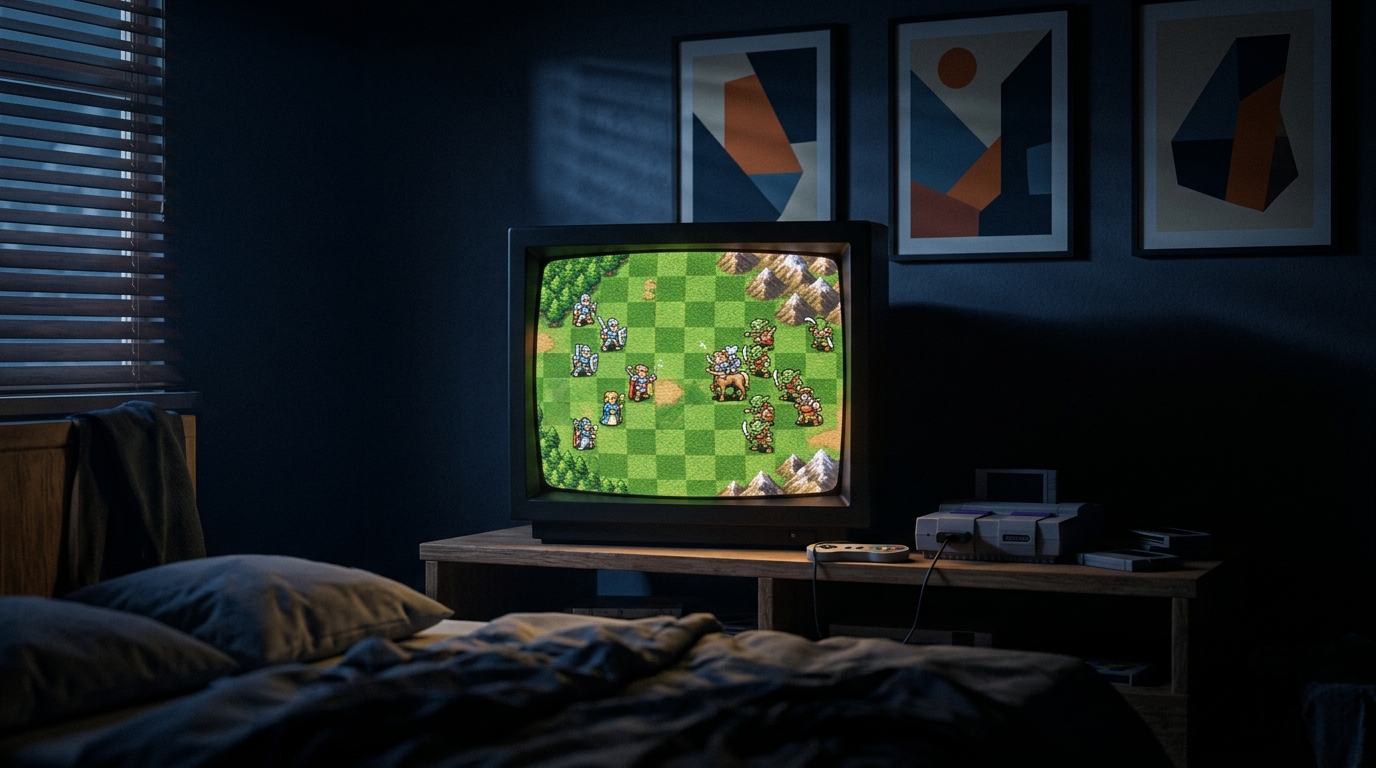
There’s a specific kind of nostalgia that hits when you see a CRT television flicker to life in a dim bedroom, Sega Genesis humming beneath a stack of cartridges, a Street Fighter II poster peeling from the wall. The Sega Genesis Classics collection’s VR hub mode sells that fantasy wholesale — and for Shining Force II, one of the finest tactical RPGs ever made, that fantasy is almost enough.
Almost.
The VR option here is not a reimagining of Shining Force II for headsets. It is the 1993 Sega Genesis original, untouched, playing on a simulated CRT television inside a 3D bedroom environment. You sit on a virtual bed surrounded by 90s paraphernalia, select your game from a floating menu, and watch the pixels bloom across a curved tube screen with authentic scanlines and optional smoothing filters. The bedroom itself is the entire VR experience. The game remains stubbornly, defiantly 2D.
That distinction matters because Shining Force II deserves better than wallpaper. This is a 30-plus hour tactical RPG with branching class promotion paths, a sprawling cast of fighters, mages, archers, and centaurs, and grid-based battles that reward careful positioning over brute force. The story stretches from the theft of the Sword of Hajya to the awakening of ancient evils, with enough party customization and hidden characters to sustain multiple playthroughs. Playing it on a virtual CRT adds atmosphere — the warm phosphor glow, the faint curvature of the screen, the sense that you’ve time-traveled to 1994 — but adds nothing to how you actually command Bowie and the Shining Force across Granseal’s battlefields. You are not leaning over a holographic grid. You are not pointing at units with motion controls. You are playing a Genesis game on a very pretty virtual television.
Controls reinforce the distance between the fantasy and the reality. A gamepad is the sensible choice, and the collection supports modern controllers without fuss. VR controllers technically function, but mapping Vive wands to a 16-bit d-pad and three-button layout is an exercise in compromise. The interface was built for a television three feet from your couch, not a headset strapped to your face. Menus are readable but tiny. The tactical grid demands precision that a virtual screen at virtual distance doesn’t always deliver. It’s playable, certainly, but there’s no ergonomic advantage over a monitor. The VR bedroom is aesthetic, not functional.
Where the experience does deliver is comfort and stability. The bedroom hub is static — no artificial locomotion, no camera shake, no motion sickness triggers whatsoever. You can look around the room, lean closer to the screen, or settle into the virtual bed and play for hours without strain. Performance is trivial; the Genesis Classics wrapper is a lightweight 3D room running a decades-old 2D engine. On any PCVR headset that runs SteamVR, this is effortless. The scanline filters and CRT simulation are genuinely well-done, too, with enough options to satisfy both purists who want raw pixels and nostalgics who want that curved-glass, slight-reflection look.
The catch, and it’s a significant one, is availability. The Sega Genesis Classics collection was delisted from Steam in December 2024. If you already own it, the VR mode remains accessible in your library. If you don’t, this VR option is effectively dead — there is no legitimate purchase path anymore. That makes this entire conversation conditional. The VR bedroom hub was a nice bonus feature added in a 2018 update, not a dedicated product, and Sega’s decision to pull the collection from sale suggests they have moved on to other classic re-release strategies. Whether this wrapper survives future Windows or SteamVR updates is an open question that existing owners will have to monitor.
So who is this for? If you bought the collection years ago, have a headset gathering dust, and want to replay Shining Force II with a layer of atmospheric nostalgia, the VR hub is a pleasant way to do it. The bedroom environment is charming, the CRT simulation is polished, and the game itself remains a masterpiece of the genre. It is genuinely relaxing to sit in that virtual room with a tactical RPG that moves at its own deliberate pace, no rush, no motion controls waving in your face.
But if you’re looking for a tactical RPG that actually uses VR — spatial battles, motion-controlled unit commands, immersive field exploration, anything that justifies the headset beyond “I could do this on a monitor but the room is cute” — this is not that. It was never trying to be. This is a very good game inside a very thin VR wrapper, and the wrapper doesn’t change the game in any meaningful way. The tactical depth is still there. The characters are still memorable. The music still carries weight. But none of that is because of the VR.
If you own the collection, it’s worth one evening just to feel that CRT glow in a virtual dark room, to remember what it felt like when 16-bit strategy games were the height of sophistication. If you don’t own it, you’re not missing a VR experience. You’re missing a delisted Steam bonus feature for a game that plays identically — and arguably more comfortably — on a flat screen. The game is essential. The VR option is a novelty.