
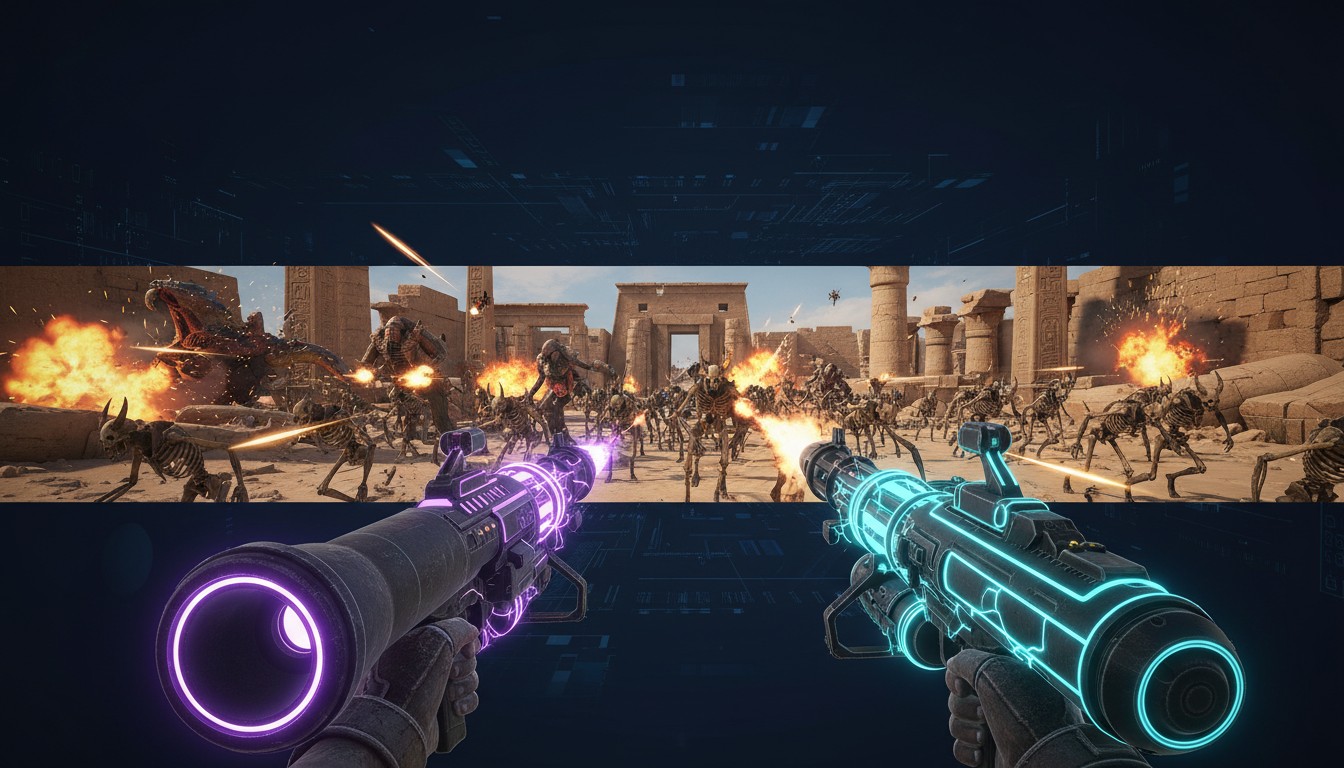
Here’s something that shouldn’t feel as novel as it does: a developer actually rebuilt their game for VR instead of just checking a box.
When Croteam released Serious Sam 3 VR: BFE in November 2017, they didn’t just add head tracking to the flat version and call it a day. They built a standalone VR release with full motion controls, dual-wielding, multiple locomotion options, and the complete campaign. That’s the bar more developers should have aimed for in that era—and honestly, it’s still rarer than it should be.
What This Actually Is
Serious Sam 3 VR: BFE is exactly what the name suggests: the full Serious Sam 3 campaign, rebuilt for VR headsets. This isn’t a mod you bolt onto the flat version, and it isn’t some injection driver that’ll give you stereoscopic 3D and a headache. It’s a proper native port that you buy separately on Steam for thirty bucks.
The campaign runs from start to finish. You’re still Sam Stone, still fighting Mental’s horde across Egypt and beyond, still dealing with the same story beats and set pieces. But now you’re physically holding those ridiculous weapons, physically dodging those charging Kleer skeletons, and physically wondering how the hell you’re supposed to survive the next wave.
The VR version also includes the multiplayer modes—deathmatch, capture the flag, co-op. There’s even cross-platform play with the flat version via Serious Sam Fusion 2017, which is a genuinely impressive technical feat that mostly works.
How It Plays
This is where Croteam earned their money. The motion control implementation is comprehensive—every weapon can be aimed naturally, reloaded manually, and yes, dual-wielded. Picking up a shotgun in each hand and blasting through a corridor of screaming enemies feels exactly as stupid and satisfying as it sounds.
The locomotion options cover the spectrum. You’ve got teleport (instant or blink variants) for comfort, and classic full locomotion with optional comfort vignetting for the rest of us. The game was built in 2017, so the smooth turning is click-based rather than analog, but it’s functional. Some players have found clever workarounds—alternating short teleports with both controllers to simulate running and dodging without the nausea factor.
Room-scale tracking is supported and recommended. The Serious Sam formula of constant movement and strafing works surprisingly well when you can physically step around cover or lean to aim around corners. After an hour in a hectic arena, you’ll understand why this series has always been about movement first and aiming second.
The Good Stuff
The dual-wielding alone justifies the purchase. In flat Serious Sam, you’re locked to whatever weapon combo the game allows. In VR, you grab what you want—minigun in one hand, rocket launcher in the other, why not? The weapon variety translates beautifully to motion controls. The sledgehammer melee feels weighty. The C4 charges feel satisfying to throw. Even the pistol has a physicality that makes the early levels more engaging.
Performance is solid on modest hardware by 2017 standards. The Serious Engine was never a brute-force renderer, and it holds up in VR without requiring a supercomputer. The campaign length is substantial—you’re getting a full game’s worth of content, not some truncated VR “experience.”
The Steam Workshop integration means there’s community content available if you want more after the campaign. New levels, modifications, custom challenges. It’s not the most active Workshop community anymore, but there’s enough there to extend the value.
The Realities
It’s not perfect. Some of the boss encounters weren’t rebalanced for dual-wielding, which can make them feel trivial if you’re abusing the power fantasy—or frustrating if you expected a challenge. The cutscenes are locked to flat-screen presentation, occasionally yanking you out of the immersion when the camera does something your stomach disagrees with.
The multiplayer population is functionally dead for matchmaking. You’ll need friends who also own the game if you want to experience the co-op or competitive modes. The cross-play with flat players is technically impressive but creates a weird imbalance—mouse-and-keyboard players have advantages that motion control players struggle to match.
And let’s be honest: Serious Sam 3 was never the strongest entry in the series. The opening levels are notoriously slow, the desert environments get repetitive, and the “realistic” military aesthetic of the early game feels at odds with the series’ arcade roots. The VR version doesn’t fix any of that—it just makes the shooting feel better.
Who Should Play This
If you’ve got a PCVR setup and you’ve been looking for a substantial single-player shooter that isn’t just another wave-based shooting gallery, this is worth your time. It’s actual campaign content with actual level design, not a sandbox that throws enemies at you until you quit.
If you’re a Serious Sam fan who missed this entry, the VR version is arguably the definitive way to experience it. The motion controls add enough to the formula that you’ll forgive the campaign’s weaker moments.
Skip it if you’re looking for populated multiplayer or if you get motion sick easily—even with teleport options, this is a fast-paced game with enemies constantly swarming from all directions. Also skip if you already hated Serious Sam 3 on flat screens; VR doesn’t fix the design problems, it just wraps them in better controls.
The bottom line: this is what official VR ports should look like. Full game, full controls, full respect for the platform. At thirty bucks, it’s a solid value for anyone who wants old-school shooter chaos in their headset. Just know what you’re getting into—the game is eight years old, the multiplayer is quiet, and the campaign has rough edges. But when you’re dual-wielding miniguns against fifty screaming Kleers, those concerns fade fast.